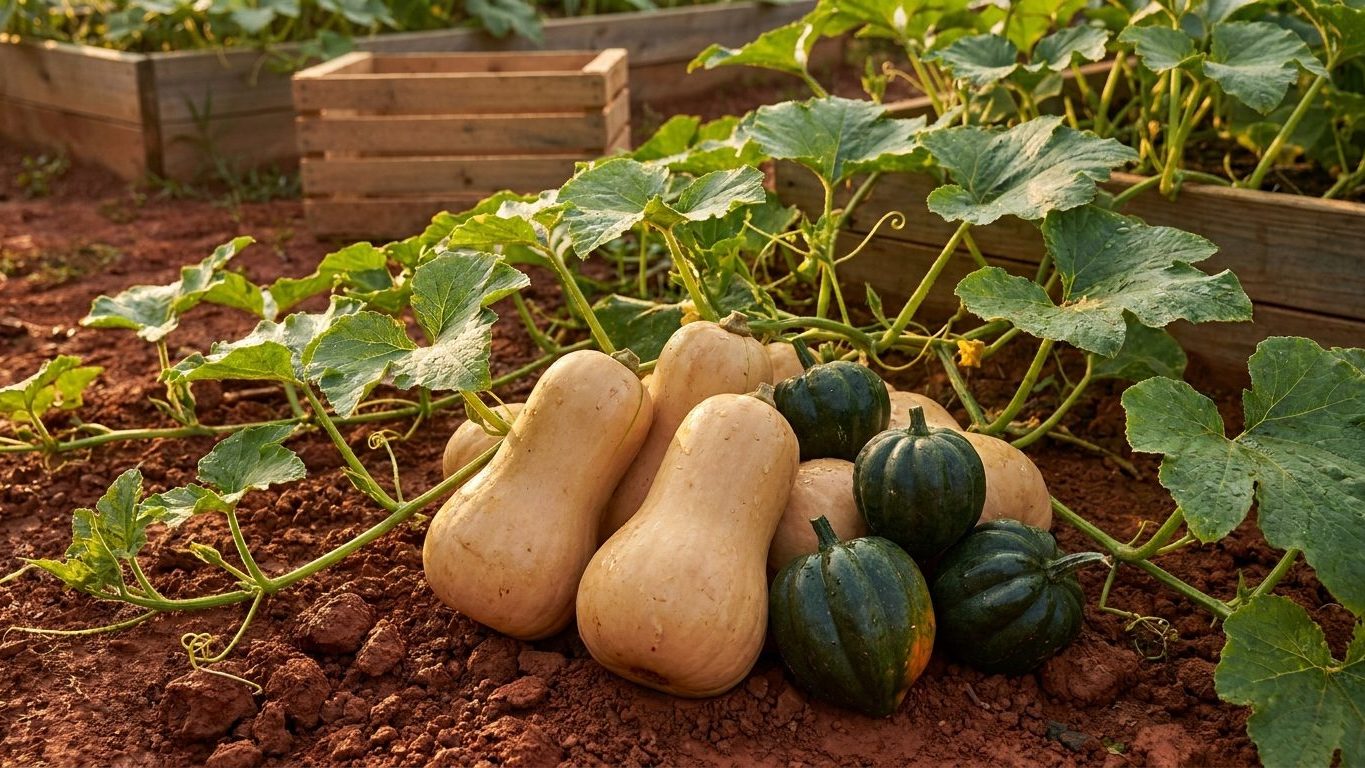

For most of western Washington’s cool, short-summer climate, the winter squash that actually finish and cure well are the fast, compact types: Delicata, Acorn, and Buttercup/Kabocha. Long-season, heat-hungry types like giant Hubbard and many butternuts struggle to ripen fully before fall rains and cooling nights set in.
The short answer for Washington
The facts available for this page come from the Seattle-area reference station (USW00024233), which represents western Washington’s mild, maritime climate. That matters because winter squash isn’t limited so much by frost dates here as by heat. The region averages only 3.0 days a year at or above 90F. That’s a thin heat budget, and winter squash is a crop that converts heat into sugar and starch as it matures. A variety bred for the Midwest or the Southeast, where 90-degree afternoons stack up by the dozen, doesn’t get the same push here.
That single number changes the decision more than the frost dates do. The frost-free window itself is generous: last spring frost falls between February 27 and March 18, and first fall frost doesn’t show up until November 13 to 30. On paper that’s close to eight months of frost-free growing. But a mild frost date is not the same as an early planting date. Cold, wet soil and low spring light hold squash back regardless of what the thermometer says about freezing.
Given that combination, low heat accumulation but a long frost-free stretch, the varieties that consistently perform in western Washington gardens are the ones that don’t need a heat wave to finish:
| Type | Typical days to maturity | Heat requirement | Fit for western WA |
|---|---|---|---|
| Delicata | 80-100 | Low to moderate | Strong |
| Acorn | 75-100 | Low to moderate | Strong |
| Buttercup/Kabocha | 90-100 | Moderate | Good |
| Butternut | 100-120 | High | Marginal, needs early start |
| Giant Hubbard | 110-120 | High | Poor |
Delicata and acorn types set fruit early and don’t need weeks of sustained heat to finish curing. Buttercup and kabocha ask a bit more but still land inside a normal western Washington season if started as transplants rather than direct-seeded. Butternut can work, but it’s a stretch, not a given, and it needs every trick, black plastic, row cover, an early transplant, to close the gap left by three days of real heat.
What will not work here
Giant Hubbard and other 110-to-120-day types are the clearest failure case. They need both a long window and consistent heat to swell and sweeten, and this region supplies neither in reliable amounts. Even in a warm year, three days above 90F isn’t enough to push a Hubbard through its full sugar development. The fruit often sizes up fine but tastes watery and cures poorly in storage, a common complaint from gardeners who moved a Midwest favorite west without adjusting.
Direct-seeding any winter squash outdoors in April is another near-guaranteed disappointment here. The frost-free window opens by mid-March in a mild year, but squash seed sitting in cold, wet soil at that point doesn’t germinate, it rots. Western Washington’s spring soil warms slowly under persistent cloud cover and rain, so seed started too early just sits and fails while a gardener waits for growth that isn’t coming. Transplants started indoors three to four weeks before setting out solve this, but direct-sown squash in cold soil is a repeat mistake worth naming outright.
The dry-summer trap
It’s easy to assume a Pacific Northwest garden gets watered by the sky. It doesn’t, not in summer. June, July, and August together average only about 3.0 inches of rain, and July, the driest month, brings just 0.6 inches. Winter squash vines need close to an inch of water a week through fruit set and sizing, which means the natural summer rainfall here covers a small fraction of what the crop actually uses. A gardener who assumes “rainy Washington” doesn’t need to irrigate in summer will watch vines wilt and fruit stall in July, right when sizing matters most.
Powdery mildew is the other recurring problem, not from humidity, since summers here are dry, but from cool, moist nights combined with overhead watering that wets foliage late in the day. Squash planted too close together, with leaves that stay damp overnight, mildews out by late summer regardless of how little rain falls. Watering at the soil line in the morning, and giving vines the spacing their tag recommends, avoids most of it.
What changes across Washington
Washington’s USDA hardiness zone range runs from 4a to 9a, and that spread alone tells you this page cannot be the last word for every county. The USDA Plant Hardiness Zone Map is built on one variable, the average annual extreme minimum temperature, and a five-zone range across one state is enormous. Zone 9a supports a very different squash season than zone 4a.
The temperature and rainfall facts cited above come from a western Washington reference station, representing the mild, maritime side of the Cascades. Eastern Washington is high desert once you cross the mountains, with a shorter, hotter, drier growing season shaped by continental extremes rather than ocean influence. This page does not carry frost dates or summer rainfall figures for that side of the state, and it would be a mistake to apply the Seattle numbers to a garden near Spokane or in the Columbia Basin. A gardener there likely has more heat to work with, which opens the door to butternut and even some Hubbard types that struggle on the coast, but also a harder, faster frost in fall.
Elevation adds another layer inside western Washington itself. Gardens gaining elevation toward the Cascade foothills run colder and see frost earlier than the lowland reference station, shortening the effective season even within the “mild” side of the state. None of this is something to guess at from a state-level page. The next section points to where a reader checks it for their specific location rather than assuming either extreme.
Where to check this for your own county
Washington State University’s Cooperative Extension is the right next stop. A state-level page like this one can only describe the broad pattern behind the reference station’s numbers. A county office works from local trial data and local frost records, and that beats a statewide average every time, especially in a state that spans zone 4a to zone 9a and both a maritime coast and a high desert interior.
Two things are worth pulling from the county extension site specifically. First, the local planting calendar for vegetable crops, which will reflect actual county-level frost timing rather than the Seattle-area normals used here. A garden in Whatcom County, the Columbia Basin, or the Okanogan Highlands each works on a different clock, and the county calendar accounts for that in a way a single statewide date range can’t.
Second, look for variety trial results or Master Gardener recommendations specific to squash. WSU Extension and its county Master Gardener programs regularly test winter squash varieties under local conditions and publish which ones size up, cure well, and resist regional disease pressure, information no general planting guide can replicate. If a county page lists specific Delicata or Buttercup cultivars that performed well in trials there, that recommendation should carry more weight than the general type-level guidance offered on this page. This page describes the pattern behind the state’s climate variables; the county office describes what actually grew in soil like the reader’s own.
Checking this against your own garden
Every date and average on this page describes a typical year at one reference station. A reader’s own garden will confirm or contradict it, and that observation outranks the calendar. Three things are worth watching before trusting any planting date.
- Soil warmth by feel: squash seed and transplant roots want soil that feels comfortably warm to bare skin, not just frost-free. Cold soil that still feels damp and chilly in April, even weeks after the average last frost, means the garden runs cooler than the regional normal and squash should wait.
- The first flush of male flowers: squash vines typically send out male flowers before the female flowers that actually set fruit. Watching for that first wave gives a real read on how the plant is pacing itself against the season, useful for deciding whether a given year is running ahead of or behind a typical one.
- The timing of the first true leaves: the gap between the seedling’s initial round leaves and its first true, lobed squash leaves tracks directly with soil and air warmth. A long gap points to a cooler-than-average spring in that particular garden, a signal worth remembering for next year’s timing.
A garden tucked against a south-facing wall, or one sitting in a low, shaded pocket, can run weeks apart from the regional average despite sharing the same zip code. Watching the plant itself, rather than the calendar, is what actually catches that difference.