
Yes, insulation helps a Wyoming home stay cooler, but the honest answer is that summer isn’t where this state’s insulation dollar works hardest. Cheyenne averages 10.4 days a year above 90°F. That’s a short, sharp season of heat sandwiched inside a much longer, much colder stretch, and that changes what insulation is really buying you here.
The short answer for Wyoming

Ten and a half days above 90°F, on average, at the Cheyenne reference station. That’s the number from the NOAA Climate Normals for 1991-2020, and it’s the clearest single measure of how much summer heat this state actually carries. Compare that to a Gulf Coast city logging 90-plus days above 90°F, and the picture is obvious: Wyoming’s summer is a brief event, not a season-long siege.
That number lines up with where the state sits on the country’s climate map. Wyoming’s 23 counties fall into three IECC climate zones: 17 counties in zone 6B, 3 in zone 7, and 3 in zone 5B. Zones 6 and 7 are cold-climate zones, and zone 7 is about as cold as the Lower 48 gets outside a few mountain pockets elsewhere. There’s no zone in this state’s spread that reads as hot or even mixed-hot. Every one of Wyoming’s counties sits on the cold side of the national divide.
So the summer answer here isn’t the same as the answer for a household in Georgia or Arizona. In this state, insulation still slows the heat that gets into an attic and a house on those 10 or so days a year, and it does that job well, for reasons the next section gets into. But the bulk of what a properly insulated Wyoming home is protecting against is the other nine or ten months, when the outdoor temperature is working the other direction. If you’re deciding how much to spend and where, the winter is where the real return sits. The summer benefit is real, it’s just the smaller half of the year’s story.
This is worth saying plainly because a lot of insulation advice online is written for hot-climate readers, and it doesn’t fit a Wyoming house without adjustment. A radiant barrier pitched for a Phoenix attic, for instance, isn’t solving a problem this climate has much of. More on that below. For now, the short version: insulation cools a Wyoming home on its hot days, but it heats it far more often, and that’s the frame that should guide any project here.
What happens above the ceiling
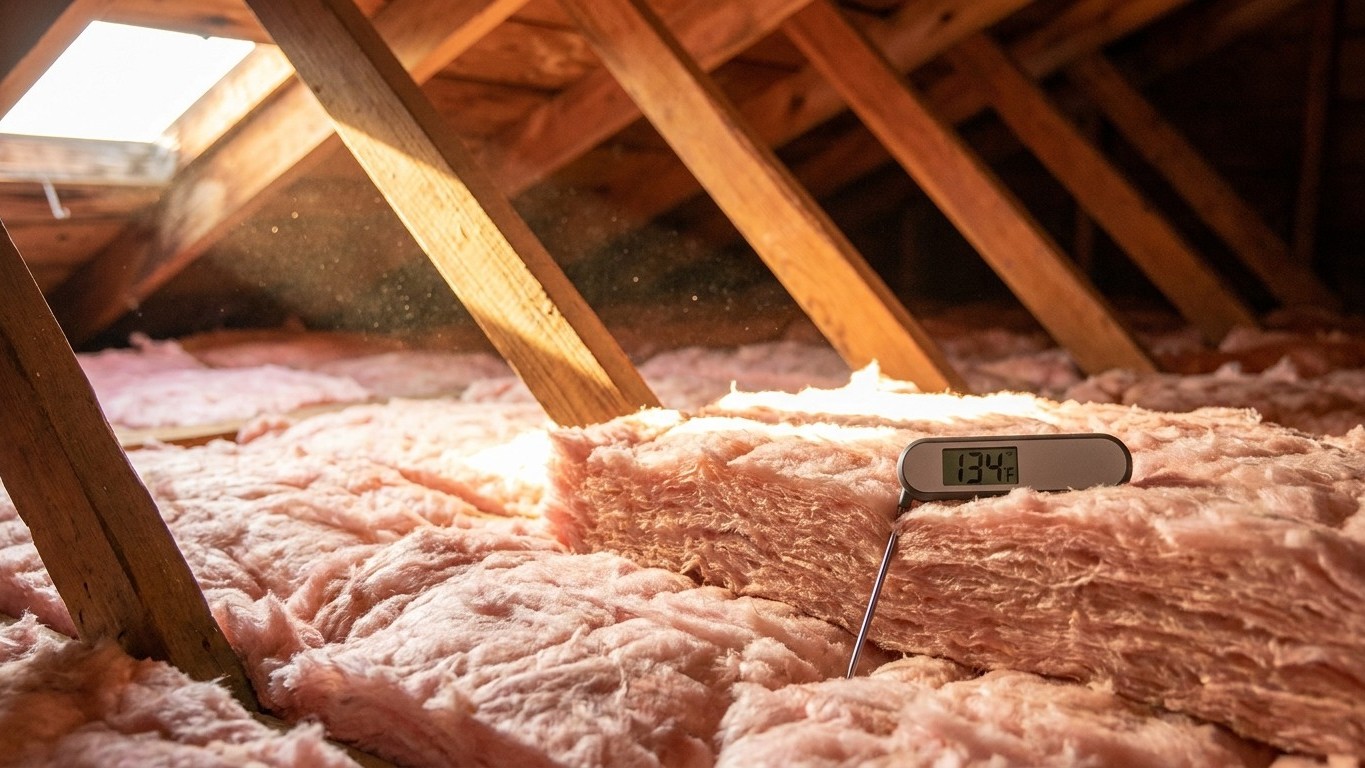
On one of Wyoming’s 90°F days, an attic isn’t sitting at 90°F. A sun-loaded roof deck can push attic air well past the outdoor reading, sometimes by 40 degrees or more, because a shingled roof absorbs solar radiation all day and has almost no way to shed it fast. That superheated air sits directly above the ceiling drywall, above any ductwork routed through the attic, and above anything stored up there. The heat doesn’t stay put, it works its way down through the ceiling assembly into the living space below, and it warms ducts carrying supply air meant to be cold.
The insulation batts or blown fill sitting on that attic floor are what stand between that superheated air and the rooms below. And here’s the point worth understanding clearly: it’s the same material doing the same job in both directions. Insulation isn’t a winter product that happens to also work in summer, it’s a resistance to heat flow, full stop. In January, that flow runs from the warm house up into the cold attic. In July, on those 10-odd hot days, it reverses and runs from the blistering attic down into the cooler house. One layer of insulation resists both.
What ENERGY STAR recommends for retrofits
ENERGY STAR publishes retrofit insulation levels by climate zone, covering both attic and floor insulation for existing wood-framed homes. Since this table is organized by IECC zone rather than by state, and Wyoming spans three of them, here are the relevant rows:
| Zone | Attic if uninsulated | Attic if you already have 3-4 inches | Floor |
|---|---|---|---|
| Zones 6, 5 and 4C | R60 | R49 | R30 |
| Zones 7 and 8 | R60 | R49 | R38 |
Zone 5B, which covers 3 of Wyoming’s counties, falls under the “Zones 6, 5 and 4C” row. These are retrofit targets for existing homes, not new-construction code minimums, and they aren’t assigned to any particular county here. Check the ENERGY STAR map or your county’s listing to find which row applies to your address before buying material. What matters for this article’s question: whichever row fits, it’s the same insulation doing the job on both the coldest night and the hottest afternoon.
What homes in Wyoming cool with
Cooling equipment data from the EIA’s 2020 Residential Energy Consumption Survey shows 71% of households in this state use some form of air conditioning. Of those, 40% run a central air-conditioning system, and 23% rely on individual equipment: a window unit, a wall unit, a portable, or a ductless mini-split. Ceiling fans show up in 63% of homes, a reasonable stand-in strategy in a climate where the AC only earns its keep about ten days a year. All three figures are shares of households surveyed, not shares of all houses standing in the state.
The gap between 71% total air conditioning and 40% central air is the story worth noticing. Nearly a third of Wyoming households cooling their homes are doing it with something other than a whole-house central system, a mini-split, a window box, a portable unit dragged out for the worst week of July. That split matters for how insulation connects to comfort here.
In a home running central air with ducts routed through the attic, those ducts sit in the hottest space in the building on a 90-degree day, right in that superheated air described above. Ceiling insulation resting on the attic floor does nothing to protect ductwork suspended or run through that same attic, that’s a separate sealing and insulating job, one worth checking on its own rather than assuming attic insulation covers it. For households running a window unit or a mini-split instead, there’s no attic ductwork in the equation at all; what matters is the insulation and air-sealing of the room itself, since that’s the only envelope the equipment has to fight.
Either way, the equipment a Wyoming household already has tells you where to look next. Homes with attic ducts should have those ducts checked and insulated as their own project. Homes cooling room by room with window units or mini-splits get more return from tightening up that specific room’s walls and windows than from anything happening two floors up in the attic.
What the heat asks for that the cold does not
Two tools belong specifically to hot climates, and neither one fits Wyoming’s summer profile.
A radiant barrier is a reflective material, usually foil-faced, installed under the roof deck to bounce radiant heat back out rather than let it soak into the attic. It carries no R-value, it’s not insulation and doesn’t replace it, and it earns its keep specifically under a roof that’s baking in direct sun for long stretches of a long, hot season. That’s not Wyoming’s situation. With roughly 10 days a year above 90°F, a radiant barrier here would be solving a problem this climate mostly doesn’t have. It’s not the tool for a house in a state where 20 of 23 counties sit in zones 6B or 7.
Vapor movement is the second hot-climate consideration, and it works in the opposite direction of what a lot of homeowners expect. In a warm, humid climate, moisture-laden air sits outside and pushes inward through walls and ceilings in summer, which is exactly why the model energy code skips requiring an interior vapor retarder in the country’s warmest, most humid zones. Wyoming’s situation is different enough, and specific enough to its own moisture regimes across zones 6B, 7, and 5B, that it deserves its own answer rather than a summer-heat generalization. Check this territory’s vapor barrier guide for how that plays out here rather than treating it as settled by the cooling question alone.
Both of these point to the same lesson: a technique built for Phoenix or Houston doesn’t automatically transfer to Cheyenne or Casper just because both places get hot in July. Wyoming’s brief hot season calls for the standard insulation approach covered above, not the radiant-barrier-and-vapor-retarder toolkit built for climates carrying heat for half the year.
What the work is worth
ENERGY STAR’s published estimate is specific and worth quoting exactly: “EPA estimates that homeowners can save an average of 15% on heating and cooling costs (or an average of 11% on total energy costs) by air sealing their homes and adding insulation in attics, floors over crawl spaces, and accessible basement rim joists.” Both numbers matter together : 15% is measured against heating and cooling costs specifically, while 11% is measured against total energy costs, a broader bucket that includes things like water heating and appliances.
That 15% figure covers heating and cooling as one combined category, and that’s exactly why this figure fits the question this article is answering. The saving isn’t a winter-only number that happens to carry over into summer as an afterthought, it’s a single estimate built from both seasons together, which matches how insulation actually behaves in a place like Wyoming: doing far more work across the cold months, doing real work on the state’s roughly 10 hot days each year, and showing up as one line-item saving because the same material handles both.
This figure is an average drawn from energy modeling of a typical existing U.S. home, not a guarantee for any specific house in Cheyenne, Casper, or Jackson. It also applies specifically to attics, floors over crawl spaces, and accessible basement rim joists, the places ENERGY STAR modeled, not to walls, windows, or doors, which involve their own separate costs and returns. No price figures or payback timelines apply cleanly to a Wyoming home without knowing its current insulation level, its size, and which of the state’s three climate zones it sits in. What the estimate does confirm is the core point this whole page has been building toward: in a state where summer heat is a short season and winter cold is the long one, the same insulation upgrade earns its keep on both ends of the calendar.