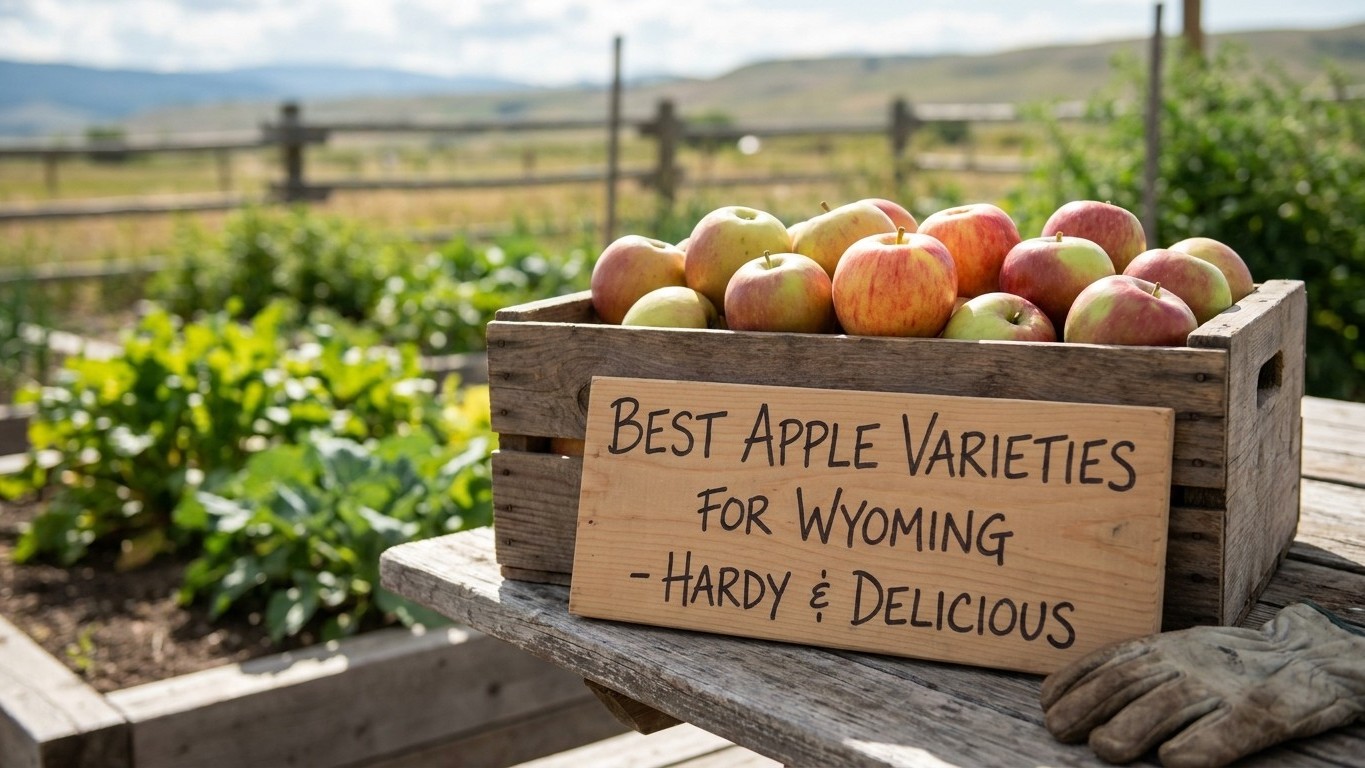

No single apple cultivar is right for every part of Wyoming, and the trait that actually decides success is winter hardiness paired with a bloom date late enough to dodge the last spring freeze. NOAA’s 1991-2020 climate normals for the Cheyenne reference station put that freeze window at May 7 to May 18, with the first fall freeze arriving September 24 to October 5, and the coldest month there averaging a nightly low of 17.3°F. Before you order anything, call the University of Wyoming Extension office for your county and ask which apple cultivars they’ve actually watched survive on sites like yours, because a tree that comes through a Cheyenne winter can fail forty miles away and a thousand feet higher.
The short answer for Wyoming
The honest answer is that no apple variety list has been verified against enough Wyoming sites to hand you a name with confidence, and printing one anyway would set you up to lose a tree. What can be stated with confidence is the filter that matters here: extreme winter hardiness comes first, bloom timing comes second, and chill requirement barely matters at all. Wyoming winters supply more cold than almost any commercial apple cultivar needs to break dormancy properly, so chill hours are rarely the thing standing between you and a crop. The thing that is standing between you and a crop is a scion and rootstock combination that can take a Cheyenne-area winter without dieback, on a tree whose blossoms open after the frost risk in your specific spot has actually passed.
That answer depends on three things you control before you ever pick a variety name: your site’s elevation and drainage, the rootstock the tree is grafted onto, and whether you’ve confirmed your local freeze dates against the nearest NOAA station rather than assuming Cheyenne’s numbers apply. A dwarfing rootstock breaks dormancy and blooms earlier than a standard or semi-dwarf tree, which sounds like a convenience until you remember that earlier bloom means more exposure to a frost that, per NOAA’s 1991-2020 normals, has a real chance of showing up as late as May 18 at the Cheyenne station. Everything downstream of that choice, including which named cultivars your local extension office will actually recommend for your county, follows from getting this filter right first. Read Growing Apples in Wyoming before you plant if you haven’t already, since the site prep and rootstock decisions there are assumed here.
Working through it

Ranking a state’s worth of apple cultivars by name only works if those names have been checked against local winters, and that check hasn’t been documented for Wyoming in a source this page can point to. What can be ranked, with confidence, is the set of traits you should be shopping for, in order of how much each one costs you if you get it wrong.
Hardiness first, because it’s non-negotiable
NOAA’s 1991-2020 climate normals show Cheyenne’s coldest month averaging a nightly low of 17.3°F, and that number is a mean, not the coldest night of a hard winter. A tree needs to shrug off cold well beyond that average to survive an actual Wyoming winter, especially at elevation. This is the filter that eliminates most apple cultivars sold in big-box garden centers before you even get to flavor or size. Ask your extension office for cultivars specifically bred for extreme cold, not just cultivars that are merely “hardy” on a generic tag, because the gap between those two claims is where trees die in year three or four.
Bloom timing second, measured against the frost window
Once hardiness rules a cultivar in, the next question is when it flowers. A cultivar that blooms early in its usual range is gambling against NOAA’s May 7 to May 18 last-freeze window at Cheyenne, and a frost hitting open blossoms can wipe out the year’s crop even on a tree that survives the winter itself with no damage. A later-blooming cultivar costs you nothing except patience, and in this climate patience is the cheaper trade every time.
Rootstock third, because it sets both size and risk
Rootstock choice is a catalog fact, not a local one, so it’s safe to compare directly:
| Rootstock class | Typical mature size | Relative bloom timing | Frost exposure | Staking |
|---|---|---|---|---|
| Standard/seedling | 18-25 ft | Latest of the three | Lowest | Not needed |
| Semi-dwarf (MM111, M7) | 12-15 ft | Intermediate | Moderate | Occasional in windy sites |
| Dwarf (M9, M26) | 8-10 ft | Earliest | Highest | Permanent stake or trellis |
A standard rootstock takes longer to bear its first fruit and grows into a tree that needs a ladder, but it’s the forgiving choice for a climate where a late frost is a genuine annual possibility. A dwarf tree bears sooner and fits a small yard, but it blooms into that same frost window earlier and with less wood mass to buffer a cold snap, which is a real cost in a place like Cheyenne.
Pollination, the step people forget
Most apple cultivars are not reliably self-fertile, which means you need a second apple or an ornamental crabapple blooming at an overlapping time within roughly a hundred feet. Skipping this step is the quiet way a hardy, correctly timed tree still produces almost no fruit.
What changes across Wyoming
Wyoming is not one climate, and the NOAA figures cited above come specifically from the Cheyenne reference station, so they describe a plains-elevation site and nothing further west or higher. Towns sitting well above 6,000 feet, including much of the mountain valley terrain around Jackson and the higher parts of the Wind River area, run a shorter frost-free season and colder nights than Cheyenne’s normals show, because temperature drops with elevation regardless of latitude. A site in a low valley bottom anywhere in the state, where cold air drains downhill overnight and pools, will also read colder on a given morning than a slope or ridge just a few hundred feet above it, which is why two orchards a mile apart can have genuinely different outcomes with the same cultivar.
The Big Horn Basin and other lower, drier pockets of the state can run warmer and longer in season than the Cheyenne figures suggest, which is exactly why you should not apply this page’s Cheyenne-anchored dates to a different county without checking. NOAA publishes the same 1991-2020 normals and freeze-probability data for stations across Wyoming, and the nearest one to your address is the number that actually applies to your trees, not the Cheyenne figures used here for illustration. Wind exposure matters too on the plains and in gap terrain, since a site with no windbreak dries out and stresses a young tree faster than an identical tree in a sheltered yard, even when both sites report the same overnight low.
None of this means apples are off the table anywhere in the state. It means the cultivar and rootstock decision has to be made against your own site’s numbers, checked through your county’s extension office, rather than against a single statewide answer this page or any other can responsibly print.
The mistakes this climate punishes
The most common failure is buying a cultivar for its flavor reputation without checking its bloom timing against NOAA’s Cheyenne-area last-freeze window of May 7 to May 18, or the equivalent window for your own county. An early-blooming tree can survive the winter perfectly and still lose its entire crop to a frost that arrives on schedule for this climate, and the damage shows up as blackened, collapsed blossoms within a day or two of the cold snap, not as a slow decline you can catch early.
The second mistake is fertilizing or pruning late in the season, which pushes soft new growth right into the first fall freeze window of September 24 to October 5 at the Cheyenne station. Wood that hasn’t hardened off by then is the wood that dies back over winter, and the dieback often doesn’t show until the following spring when that section of branch fails to leaf out at all.
The third is planting a dwarf tree with no windbreak on an exposed plains site and assuming size is the only tradeoff that rootstock made. Dwarf rootstock also has a smaller root system relative to the tree it supports, which makes it slower to recover from a stress that would barely register on a standard tree, and that stress is common on Wyoming’s open, windy ground.
- Early bloomer planted where the frost window runs to mid-May: crop loss shows as blackened blossoms within days of a spring cold snap
- Late-season fertilizing or pruning: winterkill shows the following spring as branches that never leaf out
- Dwarf rootstock with no windbreak: shows as stunted growth and repeated winter injury over several years, not a single dramatic loss
- Skipping a pollinizer: shows as heavy bloom followed by almost no fruit set
Each of these is a decision made months before the damage shows, which is why the fix is always upstream, at the buying and planting stage, not at the point where the tree is already struggling.
Checking this against your county
Every figure on this page is anchored to the Cheyenne reference station, and Wyoming’s terrain changes enough over short distances that your county deserves its own numbers before you commit to a variety or a planting date. The University of Wyoming Extension office serving your county is the right first call, both for the cultivar names a state list can’t responsibly print here and for a read on your specific elevation and site risk. If you’re still working out the planting sequence itself, The Wyoming Apple Calendar, Stage by Stage lays out what happens at each stage relative to these same frost dates.
Common questions
Can you even grow apples in Wyoming?
Yes, apples are grown successfully in parts of Wyoming, particularly where growers have matched an extremely cold-hardy cultivar and rootstock to a site with good frost drainage. It is not a crop you can plant on autopilot the way you might in a milder state, and the margin for a wrong rootstock or a badly timed planting is smaller here than in most of the country.
Do I need more than one apple tree to get fruit?
In almost every case, yes. Most apple cultivars need a second apple tree or a nearby ornamental crabapple blooming at an overlapping time to set fruit, and a single isolated tree often blooms heavily and sets little or nothing.
Should I worry about chill hours in Wyoming?
Generally not the way you would in a warm state. Wyoming’s long, cold winters accumulate chill well past what almost any apple cultivar requires to break dormancy correctly, so the limiting factor here is surviving the cold and timing bloom after frost risk drops, not accumulating enough winter chill.
Is it worth buying a dwarf tree for a small yard?
It can be, but go in knowing the tradeoff. A dwarf tree blooms earlier and has less wood mass to buffer a cold snap than a standard or semi-dwarf tree, so in an exposed or higher-elevation Wyoming site it carries more frost and winter-injury risk in exchange for its smaller footprint and earlier bearing age.