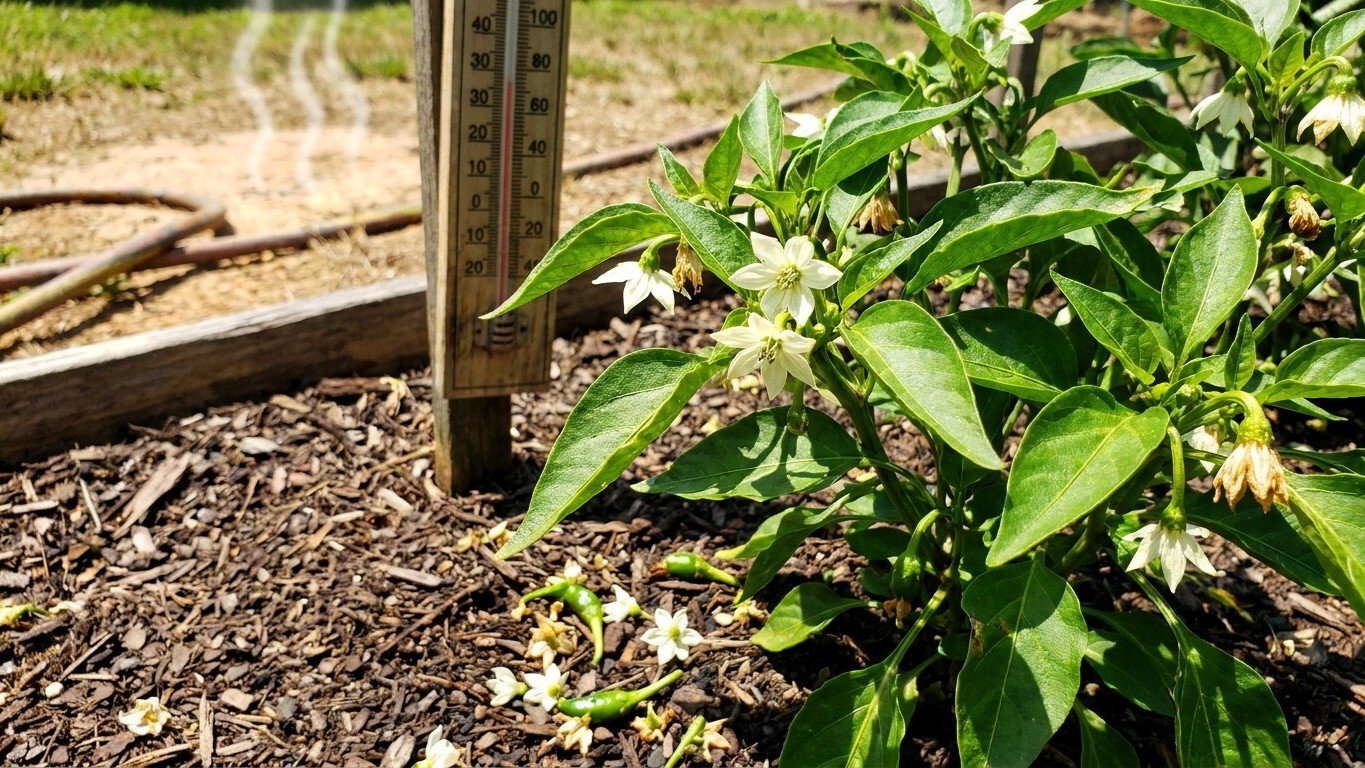

Peppers stop setting fruit in Wyoming for two reasons that pull in opposite directions: a stretch of days that push past 90 F, and nights that drop below 55 F before or after the heat arrives. Add a frost-free window that often opens only in mid-May and a growing season measured at 6,000 feet, and the plant spends much of the summer just outside the range where pollen stays viable. The fix starts indoors, months before the ground ever warms.
The short answer
Cheyenne’s reference station logs an average of 10.4 days a year at or above 90 F, based on NOAA NCEI Climate Normals covering 1991-2020. That’s not a heat wave measured in isolated afternoons. It’s more than a week and a half, most years, when daytime temperatures climb high enough to stop pepper flowers from setting fruit at all. Pollen becomes sterile or clumped, blossoms open and drop without ever forming a pod, and a plant that looked loaded with flowers in July can end August with almost nothing to show for it.
Ten days doesn’t sound like much until it lands during the exact week your plants are flowering hardest. Peppers don’t average out heat stress over a season. A single 92 F afternoon during peak bloom can cost a plant its best flush of the year, and Wyoming’s high country tends to deliver those afternoons in short, sharp clusters rather than spread evenly across summer.
The other failure point sits at the opposite end of the thermometer, and it matters just as much. Pepper fruit set fails when nights drop below 55 F, not just when days get too hot. That threshold comes from Utah State University Extension’s guidance on peppers, and it applies wherever pepper flowers open, regardless of elevation or region. Cool nights slow pollen germination and cause the same blossom drop that heat does, just from the other direction.
Here’s the catch for Wyoming gardeners: this site tracks days above 90 F for the state, because that figure is measured and published at the reference station. Summer night minimums are not part of that same public dataset, at least not in a form specific enough to state here as fact. That means no one can respond with a confident number for how many nights in a Wyoming July or August dip under 55 F. What can be said is that at elevations common across the state, cool nights are a real and recurring risk during the growing season, and the only reliable check is a thermometer left outside near the pepper bed, read at first light for several nights running. Latitude tells you nothing useful here. Elevation and local terrain, cold air pooling in a low spot, an open exposure to night sky, all shift the number by more than latitude ever could.
When to start seed here
Peppers are slow from seed, and Wyoming’s frost dates leave a narrow window to work with. Utah State University Extension recommends starting seed 8 to 10 weeks before transplanting, and transplanting only after frost has passed and soil has warmed to 60 F. Counting backward from the state’s frost data turns that guidance into a plantable date for your own county.
- Find your last spring frost date. NOAA NCEI’s 1991-2020 Climate Normals, using 32 F freeze probabilities from station USW00024018, place the window between May 7 and May 18 for this reference point. Land above 6,000 feet routinely sees frost risk stretch later, and frost is possible in any month at the higher elevations found across the state, so treat this as a starting range, not a guarantee.
- Wait for soil, not just air. Air temperature can feel warm on a sunny May afternoon while the soil six inches down is still cold. Peppers transplanted into soil below 60 F sit and sulk instead of growing, so a soil thermometer pushed into the bed is worth more than a calendar guess.
- Subtract 8 to 10 weeks from your realistic transplant date. If your frost-free window opens around mid-May and soil warms a week or two after that, seed-starting indoors should begin in early to mid-March for most of the state, adjusted earlier for higher, colder ground and later for lower valleys that warm faster.
- Build in a buffer for a false start. Wyoming’s frost-free season runs roughly 130 days at 6,000 feet, and a late cold snap can undo an early transplant fast. Many gardeners hold transplants back a week past the average last frost date specifically because “average” means half the years run later.
- Track the flowering math separately from the sowing math. Utah State University Extension notes that pepper fruit set failure windows (the hot days and cool nights that block pollination) run from the point of flowering, not from the date of sowing or transplanting. That means a plant seeded on schedule can still hit trouble in July or August if a heat spike lands during its bloom period, regardless of how well the early calendar was managed.
None of this arithmetic is exact to the day, and it shouldn’t be treated that way. It’s a framework built on published frost probabilities and a general recommendation for indoor start times, adjusted by the grower for their own yard, their own elevation, and whatever the current season is actually doing.
What goes wrong here
- Blossom drop from a hot spell. When daytime highs push into the 90s, even for a few days clustered around Cheyenne’s average of 10.4 days a year at or above 90 F, open pepper blossoms can drop before setting fruit. The remedy is timing more than chemistry: avoid pushing transplants out so early that peak bloom lands during the hottest stretch of summer, and use light shade cloth over plants during a forecast heat spike to buy the flowers a few extra degrees of relief.
- Blossom drop from a cool night. The same dropped-flower symptom shows up when nights fall below 55 F, per Utah State University Extension. Since this site doesn’t carry summer night minimums for Wyoming, the only fix is direct observation: check an outdoor thermometer at your own garden site on cool nights, especially in early and late summer, and consider row cover or a cold frame if your site regularly runs cool after dark.
- Sunscald where the sun is strong. High elevation across Wyoming means more intense solar radiation, and pepper fruit exposed directly to strong afternoon sun can develop pale, blistered patches on the skin. Leaving enough foliage cover on the plant, rather than pruning it back hard, shades developing fruit and cuts this risk without any extra input.
- Blossom-end rot. Irregular watering, common where soil dries fast between waterings, disrupts calcium uptake to developing fruit and shows up as a sunken, dark patch on the blossom end of the pepper. Even, consistent soil moisture, achieved with mulch and a steady watering schedule rather than deep-then-dry cycles, is the standard remedy and works regardless of soil type.
Common questions
Why do my pepper flowers fall off without ever forming fruit?
Blossom drop happens at both temperature extremes. Utah State University Extension identifies nights below 55 F and days above 90 F as the two failure points for pepper fruit set. Wyoming’s Cheyenne reference station averages 10.4 days a year at or above 90 F, so the hot-end risk is measured and real, while the cool-end risk depends on your specific site’s night temperatures, which aren’t part of this published dataset.
How early can I transplant peppers outside in Wyoming?
Not before frost has passed and soil has reached 60 F. NOAA NCEI’s climate normals for station USW00024018 place the last spring frost window between May 7 and May 18, though ground above 6,000 feet often runs later and frost risk persists year-round at the highest elevations.
Does a hot summer mean I should plant peppers later to avoid heat during bloom?
It’s worth considering. Since the flowering window is what actually collides with heat and cold thresholds, not the sowing or transplant date, shifting a planting schedule to avoid peak bloom landing during the hottest stretch of days above 90 F can reduce blossom drop, though it has to be balanced against the short frost-free season Wyoming already provides.
Can I fix cool-night blossom drop with row cover?
Row cover or a cold frame can raise nighttime temperature around plants by trapping ground heat, which helps where nights regularly fall below the 55 F threshold Utah State University Extension cites. Since this site doesn’t publish summer night minimums for Wyoming, checking a thermometer at your own garden site is the only way to know whether that risk applies to your location.