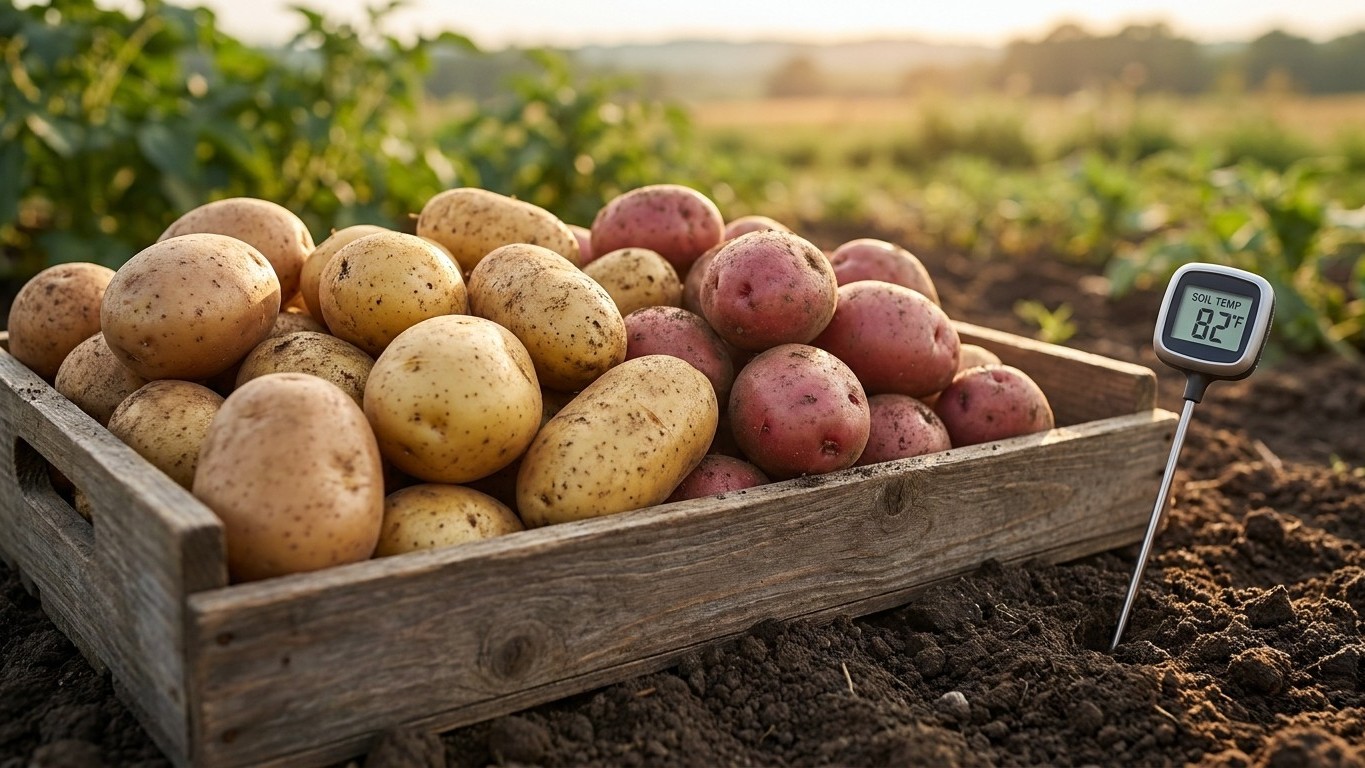

Early and mid-season potato varieties bred for baking or boiling are the ones that consistently size up in Wyoming ground. The state’s growing season is too short and its nights too cool at elevation for the long-season russet types built for warmer storage regions. Certified seed of an early or mid-season class, planted the moment soil hits 50°F, is what matches this climate.
The short answer
At the NOAA reference station used for this region, Cheyenne (station USW00024018), the last spring frost falls somewhere between May 7 and May 18, based on the 1991-2020 Climate Normals from NOAA NCEI. That’s a wide 11-day spread, and it matters because it sets the earliest safe date for a crop that has almost no room for delay. At elevations near 6,000 feet, the frost-free window runs roughly 130 days total, and in the high country frost can show up in any month at all. That’s not a growing season by the standards of a place like Idaho or Washington. It’s a compressed window that rewards varieties built to finish fast and punishes ones that need a long, steady summer to bulk.
This is why season class matters more than variety name. An early-season type reaches harvestable size well before the frost-free window closes, giving the gardener a buffer against both the uncertain spring end date and an early fall frost. A mid-season type asks for more of that 130-day window but still has margin most years. A late-season variety, the kind bred for months of cold storage in warmer growing regions, is the riskiest choice here, not because it can’t grow, but because it needs more warm days than this reference station reliably provides.
Neither Utah State University Extension nor the University of Maine Cooperative Extension publishes a days-to-maturity figure for any potato variety, so no specific number belongs in a planting plan. What both sources do publish is the season class itself, and that classification is the actual decision-making tool. For Wyoming ground, that means leaning toward early and mid-season potatoes suited to boiling or baking rather than the late storage types, and treating certified seed as non-negotiable, since uncertified seed potatoes carry viruses that show up as reduced yield with no visible warning sign until the crop is already compromised.
In practical terms: an early-season potato suited to boiling, a mid-season all-purpose type suited to both boiling and baking, or a mid-season variety marketed for baking will all fit inside that 130-day window with room to spare. A late-season baking-type russet, grown the way it’s grown in a state with a five-month frost-free season, is fighting the calendar from the start.
What actually decides it
Two separate mechanisms govern whether a given potato variety works in Wyoming, and they don’t operate on the same schedule. Understanding both lets a gardener reason through a location this page never covers, whether that’s a river-bottom garden at 4,500 feet or a mountain valley plot pushing 7,500.
The frost window sets the outer limit
The NOAA NCEI Climate Normals for the Cheyenne reference station put the last spring frost between May 7 and May 18, and that date range is a 30-70% freeze probability band, not a guarantee. A gardener at a higher, colder site than the reference station should expect that window to shift later and the total frost-free count to run under the roughly 130 days seen at 6,000 feet. The frost window is what caps the total number of growing days available, which is why an early-season variety, needing fewer of those days to reach harvestable size, carries less risk than a late-season one at any elevation where the count is already tight.
The heat ceiling limits growth from the other direction
Frost isn’t the only constraint. Utah State University Extension and the University of Maine Cooperative Extension (Bulletin #2077) both describe a heat ceiling: once soil temperatures climb above 90°F, tuber set and fill stop, and no amount of irrigation reverses that. This is the mechanism most gardeners never learn until a crop that looked fine all summer comes up small at harvest. It also explains why the planting rule (soil at 50°F, 14 to 21 days before the last frost date) exists in the first place. Planting that early pushes the bulking phase into the cooler part of the season, ahead of any stretch of 90°F-plus soil that a lower-elevation Wyoming site might see in mid-summer. Where a location’s count of 90°F days runs high, the answer isn’t a longer-season variety pushed later into summer. It’s an earlier planting of an early or mid-season type, dug before the heat sets in, treating the crop as a spring harvest rather than a late-summer one.
Put those two mechanisms together and the logic for any unlisted Wyoming location becomes straightforward: shorter frost-free window plus higher risk of hot soil equals stronger preference for early-season varieties, planted as soon as the 50°F soil threshold is met.
How to do it
- Check a soil thermometer at planting depth in early spring; wait until the reading reaches 50°F before planting, since this is the trigger point both extension sources use rather than a fixed calendar date.
- Count back from the local last-frost expectation: at the Cheyenne reference station that falls May 7 to May 18, so planting typically lands 14 to 21 days before whichever end of that window applies to a given site’s elevation and exposure.
- Select certified seed potatoes of an early or mid-season class suited to boiling or baking, rather than uncertified seed saved from a previous crop or bought without a certification label.
- Cut seed pieces with at least one eye each, if using whole seed larger than golf-ball size, and let the cut surfaces callus for a day or two before planting to reduce rot risk in cool spring soil.
- Plant into hilled rows so the developing tubers stay covered as the plant grows, protecting them from light exposure and from the shallow soil layer’s temperature swings.
- Track soil temperature again through summer; in lower-elevation or south-facing plots where 90°F-plus soil is likely, plan to harvest early varieties before that heat arrives rather than leaving them in the ground for extra sizing.
- Harvest once foliage begins dying back naturally, which for early and mid-season types in this climate typically arrives well ahead of the first fall frost risk at elevation.
What goes wrong
- Planting a late-season variety because it’s what’s available locally. A late-season type bred for long storage in a warmer growing region often needs more warm days than the Cheyenne-area frost-free window reliably supplies. The remedy is to check the season class on the seed label before buying and default to early or mid-season stock when the class isn’t clear.
- Using uncertified seed potatoes, whether saved from last year’s crop or bought without a certification tag. Uncertified seed carries viruses that reduce vigor and yield without any visible sign until harvest disappoints. The remedy is simple: buy certified seed potatoes every time, no exceptions.
- Planting by calendar date instead of soil temperature. Soil at higher elevations warms unevenly, and a fixed date that works in one garden can be two weeks premature in another just a few miles away. The remedy is a soil thermometer, checked at planting depth, with 50°F as the trigger rather than any date on a calendar.
- Leaving a crop in hot soil expecting it to keep sizing through summer. Once soil crosses 90°F, tuber set and fill stop, and extra water or fertilizer doesn’t restart the process. The remedy is treating the crop as a spring-to-early-summer harvest in warmer, lower-elevation plots, digging before the heat ceiling is reached rather than after yield has already stalled.
- Ignoring the width of the frost-date window. Treating May 7 as a guaranteed safe date when the actual band runs to May 18 exposes young plants to a frost they weren’t ready for. The remedy is planning for the later end of the published window in any site colder or higher than the reference station, and using row cover for early plantings as extra insurance.
Common questions
Can a late-season russet variety still be grown in Wyoming at all?
It can be planted, but it carries more risk in this climate than an early or mid-season type, since it needs more warm growing days than the roughly 130-day frost-free window at 6,000 feet reliably provides, per the frost-date data from NOAA NCEI.
Does the 50°F soil rule apply the same way at every elevation?
The 50°F trigger itself doesn’t change, but the calendar date it falls on will, since higher and colder sites warm later in spring than the Cheyenne reference station.
Why does certified seed matter so much for a home garden?
Certified seed potatoes are grown and inspected specifically to keep virus levels down; uncertified seed, including saved tubers from a grocery-store potato, can carry viruses that quietly cut yield with no visible symptom until the harvest comes up short.
What happens if soil hits 90°F before the crop is dug?
Tuber set and fill stop at that point, according to Utah State University Extension and the University of Maine Cooperative Extension, and the loss in sizing isn’t recovered later in the season even with normal watering afterward.