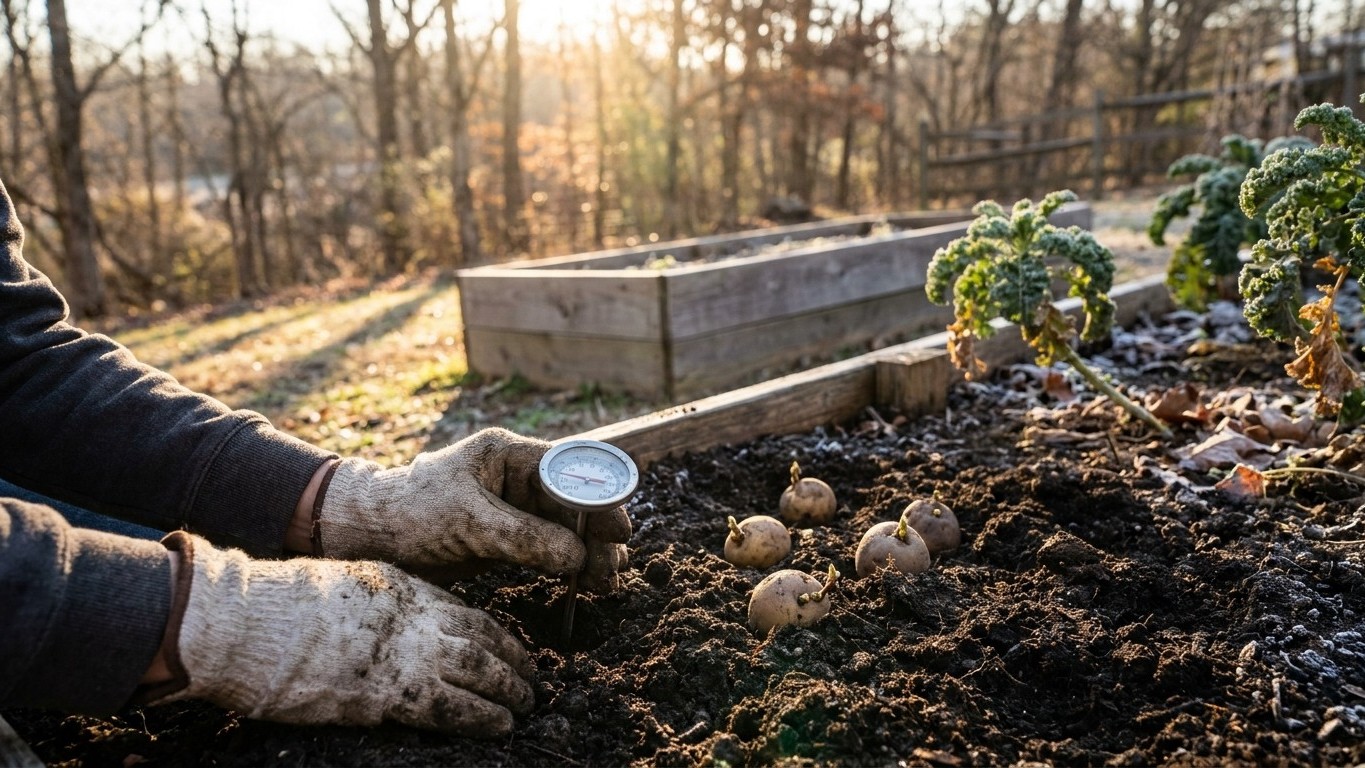

The count for Wyoming gardeners runs from 14 to 21 days before the last spring frost, and that frost date itself falls between May 7 and May 18 for the Cheyenne area, according to NOAA NCEI’s 1991-2020 Climate Normals. That puts most seed potatoes in the ground in the second half of April at lower elevations. Higher ground pushes everything later, since frost can linger well past that window.
The short answer
NOAA NCEI’s 1991-2020 Climate Normals, pulled from station USW00024018 in the Cheyenne area, place the 32 F freeze probability window (the band where the odds of a freeze run between 30% and 70%) between May 7 and May 18. That is the reference date this page works from, and it belongs to Cheyenne specifically, not to the whole state. A garden at higher elevation in the Wind River Range or up near Jackson is working from a different frost calendar entirely, one this page does not carry numbers for.
Once you have a local last-frost date, Utah State University Extension and the University of Maine Cooperative Extension both point to the same planting rule: seed potatoes go into the ground 14 to 21 days before that date, timed to soil temperature rather than the calendar square. For a Cheyenne-area garden working off the May 7 to May 18 window, that lands planting somewhere in the last two or three weeks of April.
The reason for counting backward instead of forward is built into the plant. Potatoes tolerate cool, even lightly frosty soil far better than most garden vegetables, because the seed piece and the young shoot sit below ground while the true growing point develops. That tolerance is what lets a gardener plant weeks ahead of the frost-free date instead of waiting for it, which matters a great deal in a state where the frost-free season is short to begin with.
At 6,000 feet, the frost-free stretch runs roughly 130 days, and at higher elevations frost is possible in any month of the year. That is not a caveat to skim past. It is the reason season extension, meaning row covers, cold frames, or simply accepting a shorter harvest window, is not an optional upgrade for a lot of Wyoming gardens. It is baked into the planning from the start.
What actually decides it
Soil temperature, not the calendar
The date on the wall is a proxy. What the potato actually responds to is soil temperature at planting depth, and both Utah State and Maine’s extension services identify 50 F as the threshold. Below that, a cut seed piece sits in cold, often wet soil longer than it should, and the delay raises the odds of rot before a shoot ever appears. A calendar date and a 50 F soil reading usually land close together in a normal spring, but not always, and when they diverge, the soil thermometer is the one to trust.
The heat ceiling above 90 degrees
The other end of the season matters just as much, and it is the mechanism that decides the whole crop. Tuber set and fill, meaning the stage where the plant is actually building the potatoes underground, is inhibited once soil temperature climbs above 90 F. Watering more does not reverse that. This is why the planting window is pushed as early as the soil allows: the goal is to get the crop through tuber set and filling before summer heat drives soil past that ceiling. A gardener working a hot, low-elevation valley is racing that ceiling in a way that a gardener at 7,000 feet, where soil rarely gets that warm, is not. That difference is worth checking against your own location’s count of 90 F days, because it changes whether you are growing a full-season crop or planting early specifically to dig a spring crop before the heat arrives.
Elevation and frost variability
Wyoming’s elevation swings do more to the planting date than almost anything else on this page. A garden that sits meaningfully higher than the Cheyenne-area reference station is working with a shorter frost-free stretch and a real chance of frost outside the May-to-September range most vegetable gardeners assume. That is the case this page cannot give a number for. The mechanism to carry forward is this: the higher and colder the site, the more the planting decision shifts from “count back from last frost” toward “protect against frost whenever it shows up,” which is a different kind of planning.
How to do it
- Find your own local last-frost window rather than borrowing the Cheyenne-area date, especially if your garden sits at meaningfully higher elevation.
- Check soil temperature at planting depth with a soil thermometer, and wait until it holds at 50 F rather than planting off a fixed calendar date.
- Once that 50 F threshold is met, plant 14 to 21 days ahead of your local last-frost date, so the crop has time to grow before summer heat starts pushing soil temperatures upward.
- Buy certified seed potatoes rather than saving or trading uncertified stock, since uncertified seed can carry virus into the row and into next season’s saved seed.
- Choose a season class, early, mid-season, or late, based on how much cool spring weather your site typically gets before soil heat becomes a factor.
- Plant seed pieces at a consistent depth and hill the rows as plants grow, so developing tubers stay covered and shaded rather than exposed near the hot surface layer.
- Track soil temperature through the growing season, and plan to dig earlier than a fixed date if soil is trending toward 90 F, since tuber fill stalls at that point regardless of how much water is applied.
What goes wrong
- Planting strictly by calendar date, ignoring soil conditions. A date on paper does not account for a cold, wet spring. Check soil temperature at planting depth and wait for 50 F before putting seed pieces in the ground.
- Planting too close to the last frost date instead of ahead of it. Waiting until the frost date itself, rather than counting back 14 to 21 days, shortens the window before summer heat arrives and can push tuber fill into the hottest part of the season. Count backward from your local last-frost date, not forward from it.
- Using uncertified or saved seed potatoes. Seed carried over from a previous crop, or bought without certification, can be carrying virus that will not show up until yields drop. Buy certified seed each planting cycle.
- Applying a single statewide date to a high-elevation garden. The May 7 to May 18 window belongs to the Cheyenne area, not to every Wyoming garden. At elevation, frost risk extends further into the season, and season extension tools become part of the plan rather than a backup.
- Assuming more water solves late-season stalling. Once soil temperature passes 90 F, tuber set and fill are inhibited by the heat itself, not by dryness. The fix is timing, planting early enough and choosing a season class suited to digging before that heat arrives, not heavier irrigation.
Common questions
Should I pick potatoes for baking or for boiling in Wyoming?
Extension fact sheets from Utah State and Maine describe potato varieties by what they are best used for, baking or boiling, rather than by texture labels. Match the variety to how you plan to cook it, and pair that choice with a season class, early, mid-season, or late, that fits how much cool spring weather your site gets.
Can I still plant potatoes after the last frost date has passed?
You can, but it shortens the cool window before soil temperatures climb toward the 90 F ceiling that stalls tuber fill. Planting on the early side of the 14-to-21-day window ahead of the last frost date gives the crop more time to develop before heat becomes a factor.
How do I know when soil has reached 50 F?
A soil thermometer, inserted to planting depth, is the direct way to check. Air temperature and calendar dates are rough guides at best, and soil warms more slowly than air in spring, especially in shaded or heavy soils.
Does elevation really change when I should plant?
Yes, substantially. The Cheyenne-area frost window of May 7 to May 18 does not extend to higher ground, where frost-free stretches run shorter and frost is possible outside the usual growing months. Gardens at meaningfully higher elevation should work from their own local frost data rather than this reference date.