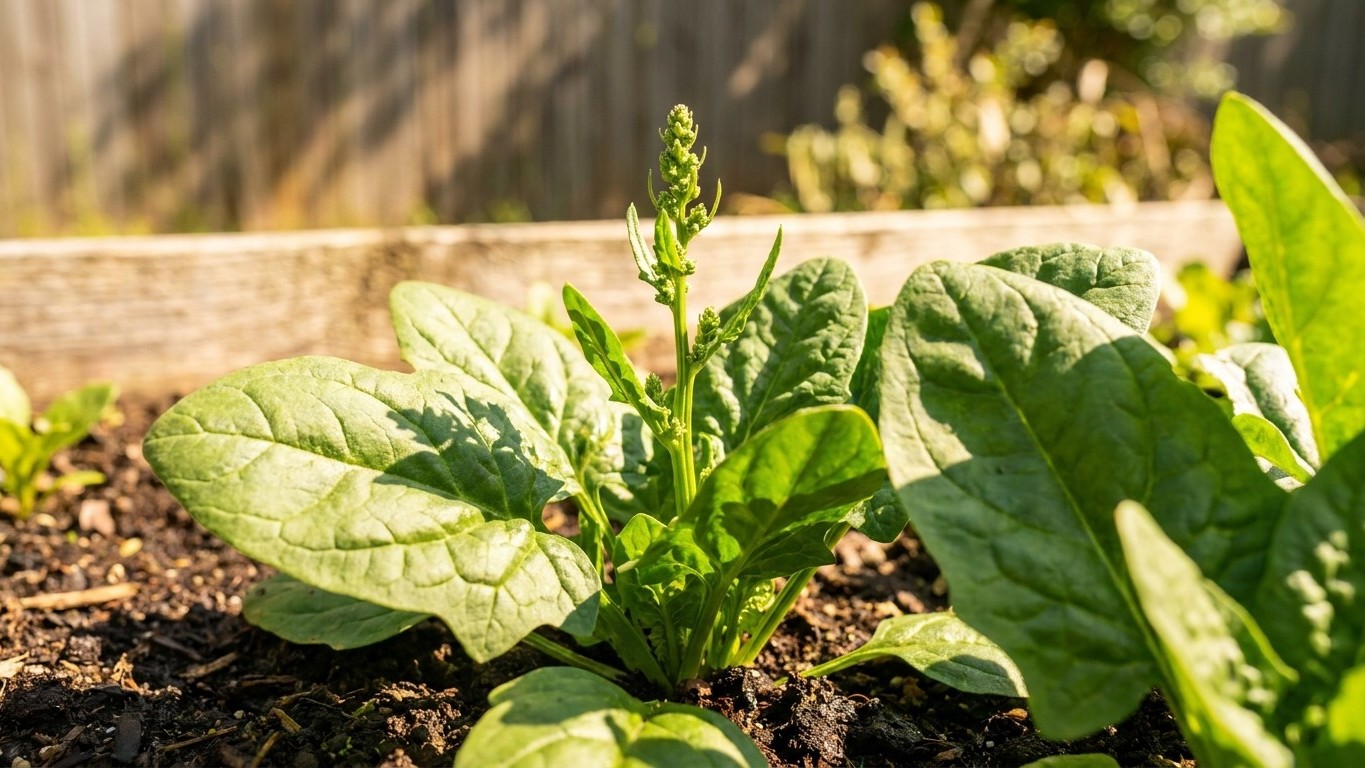

Spinach in Wyoming loses its season to three things: long days, afternoons above 75 F, and, for a fall crop, soil too warm for seed to sprout. Frost then closes both ends of the calendar. What remains is a spring window that opens in mid-April and an autumn window that opens in midsummer, with a closed stretch between them. No insect, deer or rabbit appears in the data behind this page, so this is about what the calendar takes, not what the wildlife does.
The short answer
On the longest day of the year, the reference city of Cheyenne gets 14 h 58 of daylight. That number matters more than any summer temperature reading. According to Utah State University Extension, spinach bolts, meaning it sends up a flower stalk and quits making useful leaves, during long days and warm temperatures. The two triggers work separately. A long day by itself is enough to push the plant toward flowering.
That is why a cool Wyoming summer does not hand you bonus weeks. Cool nights and a mild afternoon can slow the plant down, but they do not cancel the signal coming from nearly fifteen hours of light. Gardeners in cooler climates often assume the thermometer is the only judge. For spinach, the sun’s schedule gets a vote too. The full breakdown of how that plays out is in Will Spinach Bolt Early in Wyoming?.
So is the limit day length or heat? Both, and they hit at different moments. Heat is the more modest problem in absolute terms: the reference station averages only 10.4 days a year at 90 F or higher, which is a light heat load by national standards. But 90 F is not the number that counts for spinach. The same Utah State source says it grows best where temperatures do not exceed 75 F, and that figure does double duty. It is the point where growth stops being good, and it is also the point where the leaves turn bitter. A summer can be mild by most measures and still sit well above that line on many afternoons.
Day length, then, is the limit that never moves. Heat is the limit that varies from year to year and from one elevation to the next. The longest day is fixed by latitude at 14 h 58, so no spring or autumn trick changes it. You choose your sowing dates to keep the crop out of the long-day stretch.
Frost frames the rest. At the reference station, the last spring freeze falls between May 7 and May 18, and the first fall freeze between September 24 and October 5 (NOAA NCEI 1991-2020 Climate Normals, 30 to 70 percent probability band). That works out to roughly 130 frost-free days at 6,000 feet, and at higher elevations frost can arrive in any month. Season extension is not optional here. Row cover, low tunnels or a cold frame decide whether your two windows are generous or stingy.
In short: summer is closed to spinach, and the two shoulder seasons are open on terms the weather sets. The next two sections count them.
How long the spring window really is
Spinach goes in the ground two to three weeks before the last frost, not after it. Combined with the frost dates above, that gives you a start line. The finish line is a temperature, not a date, and this page carries no figure for when afternoons reliably pass 75 F. Take it from your own thermometer.
- Find your last-frost range. At the reference station it runs May 7 to May 18. Gardeners at higher elevations should expect later dates and plan accordingly.
- Count back two to three weeks. From May 7, three weeks back lands on April 16. From May 18, two weeks back lands on May 4. Your sowing window therefore runs from about April 16 to about May 4, depending on how the season is behaving.
- Watch the afternoon highs, not the calendar. Growth stops being good above 75 F, and bitterness arrives with it. The day your highs begin to sit above that line is the day your spring crop starts running out of road.
- Remember the second clock. Days keep stretching toward 14 h 58 at the solstice, and long days alone can trigger flowering. A sowing that goes in late has less cool weather to work with and a faster-moving light signal.
- Count the weeks that remain. Between your sowing date and the first stretch of 75 F afternoons, you have your usable spring. Write it down in weeks, not months.
What does that mean in plain terms? The window starts in cold conditions, with frost still likely, and ends when warm afternoons settle in. The front end is generous, because spinach is sown while the garden still feels like winter. The back end is the squeeze. You are racing the sun and the thermometer at once, and the plant gets only the weeks in between.
Because the source publishes no days-to-maturity for spinach, this page will not hand you a harvest date. What it can say is that an early start is the only lever you control. Sow on the first workable day inside your window, thin early, and keep the bed evenly moist so the plant is not stressed before heat arrives. A row sown in the last week of the range has the smallest margin of all.
The fall side of the year works on a different logic, and the sowing date there comes from counting backward from frost. For that, see Growing Spinach in Wyoming for the full-season picture.
The autumn crop, and when the soil lets you sow
The autumn crop gets a better deal on day length, since days shrink after the solstice, but it is blocked from both ends by a different pair of problems. One is warm soil. The other is the frost that ends everything.
Warm soil keeps the seed from sprouting
The obstacle here is heat in the ground, not cold. Utah State University Extension reports that seed germination is reduced when soil is above 80 F. In Wyoming that matters because the sowing window for fall falls in the hottest part of the year. A bed that was fine in April can be too warm in late July, even in a state with only 10.4 days a year at 90 F or higher, because soil holds heat longer than the air does.
The practical move is to measure rather than guess. A soil thermometer pushed a couple of inches deep, read in the morning and again in the afternoon, tells you more than the date on the calendar. If the bed reads above 80 F, you are not looking at a seed problem. You are looking at a timing problem, and cooling the bed with shade, water or a delay of a few days will beat re-sowing. The window opens when the soil falls, not when the packet says to plant.
Frost ends the season, so count back from it
The source says to plant 50 to 75 days before the date you want to harvest. Use the first fall freeze as a cautious harvest target: September 24 to October 5 at the reference station (NOAA NCEI). This page holds no figure for how much frost spinach tolerates, so treating that range as the finish is a conservative choice, not a rule.
Count back 50 to 75 days from September 24 and you land between July 11 and August 5. Count back from October 5 and you land between July 22 and August 16. Put together, the sowing window runs from about July 11 to about August 16, with the earliest dates reserved for the earliest frost. That is exactly when soil is hardest to cool, which is why the seedbed matters more than the seed.
The source names four varieties, Bloomsdale, Melody, Teton and Olympia, but publishes no data on any of them, so there is nothing here to say about how they differ in speed or bolt resistance. Pick by what a local garden center stocks and what you can verify for yourself. For the sowing calendar in more detail, see When to Sow Autumn Spinach in Wyoming.
Common questions
Does a cool summer let spinach last longer in Wyoming?
Not by much. The longest day at the reference city is 14 h 58, and long days alone can make spinach flower, even when afternoons stay comfortable. Cooler weather may slow the process, but it does not remove the trigger.
When should I sow spinach in spring?
Two to three weeks before the last frost. With a last freeze between May 7 and May 18, that points to roughly April 16 through May 4. Higher elevations will run later.
Can I sow spinach in July for a fall crop?
You can count back to July if you are aiming at an early-frost harvest, but the soil has to be at or below 80 F for germination to hold up. Check the bed with a thermometer first. If it reads too warm, wait until it falls.
How long does harvested spinach keep?
UC Davis Postharvest reports an optimum of 32 F at 95 to 98 percent relative humidity, and says spinach will not hold good quality beyond two weeks. That is a ceiling, not a plan. In a home fridge, the door runs warmer than the shelves, and at 41 to 50 F spinach yellows in days. Put it at the back of the bottom shelf, where it is coldest, and eat it first.