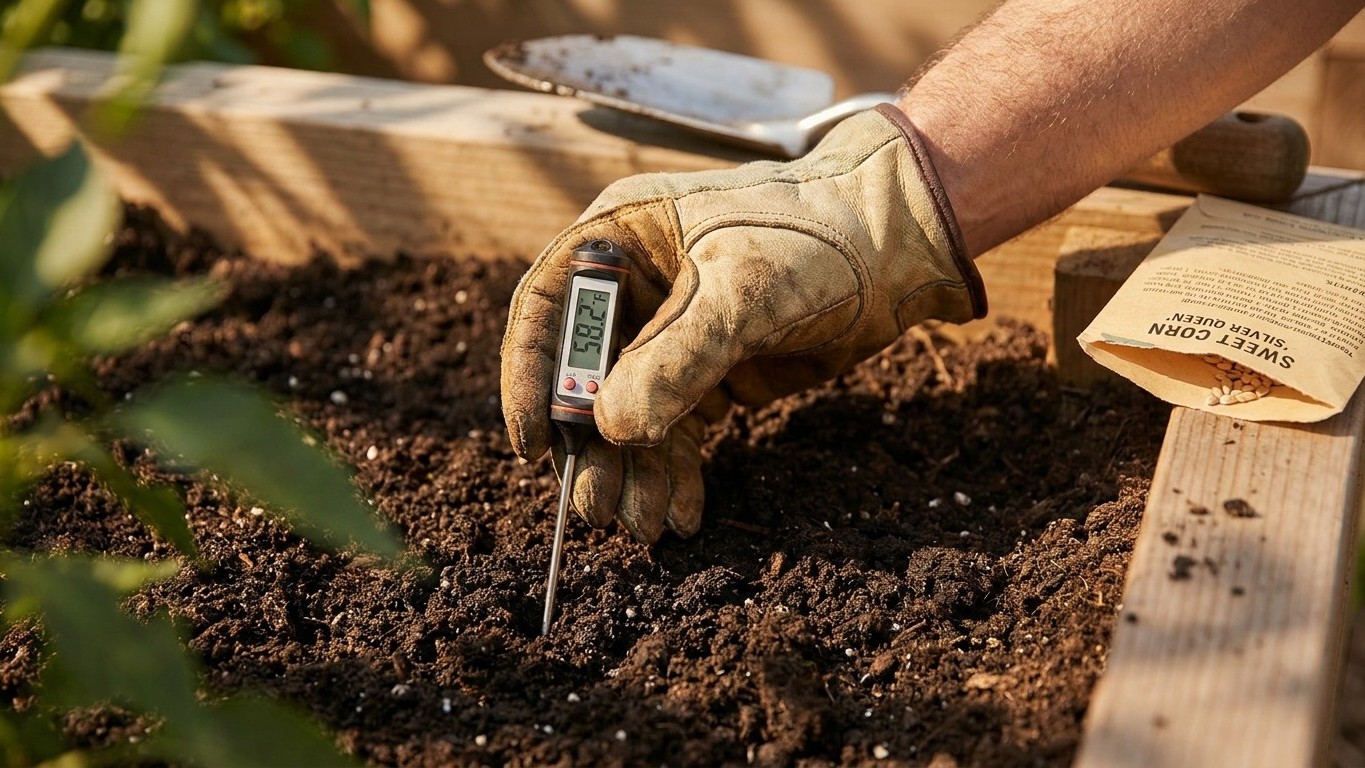

Sweet corn goes into Wyoming soil once that soil, not the air, holds steady at 60°F, and that mark shows up weeks after the last spring frost has passed. With a frost window of May 7 to May 18 and a fall frost arriving September 24 to October 5, most gardeners here are working with a planting date in late May to mid-June and a maturity target that has to land before that early autumn cutoff.
The short answer
Soil temperature and air temperature are not the same clock, and confusing them is the single most common reason sweet corn stalls or rots in the ground here. Air can hit 60°F on a sunny afternoon in early May while the top few inches of garden soil, still holding winter’s cold, sit in the 40s. Soil warms slowly, especially in Wyoming where snowmelt, wind, and elevation all work against a quick spring thaw. Since the last frost falls between May 7 and May 18, gardeners who plant the same week the frost risk clears are almost always planting into soil that has not yet reached the 60°F threshold sweet corn needs to germinate reliably.
That gap between frost clearing and soil warming typically pushes the real planting window into late May or into June, depending on the site. A south-facing raised bed in a lower-elevation valley will cross 60°F sooner than a shaded plot at 6,000 feet, where NOAA’s own data flags frost as possible in any month. That elevation note matters more in Wyoming than in most states this brief covers, because it means the safe planting date is not a fixed calendar day so much as a soil reading you take yourself, with a thermometer pushed a few inches into the ground before mid-morning.
Once soil is reliably above 60°F, the next question is arithmetic. Sweet corn needs 60 to 90 days from planting to maturity, and the growing season here, bounded by that same late-spring frost risk on one end and a first fall frost landing September 24 to October 5 on the other, gives roughly 110 to 130 frost-free days in a typical year at lower elevations, less at higher ones. Plant in late May and the math works comfortably. Plant in mid-June, because a cold spring delayed the soil warming, and the window tightens fast, especially for anything on the long end of that 60-to-90-day range.
The other number worth knowing is heat load. Cheyenne’s climate normal shows just 10.4 days a year reaching 90°F or hotter. Sweet corn is not a plant that struggles in heat the way lettuce or peas do, so this isn’t a warning against warm afternoons. It’s a reminder that Wyoming summers don’t deliver the long stretch of blazing heat that pushes corn through pollination and fill fast in warmer states. Growth here is steady but unhurried, which is one more reason the maturity window matters as much as the planting date.
Does a late variety fit here?
Days-to-maturity numbers on a seed packet are counted from the day seed goes into the ground, not from germination and not from silk emergence. That distinction decides whether a given variety has any business in a Wyoming garden.
A 60-day variety
Start with soil at 60°F sometime in late May to early June, and a 60-day type is finished well before the earliest fall frost date of September 24. Even in a cool year, where soil warming and germination both run slow, there’s a comfortable buffer left over. This is the safer end of the range for most of the state, and it’s the one that gives room for a second planting a couple weeks later if the first batch germinates unevenly, something that happens more often here than in milder climates because of that slower soil warmup.
A 90-day variety
Run the same math on a 90-day type and the margin disappears. Planted in early June, a 90-day variety matures around early September, which still fits ahead of the earliest fall frost date. But push the planting date to mid-June, which is realistic in a cold spring or at higher elevation, and that same variety is trying to finish right at, or after, the September 24 to October 5 frost window. A late frost, an unusually cool August, or a planting delayed by wet soil is all it takes to push maturity past the point where a fall freeze cuts the season short. For most of Wyoming’s growing regions, a 90-day sweet corn variety does not reliably fit this window, and gardeners who want to try one should treat it as a gamble tied to an early, warm spring rather than a dependable plan.
What goes wrong here
- Soil sown too cold. Planting on the calendar date of “last frost” rather than by soil reading is the most common failure. Seed sits in soil below 60°F, rots before it germinates, or comes up so unevenly that the stand never fills in. The fix is simple: check soil temperature directly with a thermometer a few inches deep, several mornings in a row, rather than planting by the frost date alone.
- A variety too late for the season. Choosing a 90-day type without accounting for a delayed, cool Wyoming spring leaves the crop racing an early fall frost. The fix is picking a variety toward the 60-day end of the range, or accepting the real risk that comes with anything longer, especially at higher elevation sites.
- Sweetness lost to a neighbor, not the climate. Su, se, and sh2 sweet corn types cross-pollinate when they tassel at the same time, and the result is starchy, disappointing ears that have nothing to do with soil temperature or frost dates. The remedy isn’t a measured distance, since no isolation figure is published for this; it’s timing. Stagger plantings, or plant a single type in the garden that season, so different types are not shedding and receiving pollen in the same window. Corn should also go in as a block of three or more rows rather than one or two long rows, since that shape alone improves how well each plant pollinates its neighbors regardless of type.
Common questions
Can I plant sweet corn right when the last frost date passes?
Not reliably. The last frost date, May 7 to May 18, only marks when freezing air becomes unlikely. Soil takes longer to warm, and sweet corn needs that soil above 60°F before it germinates well. Check the soil itself rather than planting by the frost date alone.
How do I know when soil has hit 60°F if I don’t have a soil thermometer?
That reading is what the crop actually needs, and there’s no reliable substitute for measuring it directly. A basic soil thermometer, pushed a few inches into the bed on several consecutive mornings, is the only way to know for sure rather than guessing from air temperature or calendar date.
Will a 90-day sweet corn variety ever work in Wyoming?
It can, in a warm spring where soil hits 60°F early and the first fall frost holds off until early October, but it’s tight in most years and unreliable at higher elevations. A 60-day variety carries far less risk for the same garden.
Why did my sweet corn turn out starchy instead of sweet?
This is almost never a climate problem. It happens when two different sweet corn types, such as an su and an sh2, tassel at the same time nearby and cross-pollinate. Planting one type per season, or staggering planting dates so tasseling doesn’t overlap, prevents it.
The Moon calendar is a separate, older custom: see when to plant corn by the moon, written as tradition rather than fact.