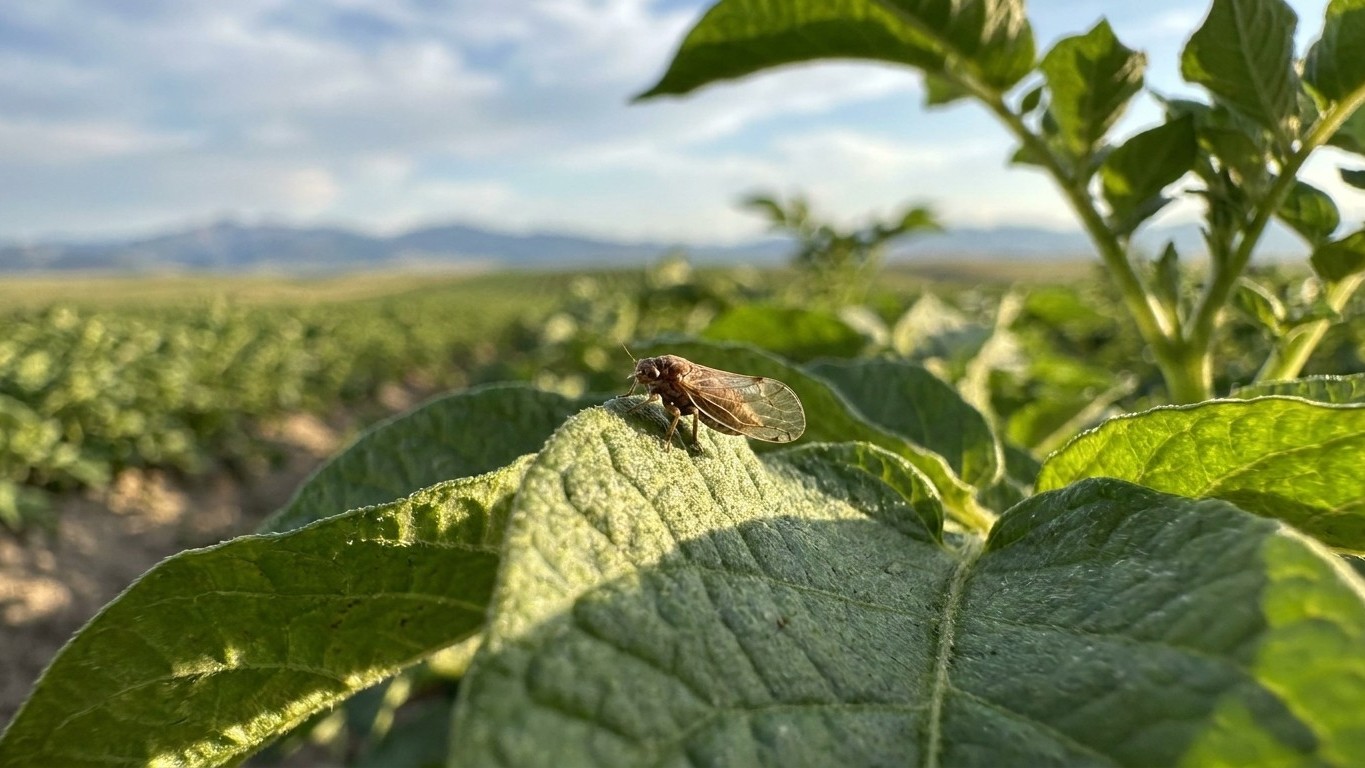

Potato psyllid doesn’t overwinter in Wyoming. It migrates in on wind currents from breeding grounds farther south, and University of Wyoming Extension doesn’t publish a fixed local arrival date for it. The insect that actually stops it here is timing: row covers set before flight, clean fields, and no volunteer nightshade left standing after harvest.
The weeks to watch

University of Wyoming Extension does not publish a specific arrival window for potato psyllid the way it does for some better-studied local pests. That gap matters, because it means growers here are working from the general biology of the species rather than a county-by-county forecast.
Migratory arrival
Potato psyllid overwinters in the southwestern United States and parts of Mexico, on wild and cultivated nightshade hosts. As those southern populations build through spring, adults get carried north on prevailing wind currents. In the northern Rockies and High Plains, that migration typically shows up as summer heat sets in, not early in the season. There’s no fixed calendar date attached to it, because the timing depends on how strong the southern flight is in a given year, not on anything happening locally.
Late-season buildup
Once adults land on a solanaceous crop, they lay eggs and the nymphs that hatch feed through summer. In regions with a longer frost-free season, this can produce several generations. Wyoming’s short growing window, roughly 130 frost-free days at 6,000 feet, usually limits things to a single breeding cycle before cold shuts it down. That’s worth knowing because it changes how you plan a response: this isn’t a pest you’re managing all season on repeat, it’s one you’re trying to keep out during a narrower stretch.
Reading the calendar from your last frost

The one date most Wyoming gardeners actually track is the last spring frost, which at the NOAA reference station (USW00024018) falls between May 7 and May 18. Potato psyllid doesn’t care about that date directly. It responds to how warm the ground and air get, which determines when southern migrant populations mature and start flying. A cold, late spring slows the whole migration; a warm one can pull it forward. The frost date matters here as the anchor for when you transplant, not as a predictor of when the insect shows up.
- Start from your local last-frost normal (May 7 to May 18 for this station) as the earliest safe transplant window for potatoes, tomatoes, and peppers.
- Count forward from that transplant date rather than from the calendar: covers should go on at transplanting and stay on through the early weeks of establishment, since young plants show psyllid yellows symptoms faster than mature ones once nymphs are feeding.
Because the frost date is a 30-70% probability band, not a guarantee, treat any date you calculate from it the same way, as a normal you’re planning around, not a lock-in commitment. A cover left on too long past that window can also cost you pollination on flowering crops, so it has to come off before bloom unless you’re hand-pollinating.
What it attacks, and what the damage looks like

Most gardeners notice the plant before they notice the bug. Leaves at the top of the plant curl upward and take on a purplish or yellow cast along the margins, growth stalls, and internodes shorten so the whole plant looks stunted and bunched. On potatoes specifically, watch for tiny aerial tubers forming in leaf axils above ground, a symptom distinctive enough that it’s usually a giveaway even without seeing the insect. This combination of symptoms has a name, psyllid yellows, and it shows up well before most people spot the pale, wedge-shaped nymphs tucked on the underside of leaves.
The crops at risk are all in the same plant family:
- Potatoes
- Tomatoes
- Peppers
- Eggplant
The nymphs do the damage, not the adults. As they feed, they inject a toxin into the plant’s vascular tissue, and that toxin is what triggers the yellowing, curling, and stunting. This matters for timing a response: once nymphs are established and feeding, the plant has already absorbed the toxin, and removing the insects at that point won’t reverse damage already done to that growth. It can still protect new growth going forward, but the leaves already affected stay affected.
How Wyoming sits in this pest’s range

On this site, potato psyllid is documented in one territory: Wyoming. That’s a narrow footprint, and it puts this state near an edge of where the pest gets tracked as a recurring concern rather than an occasional migrant nuisance. A narrow range like this doesn’t mean the insect is rare or the damage is minor where it does show up. It means the published guidance is thin, and much of what growers here rely on is general species biology rather than state-specific monitoring data.
That’s a different situation from a pest documented across many states, where the presence is a given and the only real variable is when it arrives each year. Here, presence itself is less predictable year to year, tied closely to how strong that summer migration out of the south turns out to be. Some seasons bring noticeable pressure on solanaceous crops; other seasons, growers see little to none. Treat any single year’s experience as just that, a single year, not a pattern locked in for the state.
What actually works against it

Cheapest and most reliable steps first, roughly in order of effort:
- Delay exposure with row covers. A lightweight cover installed at transplanting keeps migrating adults from landing on young plants at all. This only works before adults arrive and before flowering forces the cover off for pollination; it does nothing once psyllids are already inside the row.
- Rotate away from solanaceous crops. Moving potatoes, tomatoes, and peppers to a different bed each year reduces the odds that any local psyllid population (however small) finds a host waiting in the same spot. This helps against a resident population; it does little against a fresh migratory wave, since those adults are flying in from elsewhere regardless of what grew there last year.
- Clear volunteer nightshade and crop debris. Volunteer potatoes and wild nightshade weeds can host psyllids between plantings. Pulling them, along with old potato and tomato debris after harvest, removes a bridge population that would otherwise carry the insect from one season into the start of the next.
- Monitor with yellow sticky cards. These won’t stop an infestation, but they catch adults early enough to tell you whether this is a year worth watching closely, before nymphs are established and doing damage.
- Hand-inspect and remove affected foliage. Checking the undersides of leaves for nymphs and removing heavily infested leaves can slow buildup on a small planting. This stops being useful once nymphs are widespread across the plant, since by then the toxin has already been delivered to more tissue than you can prune away.
None of these measures work once nymphs have been feeding long enough to trigger psyllid yellows in mature growth; at that stage you’re managing an already-damaged plant, and the priority shifts to protecting whatever new growth the plant still puts out.
Common questions
Does potato psyllid survive Wyoming winters?
No. It overwinters in the southwestern US and Mexico and migrates north each year on wind currents, arriving fresh rather than emerging from local overwintering sites.
Can I still eat potatoes affected by psyllid yellows?
Affected tubers are often smaller, misshapen, or show the aerial-tuber symptom, but the toxin causing psyllid yellows is a plant stress response, not a known food-safety hazard. Yield and quality suffer more than edibility.
Do row covers hurt my potato yield if left on too long?
Yes, if left on past flowering. Covers block pollinators along with pests, so they need to come off once flowers appear unless you’re prepared to hand-pollinate, which most home gardeners aren’t set up to do for potatoes.