
December in Yukon sits deep inside the dormant season, weeks past the average first fall frost of August 25 and months from the average last spring frost of June 5. Nothing goes into open ground this month. The useful work now is garlic planted earlier in fall finishing its rest under snow, cold frames holding what little green remains, dormant pruning, and the seed orders that decide next season before the ground even thaws.
What goes in the ground in December
The honest answer is that no outdoor planting happens in Yukon this month. The territory sits in Canadian hardiness zone 1b, based on the reference city and measured against 1991-2020 normals by Natural Resources Canada. That is a severe classification built from seven climate variables, not the single-temperature USDA scale used south of the border, and it cannot be converted into a USDA number. What it means on the ground is straightforward: soil is frozen solid, daylight is short, and no seed or transplant survives being set into open earth.
Garlic and shallots are the one exception, and even that window has already closed by this point. Growers who plant garlic cloves in fall, typically before the ground locks up, are relying on a long dormant period followed by spring growth. If cloves are still sitting unplanted in December, the ground is almost certainly too hard to work, and holding them in cold, dry storage until spring is the safer move rather than forcing them into frozen soil.
What is actually possible
A few things still make sense this month, even with nothing going into bare ground:
- Cold frames or low tunnels holding hardy greens that were established earlier in the season
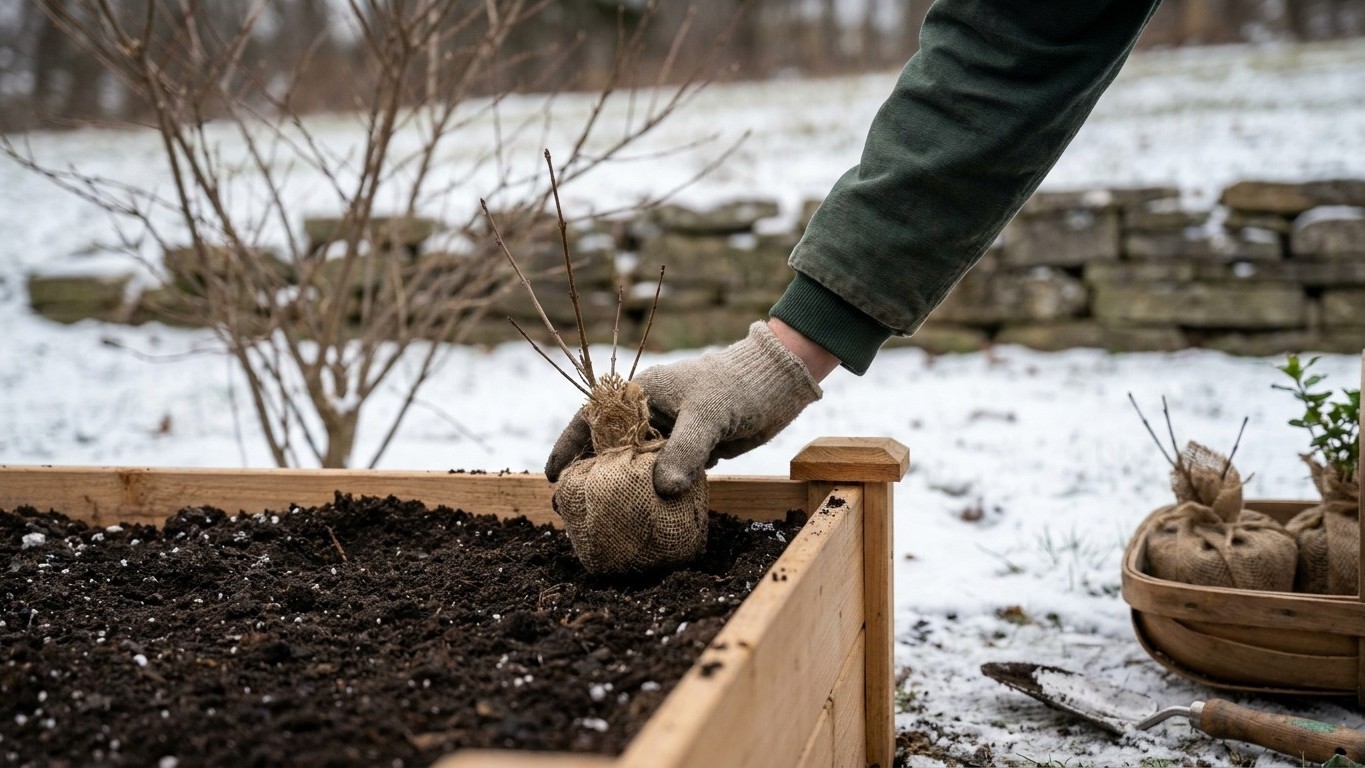
- Bare-root fruit trees and shrubs kept dormant and heeled into mulch or an unheated space, ready for planting once the ground opens
- Forcing rhubarb or chicory indoors, using roots dug and stored earlier, for a fresh harvest while the outdoor garden sleeps
- Stratifying seeds that need a cold period, left in a fridge or an unheated porch to prepare for spring sowing
None of this replaces direct sowing. It simply keeps a gardener’s hands busy and a little food coming while the calendar catches up to the climate.
What to start under cover
Working backward from an average last spring frost of June 5 is the only reliable way to time indoor starts here, since that date is a mean, not a guarantee, and in roughly half of years frost arrives later still. Counting backward from that midpoint, most long-season vegetables destined for a Yukon garden, tomatoes, peppers, and slow alliums like onions from seed, need eight to twelve weeks indoors before they are ready to go out. Counted from a June 5 midpoint, that pushes the earliest realistic start dates into late winter or very early spring, not December.
That makes this month mostly a planning and prep window rather than a sowing one. The exception is anything genuinely slow: onions and leeks from seed benefit from an early start, and gardeners who want a head start sometimes begin these in deep winter under strong grow lights, accepting the extra weeks of indoor care that requires.
The two ways this goes wrong
Starting too early means plants sit indoors far longer than the six to eight weeks most seedlings tolerate before quality drops. Roots crowd their containers, stems stretch toward whatever light is available, and by transplant time the plant is stressed before it ever reaches the garden. Starting too late is the opposite failure: with a growing season bounded by a June 5 frost midpoint on one end and an August 25 midpoint on the other, there is no room to make up lost weeks. Yukon’s short season punishes late starts more than almost anywhere else covered on this site, so December’s real job is counting the weeks now, not guessing later.
What is ready to pick
Outdoors, the honest answer is little to nothing. Snow cover and hard-frozen ground mean any harvest this month comes from what was protected earlier or stored after fall harvest, not from fresh growth in open beds.
Cold frames or unheated hoop structures can still be holding hardy greens like kale or spinach that were established before the deep cold set in. These plants slow to a near stop but do not necessarily die, and a frame that keeps wind and heavy snow off the leaves can yield the occasional picking on a milder stretch. Checking under any snow load matters here: leaves crushed flat for weeks can rot, so a light brushing after a snowfall protects what is left.
Indoors, sprouts and microgreens are the most reliable fresh food a Yukon gardener can produce this month, ready in one to two weeks from seed on a windowsill or under light, with no dependence on outdoor conditions at all.
Stored crops need a check-in too. Squash, potatoes, and onions put into storage after the fall harvest should be inspected for soft spots, sprouting, or the sweet smell that signals early rot. One softening squash or one sprouting potato left in a bin can spread trouble to everything around it, so pulling questionable produce now, rather than waiting for the whole batch to turn, saves the rest of the stored harvest.
The jobs that matter this month
Deep winter is when the season ahead gets decided, even with the ground frozen shut. A handful of tasks done now, or skipped now, shape everything from spring’s first sowing to next fall’s harvest.
Pruning, ordering, and planning
Dormant pruning of fruit trees and berry canes is best done while plants are fully asleep and their branch structure is visible without leaves in the way. Cuts made now heal by spring with far less stress on the plant than pruning during active growth. This is also the month to order seed, since popular varieties, especially the short-season types that actually mature within Yukon’s window between the June 5 and August 25 frost midpoints, tend to sell out well before spring planting begins.
Planning next season’s crop rotation on paper now, while there is time to think it through, beats improvising in spring when the ground thaws and everyone is in a hurry. Testing soil, whether through a simple kit or a lab sample, gives enough lead time to order amendments and have them ready when the ground opens.
Maintenance that pays off later
Turning compost, even a slow, half-frozen pile, keeps the breakdown process moving rather than letting it stall completely until spring. Cleaning and sharpening tools now means no scrambling for a working spade or clean pruners once planting season actually arrives. Repairing raised beds, cold frames, and fencing while there is nothing growing to work around is far easier than trying to fix a broken frame in the middle of a busy spring. And a final walk-through of stored crops, checking for the rot mentioned above, protects food that took a whole season to grow.
What not to do in December
The most common mistake this month is misreading a mild, sunny stretch as a sign the season has turned. A few days of unusually warm air do not move the average last spring frost of June 5, and soil temperature in Yukon lags well behind air temperature at this time of year. Anyone tempted to start hardening off seedlings or setting out cold-tolerant transplants because the air felt warm is planting into ground that is still solidly frozen a few inches down.
Uncovering cold frames or removing mulch after a mild spell is another version of the same error. Snow and mulch are doing real insulating work, protecting dormant roots and any overwintering greens from the deep cold that reliably returns. Pulling that protection back too soon, then getting hit with another cold snap, can undo months of careful overwintering in a single night.
Feeding nitrogen at this point in the season is also worth skipping. Dormant plants are not taking up nutrients the way they do in active growth, and a nitrogen application now mostly sits in the soil doing nothing useful, or worse, encourages soft, tender growth right before a hard freeze returns. The better move is to save feeding for when soil temperatures climb and root activity actually resumes, closer to when that June 5 frost midpoint starts to feel real again.
Checking this against your own county
Every date and figure here comes from a single reference station, and Yukon is not one climate. Elevation, valley cold-air pooling, and the real distance between the territory’s communities can shift frost windows by weeks in either direction from what a single station shows. A garden in a low valley behaves differently from one on higher, more exposed ground, even a short distance away.
Treat this page as a starting point, not a fixed instruction. For a more localized read, the federal agriculture department is the place to check further: agriculture.canada.ca.
Common questions
Can I plant garlic in Yukon in December?
Garlic is normally planted in fall, before the ground freezes hard. By December the soil is typically locked up, so unplanted cloves are better held in cool, dry storage until the ground opens again rather than forced into frozen earth.
Is anything actually growing outdoors this month?
Only what was established earlier and protected under a cold frame or low tunnel. Hardy greens can persist in a near-dormant state under cover, but nothing new is germinating or transplanting into open ground.
What does hardiness zone 1b actually mean for a Yukon garden?
It is a Canadian zone based on the reference city and seven combined climate variables, not a single temperature threshold like the USDA system, and it does not convert directly to a USDA zone. It signals a short, severe growing season and a long dormant period, which is exactly what shapes this month’s short list of tasks.
Why is the last frost date given as an average rather than a safe planting date?
Because it is a mean figure from Environment and Climate Change Canada’s Canadian Climate Normals, calculated from the Whitehorse A station over 1981-2010. In roughly half of all years, frost actually arrives later than that average, so treating it as a guaranteed safe date rather than the midpoint of a range invites real risk to any early transplants.