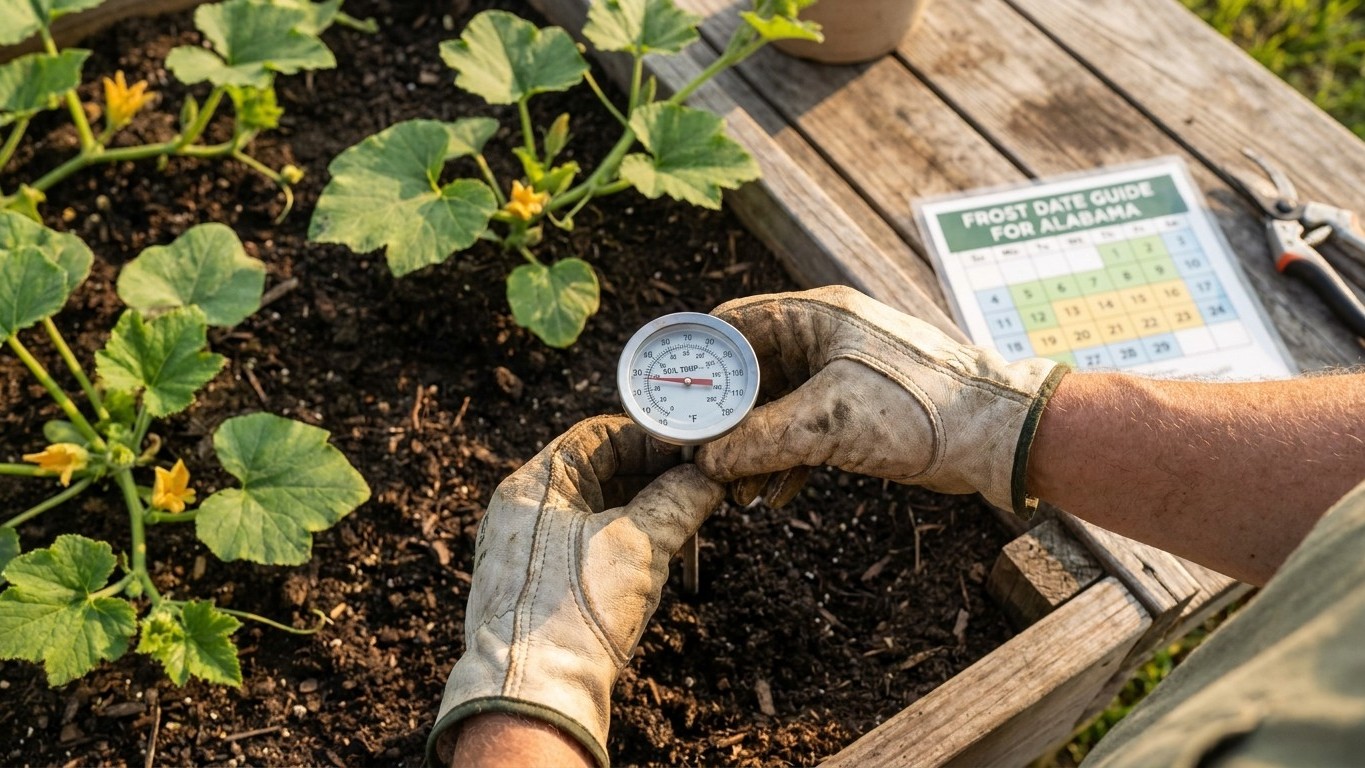

Pumpkin seed goes into Yukon soil once that soil, not the air, reaches 65°F. That threshold lands well after the average last spring frost here, so calendar dates alone won’t tell you when to sow. What decides the whole calculation is working backward from the first fall frost to figure out the very latest a flower can open and still leave enough days for a pumpkin to ripen.
The short answer
Whitehorse’s average first fall frost lands August 25. That’s a mean date from Environment and Climate Change Canada’s climate normals, gathered at the Whitehorse A station, and it carries a real catch: in one year out of two, frost actually arrives later than that. Treat it as the midpoint of a window, not a promise, and remember that a single weather station can’t speak for every valley or hillside in the territory. Northern and upland districts often run weeks behind Whitehorse.
Pumpkins need 45 to 55 days after flowering to mature, according to Utah State University Extension. That’s the figure the whole schedule hinges on, and it’s easy to misapply: the clock starts when the first female flower opens, not when the seed goes into the ground. Count backward from August 25 using that range and the math looks like this: 55 days back lands on July 1, and 45 days back lands on July 11. So the flowering deadline for a Yukon pumpkin sits somewhere between July 1 and July 11, not on one fixed day.
That’s a tight target for a subarctic garden. A flower that opens after roughly July 11 is racing a clock it’s likely to lose, because the fruit behind it won’t have logged enough warm days before frost risk climbs again. And because August 25 is only an average, a cautious grower treats July 1 as the safer edge of that window rather than July 11.
None of this addresses when to sow the seed itself, only when the plant needs to be flowering by. The gap between those two dates, how long it takes a Yukon pumpkin plant to go from seed to its first flower, isn’t a figure this page can source, which is exactly why soil temperature, Not the Frost Date, has to be the trigger for sowing.
When to sow here
- Start from the average last spring frost, June 5. Same caution applies here as with the fall date: it’s a mean from Whitehorse A, so frost lingers past it in roughly half of all years, and other parts of the territory can run behind it.
- Don’t sow the moment frost clears. Soil warms far slower than air, especially in a northern climate where the ground has spent months frozen or near-frozen. Reaching a reliable 65°F at planting depth typically takes real time after that June 5 mean, not days.
- Use a soil thermometer rather than a calendar guess. Push it a few inches into the bed on a few consecutive mornings; a single warm afternoon reading isn’t enough to confirm the soil has actually turned the corner.
- Consider row covers or clear plastic laid over the bed ahead of sowing. That kind of cover can buy about two weeks of soil warming, effectively pulling the practical sowing date earlier than it would be on bare, exposed ground.
- Weigh starting seed indoors instead of direct sowing. Transplants let the plant log growing time under cover while outdoor soil is still catching up to 65°F, which matters given how little runway sits between the last frost and the July flowering deadline worked out above.
- Once soil checks confirm 65°F, whether that’s from bare-ground warming or from a covered bed running two weeks ahead, sow or set out transplants without further delay. Every week held back cuts directly into the days available before the fall frost window returns.
Put in words: June 5 marks the frost clearing, but the soil doesn’t cross 65°F on that same day, it lags behind by weeks in a climate this far north. Row covers or plastic mulch can claw back about two of those weeks. That arithmetic is what separates a Yukon pumpkin that flowers inside the July 1 to July 11 window from one that flowers too late to finish.
What Goes Wrong here
- A late flower that never colors. If the first female flower opens after the early-July deadline, the 45-to-55-day clock runs straight past the mean frost date, and the fruit stays green and immature. The remedy is stacking every available head start: warm the soil early with covers, start seed indoors, and lean toward earlier-flowering pumpkin varieties by name, options like Baby Bear, Wee-B-Little, Spirit, Autumn Gold, Sugar Pie, Racer, Early Sweet Sugar Pie, Jack Be Little, or Bushkin, without assuming any specific day count or size for them here.
- A fruit caught by frost before it finishes coloring. Because August 25 is only a mean, frost can arrive earlier than expected in a given year, catching fruit mid-ripening. Cover vines on cold nights as the season winds down, and harvest at the first real frost warning rather than waiting for perfect color, since a frost-touched pumpkin won’t improve if left on the vine.
- A vine that dies back before the skin hardens. Cool nights can knock down foliage before the rind has fully cured, leaving a soft-skinned fruit that won’t store well. Once the vine collapses, harvest promptly with the stem attached and move the fruit somewhere it will not freeze, which is the storage guidance Utah State University Extension actually gives, rather than pushing for a specific cure temperature the source doesn’t provide.
- Insect stress shortening an already tight season. Vines weakened by pests lose growing days they can’t spare in a subarctic season. Squash bugs and cucumber beetles both have dedicated Yukon pages on this site covering identification and control, worth checking rather than repeating here.
Common questions
Should I start pumpkin seeds indoors in the Yukon? Given how little time sits between the June 5 average last frost and the early-July flowering deadline, starting seed indoors and transplanting out once soil hits 65°F is a common way to claim extra growing days without waiting on bare ground to warm on its own.
Does the 45-to-55-day figure start when I sow the seed? No. Utah State University Extension counts that range from flowering, the point when the first female flower opens, not from the day the seed goes into soil or a transplant goes outside. Confusing the two throws off the entire backward calculation from the fall frost date.
How do I actually check if soil has reached 65°F? Push a soil thermometer a few inches into the bed at planting depth, check it on a few consecutive mornings rather than a single reading, and only sow once those readings hold steady rather than spiking on one unusually warm afternoon.
What if frost hits before the pumpkin has fully colored? Harvest it anyway with the stem attached and store it somewhere it will not freeze, which is the specific guidance Utah State University Extension gives. There’s no published figure here for exact storage temperature or how long an underripe fruit will keep.