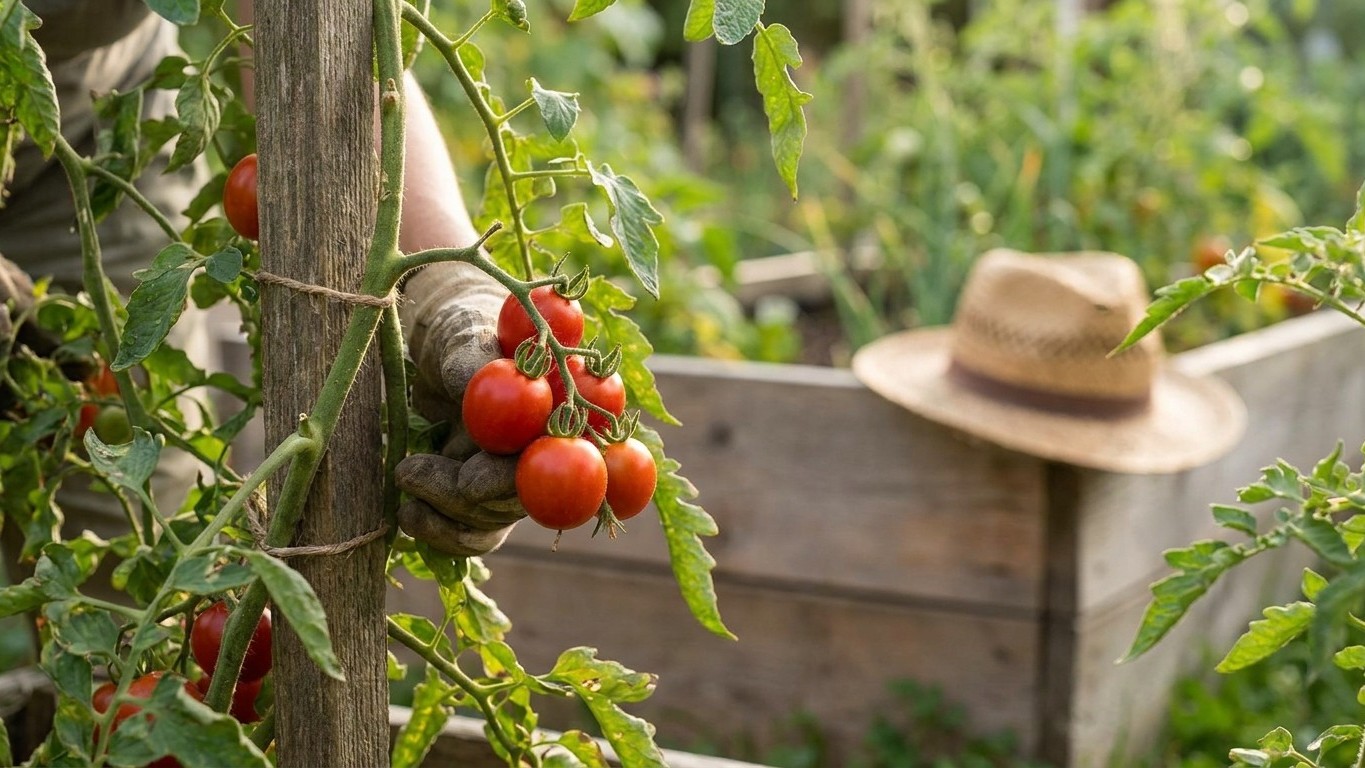

Fifty-five days is the number on the Cherry Bomb packet, and it’s the number that trips people up, because it counts from transplant, not from seed. The plant itself is indeterminate, which is the real engine behind “until frost” — it never stops setting new trusses, so a tall cage or a stake run five to seven feet isn’t optional, it’s what keeps the clusters off the ground and the vine producing past midsummer instead of collapsing into a rotting tangle.
What Cherry Bomb actually is

Cherry Bomb is a hybrid cherry tomato grown for small, round, deep red fruit that forms in clusters and comes off the vine several at a time rather than one by one. The catalogue figure puts it at about 64 days from transplant to first ripe fruit, and that count starts the day a started plant goes into the garden, not the day seed goes into a tray. Started from seed indoors, add another five to seven weeks of growing time before that transplant date, so the true span from packet to first tomato runs closer to fourteen weeks.
The plant is indeterminate, meaning it keeps growing, flowering and setting new trusses all season instead of stopping at a fixed height after one flush. That habit is the whole point of a cherry tomato bred to Keep Coming Until Frost. A determinate variety sets one wave of fruit and quits. Cherry Bomb instead needs a tall cage, a stake run five to seven feet, or a string trellis to hold the vine as it keeps climbing well past midsummer. Skip the support and the vine sprawls, the fruit rots against wet soil, and picking turns into a daily search through a tangle.
The fruit itself is a true cherry type, round, about an inch across, meant for the hand or the salad bowl rather than the sauce pot. That makes it a different growing project from a paste tomato like the one covered in the Kuzco Tomato guide, which ripens its whole crop in one narrow window built for canning. Cherry Bomb spreads its harvest out instead, which only pays off once you know how long your local season actually gives it to work.
What Cherry Bomb is good for
A cherry tomato’s fate is usually decided in the garden, not the kitchen. Fruit this size is watery relative to its skin, and most of it gets eaten standing at the plant or dropped into a bowl for the table rather than cooked down into anything. Cherry Bomb fits that pattern: the size and thin skin that make it split cleanly between the teeth are the same traits that make it a poor candidate for a sauce pot, since driving off that much water for that little flesh takes far longer than the fruit is worth.
That’s why the useful frame for this variety is salads and snacking, and why that framing is mechanical rather than a matter of taste. Round, inch-wide fruit halves or quarters cleanly into a salad without needing a knife skill beyond a slice, and it holds its shape once cut instead of collapsing the way a thin-walled slicer does. For snacking, the appeal is even more direct: nothing needs to happen to the fruit between the vine and the mouth. Cherry Bomb comes off in clusters rather than singly, which matters here too — a cluster is a handful, suited to picking on the way past rather than gathering ingredients for a dish.
What that rules out is anything that depends on flesh-to-liquid ratio. Sauce, paste, canning down into a thick base — all of that wants a tomato that is mostly flesh and low in water to begin with, which is the paste type’s whole reason for existing. Cherry Bomb is built the opposite way, and no amount of cooking time fixes a fruit that’s mostly juice and skin.
Beyond that, nothing about flavor, acidity, or sweetness is documented for this variety. The category explains the texture and the use; it does not tell you how it tastes, and that isn’t stated here because it isn’t published.
Where it ripens in time, and where it is a gamble
The 55-day figure only tells you how long Cherry Bomb needs once it is in the ground. What decides whether that is enough time is the length of your frost-free window, minus roughly two weeks for soil to warm enough to take a transplant, minus the 64 days to first fruit. Whatever is left is your picking season before frost shuts it down, and that number changes enormously depending on where you garden.
Where the margin is tight
At Whitehorse, the reference station for the Yukon, that arithmetic leaves only about 3 days of margin between first ripe fruit and the first fall frost. Growers there set transplants out in mid June and see first ripe fruit only in late August, which leaves no room for a cool year to close the gap even earlier. Worse, the Yukon’s growing season totals only around 600 accumulated degree-days of warmth for the whole year, which is short regardless of how many frost-free days sit on the calendar. That makes Cherry Bomb a greenhouse or high-tunnel crop there, not an open-ground one.
Rankin Inlet in Nunavut is similar in shape: about 8 days of margin, transplants going out in early July, first fruit only in early September, and just 159 accumulated degree-days across the year. That last number matters more than the frost dates alone. A vine can dodge frost entirely and still fail to ripen a full crop if the season never accumulates enough cumulative heat, and both Territories fall into that trap.
Alberta, measured at Calgary, opens the window further, about 40 days of margin with transplant in early June and first ripe fruit by early August, but its total of roughly 1,171 degree-days still points toward a tunnel or a greenhouse start rather than open ground. Manitoba, at Winnipeg, lands close behind with about 44 days of margin and roughly 1,832 degree-days, a total workable outdoors with a plastic mulch to lift soil temperature, which pairs well with a fast cultivar like this one.
Where the margin is wide
South of the Prairie provinces the arithmetic stops being tight at all. In Washington, Seattle’s frost-free window leaves about 162 days of margin, with transplant going out mid March to early April and first fruit by early June, plenty of room even after the fortnight for soil warming and the 64 days to maturity are both subtracted. Push further south and the margin turns enormous rather than merely comfortable: Houston, in Texas, gives about 197 days; Las Vegas, in Nevada, about 232; and New Orleans, in Louisiana, about 234. In every one of those places the frost calendar stops being the limiting factor. Heat takes over instead, which is the subject of the next section.
| Territory (station) | Set out | First ripe | Margin | Verdict |
|---|---|---|---|---|
| Yukon (Whitehorse) | mid June | late August | 3 days | Risky, needs cover |
| Nunavut (Rankin Inlet) | early July | early September | 8 days | Risky, needs cover |
| Alberta (Calgary) | early June | early August | 40 days | Greenhouse advised |
| Manitoba (Winnipeg) | early June | early August | 44 days | Workable with mulch |
| Washington (Seattle) | mid March-early April | early June | 162 days | Comfortable |
| Texas (Houston) | mid Feb-mid March | mid May | 197 days | Comfortable |
| Nevada (Las Vegas) | late Jan-mid Feb | mid April | 232 days | Comfortable |
| Louisiana (New Orleans) | early Feb-late Feb | late April | 234 days | Comfortable |
The two ways a season goes wrong
A long frost-free window is not automatically a productive one, and there are two failures a frost table will never show you. In the north, accumulated warmth can run short even when the calendar between frosts looks generous. That is exactly what the Yukon and Nunavut figures show: their frost-free windows are not the killer, their total degree-days are. A vine that never gets frostbitten can still sit and sulk if nights stay cold, because tomato flowers will not set fruit once nights fall below 50°F with any regularity, no matter how many weeks remain before frost.
In the south the opposite failure shows up. Once daytime temperatures push past 86°F, tomato pollen goes sterile and flowers drop without setting fruit at all. That is why Texas, Florida, Nevada, Louisiana and South Carolina all carry a warning about the same stretch of summer: from roughly late spring through early fall the flowers can keep blooming and still produce nothing, and growers there run two effective seasons, a spring crop and an autumn crop, rather than one long summer-long harvest.
For Cherry Bomb specifically, that second failure matters more than the first. Its 55-day maturity is fast enough that it generally clears the degree-day threshold even in a shortened northern season with help from a tunnel, but nothing about its speed protects it from midsummer sterility in the deep south. If you garden in Houston, Las Vegas or New Orleans, the practical move is to treat the 64 days as a spring sprint that finishes well before the heat shuts pollination down, then start a second round of transplants timed to mature again once temperatures drop back under that threshold in fall.
What it resists, and what it does not
Cherry Bomb carries two named resistances on the catalogue tag, and they are not equal in strength. Resistance to Late Blight is graded High, which means the plant can be exposed to the disease in a wet season and still hold a crop when neighboring susceptible varieties collapse. Resistance to Early Blight is graded only Intermediate, and that distinction matters. Intermediate resistance slows the disease’s spread and buys the plant more productive weeks, it does not stop early blight from infecting the lower leaves eventually, especially in a humid, crowded planting.
What the catalogue does not list is just as important as what it does. Cherry Bomb carries no published resistance to Septoria leaf spot, Fusarium wilt or Verticillium wilt, three of the more common tomato diseases in home gardens. That does not mean the plant is unusually vulnerable to them, most cherry tomatoes carry the same gap, but it does mean crop rotation and good airflow around the vine are doing real work here rather than being a formality. Blossom end rot, which shows up as a sunken brown patch on the fruit’s bottom, is not a disease at all but a calcium and watering problem, and no amount of disease resistance on the tag will prevent it if watering swings from bone dry to soaked.
Growing it without the usual mistakes
Support and spacing
Because Cherry Bomb is indeterminate, plan for a cage built for a tall plant or a stake run five to seven feet, set in place at transplant rather than added later once the vine is already sprawling. Space plants roughly two to three feet apart, tighter spacing crowds the lower leaves and is exactly where early blight gets its foothold. This is the same planning a grower gives Better Boy, another indeterminate bred to keep producing until frost, though Cherry Bomb’s smaller fruit means more frequent picking is needed to keep the vine cycling new flowers instead of holding onto ripe clusters.
Feeding and the timing mistake it invites
Feed at transplant and again once the first fruit sets, then ease off nitrogen for the rest of the season, heavy nitrogen late on an indeterminate vine buys more leaf and fewer tomatoes. The mistake this variety’s fast rating specifically invites is setting it out too early on the strength of that 55-day number. A quick maturity date describes what happens once the plant is established, it says nothing about the plant’s tolerance for a late cold snap, so the transplant timing still has to follow your local frost guidance, not the seed packet’s math. Water consistently once fruit is forming. Uneven soil moisture is the single biggest cause of split skins on a round cherry tomato like this one, more so than any disease on the resistance list.
Common questions
Can I grow Cherry Bomb in a container?
Yes, but size the pot to the plant, not the fruit. Cherry Bomb is indeterminate and gets tall and bushy over a full season, so a container under about 15 to 20 gallons will leave it root-bound and struggling by midsummer. A large fabric grow bag with a stake pushed through the fabric works better than a decorative pot that looks right in April but is too small by July.
Is Cherry Bomb the same as Sweet 100 or Sungold?
No. All three are indeterminate red or gold cherry tomatoes but they are separate hybrids with their own catalogue ratings for days to maturity and disease resistance. Do not swap one variety’s resistance claims onto another just because the fruit looks similar on the vine, check the actual seed packet or catalogue listing for the one you bought.
Why do my Cherry Bomb tomatoes keep splitting on the vine?
Almost always uneven watering rather than disease. A dry stretch followed by a heavy soak or a hard rain swells the fruit faster than the skin can stretch, and round cherry types split more readily than larger slicers. Mulching to hold soil moisture steady and picking fruit slightly before full ripeness in rainy stretches both help.
Do I need to prune the suckers off Cherry Bomb?
It helps but is not mandatory the way it is for some show-tomato varieties. Removing some of the side shoots below the first flower cluster improves airflow, which matters more here given the plant’s only intermediate resistance to early blight, but heavy pruning on a cherry type also cuts into the total fruit count, since more branches generally means more of the small clusters this variety is grown for.