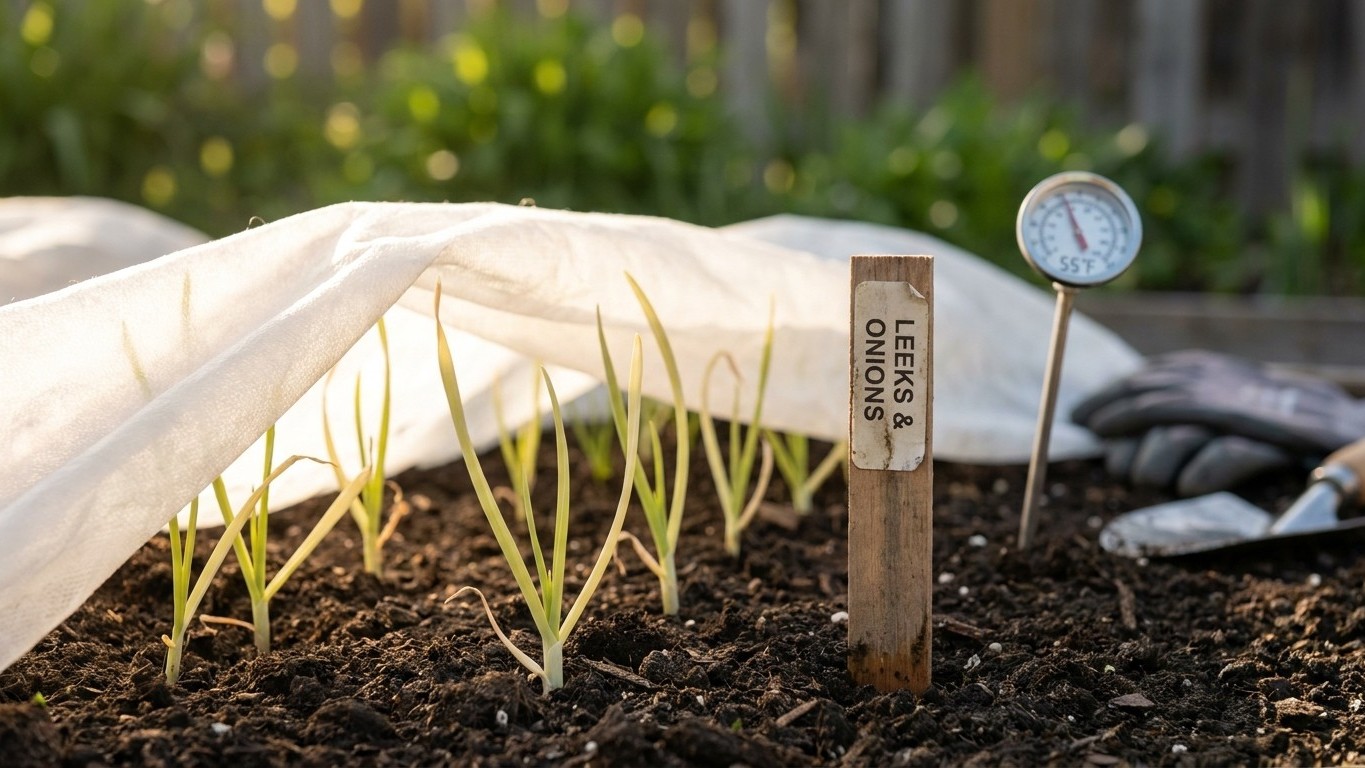

Leek moth larvae start feeding on allium crops once soil and air warm past a certain point, not on a fixed calendar day. In Quebec, that usually means late spring into early summer, with damage showing on leeks, onions, and garlic weeks after transplant, and row covers are the single most reliable home defense once the timing is right.
Reading the calendar from your last frost

Quebec gardeners plan almost everything around one date: the last spring frost. At the MONTREAL/ST-HUBERT A station, Environment and Climate Change Canada puts that average at May 6, based on the 1981-2010 climate normals. That’s a mean, not a promise. In one year out of two, frost actually arrives later than May 6, so treat it as the midpoint of a window rather than a green light for tender transplants.
Leek moth doesn’t read a calendar either. Adults become active once soil and air temperatures climb into a comfortable range for flight and egg-laying, so a warm April pushes activity earlier and a cold, slow spring delays it by a week or two. That’s why counting backward or forward from a single frost date only ever gives you another range, never a day you can circle in pen.
What this means for covers
Gardeners who transplant leeks or onions around early-to-mid May in the Montreal area typically see the first sign of feeding damage three to four weeks later, once young larvae have had time to mine into leaf tissue. That gap is the practical planning window: covers need to go on at transplant, before the first flight of adults arrives, and they need to stay sealed at the soil line through that early feeding period. Pulling them off too soon, right when the weather turns pleasant, is the single most common reason a cover fails to do its job.
What it attacks, and what the damage looks like
Before anyone identifies the insect, they usually notice the plant. Leek moth targets allium crops specifically: leeks, onions, garlic, shallots, and chives. The first clue is rarely a moth sighting. It’s a leaf that looks wrong.
On onions and leeks, look for narrow, translucent “windows” scraped into the leaf surface, as if something chewed through the top layer but left the bottom skin intact. As feeding continues, those windows dry out and split into ragged, elongated holes running parallel to the leaf’s length, sometimes called a shot-hole or lace pattern. On leeks in particular, larvae also tunnel down into the central stem, and a plant that looked fine last week can show a wilting, collapsing central leaf almost overnight once the stem tunnel cuts off its own support.
Garlic shows a milder version of the same symptom: distorted, twisted leaf tips and occasional entry into the bulb neck late in the season.
Which life stage causes the damage, and why it matters
The damage is done almost entirely by the larvae, small pale green to yellowish caterpillars that hatch from eggs laid on or near the leaves. Adult moths themselves don’t feed on the plant in any meaningful way; they’re small, mottled brown-gray insects that are easy to miss at rest. That distinction matters for timing a response. Once larvae have tunneled into a stem or bulb neck, they’re physically shielded from almost anything applied to the leaf surface, which is why the practical window for intervention is early, while larvae are still mining exposed leaf tissue rather than hidden inside the plant.
How Quebec sits in this pest’s range

On this site, leek moth is documented in two territories. That’s a narrow footprint, and a narrow range usually means the territory in question sits near an edge of where the insect is established and monitored, rather than deep in the middle of its range. Quebec’s proximity to New England and the northeastern United States puts it in a zone where the pest is present but where formal, territory-specific guidance is still thin.
Because dedicated local research on leek moth in Quebec is limited, the nearest published guidance on this site comes from University of Vermont Extension, across the border. That’s worth saying plainly rather than glossing over: recommendations on timing, monitoring, and control that circulate for this region often trace back to Vermont’s growing conditions, not to a Quebec-specific study. Vermont and southern Quebec share a similar climate band, which makes that guidance reasonably transferable, but a gardener in the Laurentians or the Gaspé is working with a cooler, later season than one in Burlington or Montreal’s South Shore, so even borrowed guidance needs local adjustment.
None of this points to a rank or a severity level for Quebec specifically. A two-territory footprint tells you the pest is documented and worth watching in both places; it doesn’t tell you which one sees worse outbreaks, because that comparison isn’t part of the available data.
What actually works against it
The measures below are ordered from cheapest to most involved, and each one has real limits worth knowing before you rely on it.
- Delay transplanting by a week or two when the schedule allows it, since this can shift a crop’s most vulnerable early leaf stage away from the first wave of adult moth activity, and it costs nothing and requires no daily attention.
- Use row covers, sealed at the edges and installed at transplant before adults are active, because they work on a simple mechanical principle: adult moths can’t lay eggs on leaves they can’t physically reach; a cover placed after the first moths have visited the crop, or one left with gaps at the base, isn’t protecting anything.
- Hand-pick affected leaves by checking regularly for window-pane feeding marks and squeezing or removing affected sections, which works while larvae are still near the surface, exposed and visible, but stops working the moment a larva has tunneled into the stem interior.
- Rotate crops and clean up in fall, clearing old allium foliage and stems out of the garden at season’s end and moving next year’s alliums to a different bed, since leek moth overwinters in plant debris and nearby vegetation, and this reduces the population that emerges the following spring, though it addresses next year’s crop rather than this year’s.
Where the limits are
None of these steps reach larvae once they’re established inside a leek stem or a garlic bulb neck. At that point the practical options are removing and destroying the affected plant material to prevent that generation from completing its cycle, not treating the plant back to health.
Common questions
Does leek moth affect vegetables besides alliums?
No. It feeds specifically on allium crops, meaning leeks, onions, garlic, shallots, and chives. Tomatoes, beans, and other unrelated vegetables in the same bed aren’t at risk from this particular insect.
Can I still plant leeks if I missed the early cover window?
Yes, but expect to rely more on inspection and hand-removal of affected leaves through the season, since the mechanical barrier a cover provides only works if it’s in place before adult moths arrive.
Is one growing season enough to get rid of leek moth for good?
Not typically. Because it overwinters in garden debris and can fly in from surrounding areas, a single season of cleanup usually reduces pressure rather than eliminating it; consistent rotation and fall sanitation over several years make a bigger difference.