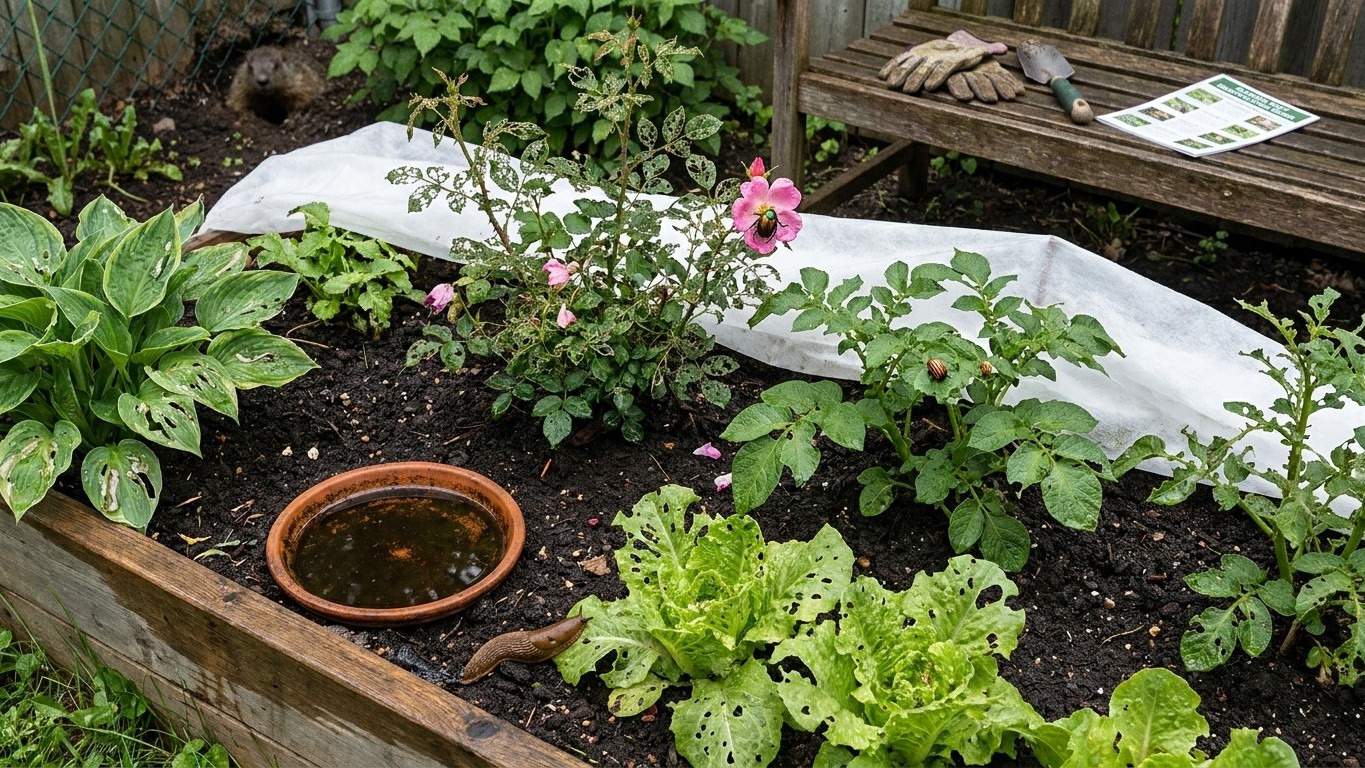

Quebec’s short, intense growing season packs a surprising punch of insect and wildlife pressure into just a few months. Gardeners here deal with Japanese beetle populations chewing through roses in July, the nocturnal Asiatic garden beetle gardeners find skeletonizing leaves on summer nights, Colorado potato beetle populations stripping nightshades by June, the striped cucumber beetle growers watch for once squash and cucumber vines take off, the Brown marmorated stink bug Quebec populations that show up on tomatoes and fruit trees by late summer, Rose chafer Quebec outbreaks that skeletonize rose blossoms and grape leaves in June, slugs thriving in cool damp spring soil, and deer or groundhogs treating vegetable beds like an all-you-can-eat buffet from May through October in Quebec. The timing matters as much as the identification: knowing whether you’re looking at a spring problem or a late-summer one determines whether you reach for row covers, hand-picking, or a targeted treatment.
Quebec sits mostly in Canadian plant hardiness zones 2 to 4, with Montreal and the St. Lawrence lowlands running slightly warmer than the Laurentians or the Gaspé. That compressed frost-free window, often just 120 to 160 days depending on the region, means pest cycles overlap fast once the soil warms. A gardener in Estrie might see three pest waves collide in the same June week that a Vermont or upstate New York gardener spreads across a longer spring.
Spring Pests: What Shows Up First

The moment soil temperatures climb past 50°F, usually mid-to-late May in southern Quebec, several pests wake up ahead of most vegetables. Slugs and snails top the list. Quebec’s cool, wet spring conditions (frequent rain, slow-draining clay soils in areas like the Montérégie) create ideal slime-trail weather. Ragged holes in lettuce, hosta, and young bean leaves are the tell. That same persistent soil moisture also fuels Dark-winged fungus gnats Quebec populations, whose larvae multiply fast in overwatered seed-starting trays and container mixes, and it’s around this same window that growers watch for the first hatching caterpillars of the Spongy moth in Quebec, whose larvae emerge just as oak and maple leaves unfurl and can strip whole branches bare within weeks. href=”https://thehomesteadpost.com/quebec/pests/leek-moth/”>Leek moth in Quebec, whose larvae tunnel into leeks, onions, and garlic just as those crops start putting on growth Swede midge in Quebec starts distorting the growing points of broccoli, kale, and other brassicas, while soft summer fruit later in the season faces pressure from Spotted wing drosophila Quebec populations targeting raspberries and other thin-skinned crops. Beer traps sunk to soil level, diatomaceous earth around seedlings, and simply watering in the morning instead of the evening cut down on the damp nighttime conditions slugs need.
Cutworms follow close behind. These gray, C-shaped caterpillars hide in soil during the day and sever seedling stems at ground level overnight, a problem that can wipe out a full row of transplants in a single week. A cardboard collar pushed an inch into the soil around each transplant blocks them cold. Spring soil turning is also when gardeners are most likely to notice Asian jumping worms Quebec populations, recognizable by their frantic thrashing and the grainy, coffee-ground texture they leave behind in the topsoil. Around the same time, gardeners growing lilies should watch for the bright red Lily leaf beetle Quebec populations that emerge to chew through foliage and flower buds. In that same cool, wet soil, the seedcorn maggot can burrow into germinating seeds and tunnel through corn, beans, and peas before they even sprout, while later in the season the viburnum leaf beetle skeletonizes hedge leaves and rounds out the early-to-mid summer pest lineup. Around the same time, tiny green inchworms from the Winter moth in Quebec that orchards and backyard fruit trees often battle can strip apple, cherry, and maple buds before the leaves have fully unfurled, while those same apple trees face a later-season threat from the Apple maggot in Quebec that orchardists watch for once fruit begins to set, and the hairy caterpillars of the Browntail moth in Quebec, which residents are increasingly asked to identify, can defoliate oaks and fruit trees while also triggering a nasty skin rash from their irritating hairs. In the vegetable patch, this is also when Asparagus beetles in Quebec start chewing on the emerging spears that growers rely on for early spring harvests, their small orange-and-black bodies easy to spot against the fresh green stalks. Flea beetles in Quebec also arrive early, peppering eggplant, radish, and arugula leaves with tiny shot-holes. Floating row covers put on at transplant time keep the beetles off before they find the crop, and they do double duty against root maggot pests too, including the Onion maggot in Quebec that growers battle in allium beds each spring, as well as the Cabbage maggot in Quebec that gardeners contend with, as well as the early caterpillar generations of the Imported cabbageworm in Quebec that growers watch for on brassicas planted in that same cool, damp spring window. Around the same time, the Fourlined plant bug in Quebec that gardeners often notice on mint, basil, and other herbaceous perennials starts leaving its telltale dark, sunken spots on new growth.
Colorado Potato Beetle
This one deserves its own mention because it’s the most persistent early-season pest for anyone growing potatoes, tomatoes, or eggplant in Quebec. Adults overwinter in the soil and emerge as soon as potato foliage appears, often by the first week of June in the Montérégie and slightly later in the Quebec City region. The orange-and-black striped adults and their reddish, humpbacked larvae can defoliate a potato patch in days. Hand-picking adults and crushing the yellow egg clusters on leaf undersides works well in home gardens, especially if done twice a week starting at emergence. Crop rotation matters too: beetles overwinter near last year’s potato bed, so moving nightshades to a different corner of the garden each season cuts the population that greets you in spring.
Summer Pests: The Peak Pressure Window
July and August bring the heaviest pest load of the year. Japanese beetles, first confirmed spreading through southern Quebec decades ago and now well established from the Montérégie to the Outaouais, emerge in early-to-mid July and feed in metallic-green clusters on roses, grapevines, raspberries, and linden trees. They skeletonize leaves, leaving lace-like remains. Traps that use floral lures often pull in more beetles than they catch, so most extension programs recommend hand-picking into soapy water in the early morning when beetles are sluggish, combined with treating lawns for grubs (their larval stage) in late summer if turf damage is visible.
Aphids build up fast in warm, humid stretches, clustering on new growth of peppers, kale, and roses. A strong jet of water knocks most colonies off, and ladybugs (which are genuinely abundant in Quebec gardens by midsummer) usually finish the job within a week or two if no broad-spectrum insecticide has wiped them out first. Spider mites prefer the opposite conditions: hot, dry spells, especially under eaves or in greenhouse tunnels, where they stipple leaves with a fine yellow speckling and spin barely visible webbing.
Squash vine borer is the pest most likely to blindside a Quebec vegetable gardener. The adult moth, which looks more like a wasp than a typical moth, lays eggs at the base of squash and zucchini stems in late June through July. The larva tunnels inside the stem, and the first visible sign is often a healthy-looking plant that wilts and collapses within days. Wrapping the base of young squash stems in aluminum foil or a strip of nylon stocking at planting time blocks egg-laying. Tomato hornworms show up slightly later, in August, stripping tomato foliage overnight with a voracity that seems impossible for a caterpillar that size, sometimes 4 inches long by the time it’s noticed. They’re easiest to spot at dusk with a flashlight, since their green coloring blends perfectly with tomato foliage during the day.
Late-Summer and Fall Pests
As nights cool in late August and September, cabbage worms and cabbage loopers move into brassica beds, chewing irregular holes in cabbage, broccoli, and kale leaves. Row covers installed at transplanting remain the most reliable barrier, since the adult white butterflies (Pieris rapae) need direct access to lay eggs on the leaves. Once caterpillars are already present, picking them off by hand two or three times a week usually keeps damage manageable through harvest.
Fall is also when wildlife pressure peaks in many parts of Quebec, particularly in rural and semi-rural areas of the Eastern Townships, Lanaudière, and Chaudière-Appalaches. Deer browse hostas, arborvitae, and vegetable garden edges most heavily as natural forage thins out before winter. A fence at least 7 to 8 feet high, or a double fence set 4 feet apart, remains the only consistently effective deterrent; repellent sprays need reapplication after every rain and lose effectiveness once deer get hungry enough.
Ground-Level Wildlife: Groundhogs, Voles, and Raccoons
Groundhogs (woodchucks) are a genuine headache for Quebec vegetable gardeners, especially those backing onto fields, hedgerows, or wooded lots. A single groundhog can clear a row of bean plants or a bed of lettuce in one feeding session, and they’re strong enough to push through loosely secured fencing. Effective exclusion means burying wire mesh fencing at least 12 inches into the ground (they dig under barriers) with the top foot left unattached so it flops outward if they try to climb.
Voles cause quieter but costly damage, especially over winter under snow cover. They girdle the bark of young fruit trees and shrubs at the base, sometimes killing a tree that looked perfectly healthy in November by the time spring arrives. Wrapping trunks with hardware cloth cylinders each fall, extending a few inches below soil level, prevents this almost completely and takes about ten minutes per tree. Raccoons round out the list, mostly by raiding sweet corn just as it reaches peak ripeness, often the night before a gardener planned to harvest. Electric fencing around the corn patch, set up about a week before expected ripening, is the most reliable deterrent gardeners report.
Building a Season-Long Pest Strategy
Quebec’s compressed season rewards gardeners who front-load their defenses rather than reacting pest by pest. Row covers installed at planting keep flea beetles, cabbage moths, and squash vine borers away before they ever find the crop, and they can simply be removed once plants flower and need pollinator access. Rotating nightshades, brassicas, and squash family crops to different beds each year breaks the overwintering cycle for Colorado potato beetles and squash bugs alike, since many pests emerge within a few feet of where they spent the winter.
Encouraging natural predators pays off more in Quebec gardens than many people expect. Ladybugs, lacewings, and parasitic wasps are already present in healthy numbers across most of southern Quebec by midsummer, and skipping broad-spectrum insecticides gives them room to work. A small patch of dill, yarrow, or alyssum left to flower near the vegetable beds draws these predators in reliably.
Timing garden walks matters just as much as any single product or barrier. A five-minute check every two or three days during peak season, looking under leaves for egg clusters, checking squash stem bases, and scanning for the first signs of wilting, catches most problems while hand-removal is still enough to solve them. By the time damage is obvious across a whole bed, the pest usually has a two-week head start.
Pest-by-Pest Guides for Quebec Gardens
Once you’ve got a feel for the season, it helps to look closer at what’s actually landing on your plants. Soil dwellers deserve early attention: Asian jumping worms arrive once soil warms past frost, while European chafer grubs chew grass roots before any wilting shows, and rose chafer adults emerge from turf a few weeks after last frost. Indoors and in seed trays, watch for dark-winged fungus gnats in consistently moist soil. On the insect front, there’s the twice-yearly boxelder bug, the established brown marmorated stink bug, and its cousin the green stink bug, plus the season-long tarnished plant bug. Crop-specific feeders include the leek moth on alliums, squash vine borer moths in cucurbits, swede midge in brassicas, and spotted wing drosophila in ripening fruit. For trees and ornamentals, there’s the emerald ash borer, spongy moth caterpillars, and the lily leaf beetle.