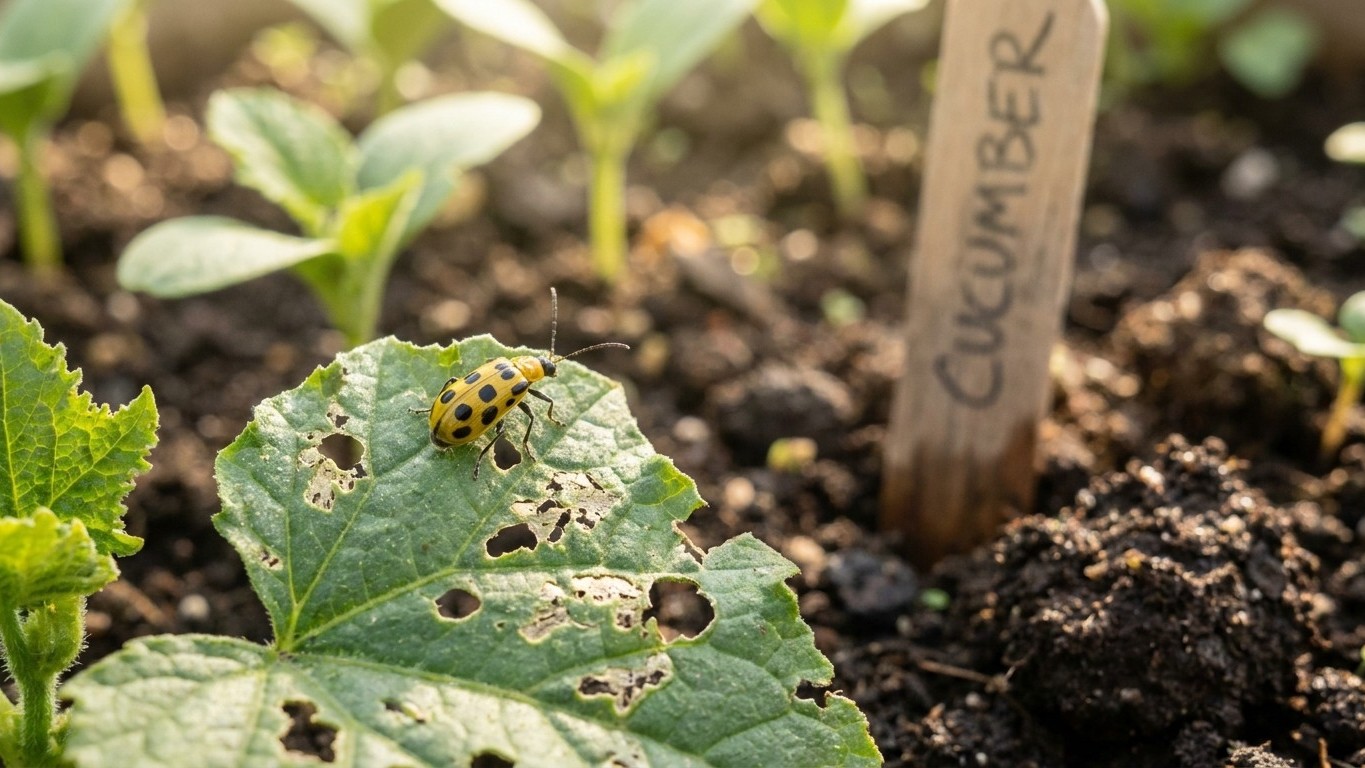

Western spotted cucumber beetle activity in Washington tracks soil warmth, not a printed calendar date. For gardens west of the Cascades, the practical window opens as the last frost stretch of late February to mid-March fades and soil finally heats up. Adults chew leaves and flowers above ground while larvae work roots below. Timed row covers, fast crop rotation, and fall cleanup are what actually change the outcome, per WSU Extension.
Reading the calendar from your last frost

NOAA’s 1991-2020 Climate Normals put the last spring frost for western Washington (station USW00024233, near Seattle) somewhere between February 27 and March 18. That’s a normal, a band built from three decades of freeze probabilities, not a guarantee that pins the beetle’s arrival to one morning. Counting backward from a range only produces another range. Nobody, not even the weather service, can tell you the exact day this insect wakes up.
What actually triggers activity is soil temperature, not the date on a seed packet. A warm February pushes beetles active earlier; a cold, wet March holds them back right alongside your tomatoes. That’s the twist gardeners miss: a mild last-frost window doesn’t mean an early planting window. Cold, soggy soil and thin late-winter light keep cucurbit and bean seedlings sluggish well after the freeze risk has passed, and a sluggish seedling is an easier target once the beetle does show up.
In practice, the first chewed cotyledons or notched leaf edges tend to appear within a couple of weeks of transplanting, once soil crosses into beetle-active range. That’s the signal for timing covers: get them on at transplant, before the first adults find the row, and plan to lift them once flowers need pollinators. Wait for a confirmed sighting and you’re already behind.
One more caution worth repeating: this frost window describes western Washington’s mild, maritime climate. East of the Cascades, the growing season runs on high-desert rules with a much shorter frost-free stretch. A gardener in Spokane planning around a Seattle frost date is planning around the wrong climate entirely.
What it attacks, and what the damage looks like
Most gardeners notice the symptom before they ever spot the insect. A cucumber or squash vine that wilts suddenly, with no obvious drought stress, is one classic sign. Young leaves riddled with small, ragged holes, almost lace-like, are another. Look closer at fruit rind and you may find shallow scarring or scabbing where an adult beetle fed on the surface. Flowers, especially on squash and melon, can show chewed petals and damaged pollen structures, which hits fruit set even when the plant itself looks otherwise fine.
The crop list runs wider than the name suggests. Cucumbers, squash, melons, and pumpkins take the brunt of it, but beans, corn seedlings, and a range of other vegetable starts get fed on too, and ornamentals like dahlias aren’t immune. In a mixed backyard bed, that means damage can show up in a spot you weren’t watching at all.
Two life stages, two very different problems
Adults do the visible damage: chewed leaves, scarred fruit, ragged flowers. They’re the ones you can actually see and, more importantly, actually catch. Larvae are the invisible half of the problem. They live in the soil and feed on roots and the underground portion of stems, which is exactly why a plant can look fine one week and collapse the next with no chewing evident above the soil line. Once larvae are established on root tissue, nothing you do to the leaves matters. That distinction decides which control method still has a chance and which one is already too late.
How Washington sits in this pest’s range

On this site, western spotted cucumber beetle is currently documented in two territories. That’s a narrow footprint by this content set’s standard, and it puts Washington near the edge of what’s been written up here rather than in the middle of a broad, well-mapped range. That’s a statement about documentation, not about how common or severe the insect actually is in the field, a distinction worth holding onto since a short list of documented territories doesn’t equal a ranking or a trend.
Where a pest is documented in many territories, the meaningful difference between them is almost always timing rather than presence, since the same insect just wakes up earlier or later depending on climate. With only two territories logged here, that comparison isn’t available yet. What is available is a solid local source: WSU Extension covers this pest for Washington conditions specifically, which matters more than a national overview would, given how much this insect’s schedule depends on regional soil warmth rather than a fixed biological clock.
None of this should be read as Washington sitting at a low-severity or high-severity end of anything. The count reflects what’s been documented on this site, not a claim about how the beetle behaves compared to other states.
What actually works against it
Timing costs nothing and does the most work.
- Delay transplant until soil has genuinely warmed, rather than rushing seedlings out the moment frost risk clears, so plants are past their most vulnerable, tender-leaf stage by the time adult beetles are active in numbers; a tougher, more established seedling shrugs off feeding that would stunt a fresh transplant.
- Use row covers as a physical barrier the adult beetle can’t get through to reach leaves or flowers, putting them on at transplant, before adults find the row, and removing them once flowers open on cucurbits so pollination can occur, pairing the covers with a head start on maturity since that removal window is also the moment protection ends.
- Hand-pick adults, especially in early morning when they’re sluggish and slower to fly off, to thin numbers directly at zero cost beyond time, though this won’t touch anything already happening below the soil surface.
- Rotate crops, moving cucurbits, beans, and corn to a different bed each year, to interrupt the cycle by denying newly hatched larvae the root systems they need close by, since larvae don’t travel far on their own.
- Clear garden debris and spent vines in fall to remove overwintering shelter for adults, cutting down how many survive to the following spring.
Here’s the hard limit worth being honest about: once larvae are established inside roots or the base of a stem, none of the above reaches them. Covers, hand-picking, even a clean bed, all target the adult stage or the following season, not an active underground infestation. At that point the plant either has the root mass to tolerate the damage or it doesn’t, and prevention before planting was the only leverage that mattered.
Common questions
Does the row cover need to stay on all season?
No. It needs to come off once cucurbit flowers open so pollinators can reach them. After that point the cover’s job is largely done anyway, since bigger plants tolerate feeding better than fresh transplants.
Can this beetle survive a Washington winter?
Adults overwinter in plant debris and sheltered garden edges, which is exactly why fall cleanup matters as much as spring prevention. Clearing old vines and leaf litter removes the shelter they’d otherwise use to make it to spring.
Is this the same insect as the striped cucumber beetle?
No. They’re different species that get lumped together because they attack the same crops in similar ways. Look for the spotted pattern on the wing covers versus stripes to tell them apart, though the damage they cause on cucurbits looks nearly identical.