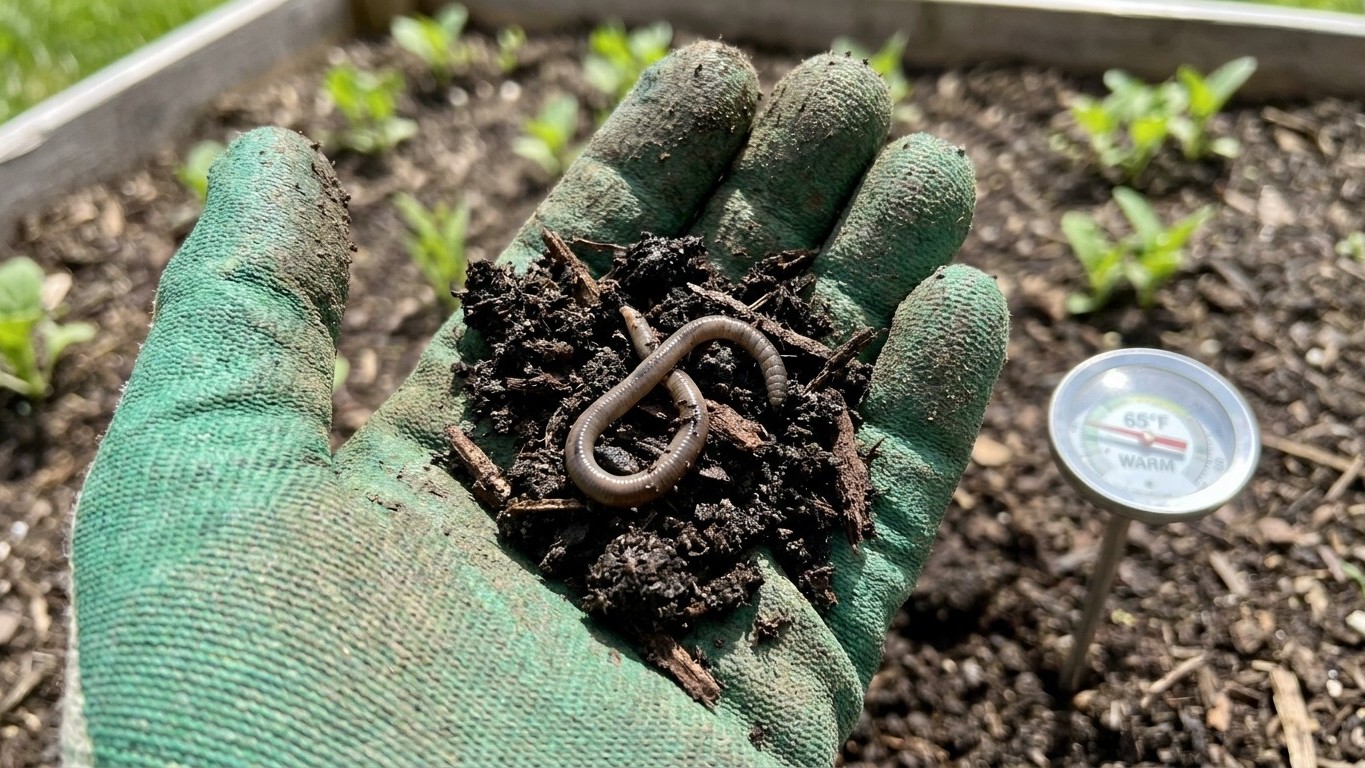

Asian jumping worms become active in Vermont gardens once soil temperatures climb past the point where cocoons hatch, usually not far behind the region’s last spring frost. There’s no pesticide that reaches them once they’re established, but there are timing choices and habits that keep a new population from taking hold in the first place.
Reading the calendar from your last frost

Vermont gardeners plan around one date: the last spring frost. At the Burlington station, NOAA’s 1991-2020 Climate Normals put that window between April 30 and May 10, based on 32F freeze probabilities recorded at station USW00014742. That’s the date most people use to decide when tomatoes and peppers go in the ground.
Soil warmth, not the calendar
Jumping worm cocoons don’t check a calendar. They hatch once soil warms enough, which usually tracks close to that frost window but can shift several days either way depending on how the season runs. A warm April pulls activity earlier. A cold, wet spring pushes it back. That’s why the frost date works as a normal to plan around, not a guarantee you can count on for a single exact day.
Because the worms answer to soil temperature rather than the sun’s angle, the practical move is to watch soil conditions directly rather than counting days on a calendar. Once transplants are in and the soil has held steady warmth for a while, that’s the stretch when juvenile worms start feeding hard enough to show up in mulch and topsoil. This is also the window when protective habits, like keeping new mulch and compost quarantined, need to already be in place, since waiting until damage appears means the season’s population is already established.
Worth remembering: Burlington sits right on Lake Champlain, the mildest pocket in the state. Gardens up in the Green Mountains or out in the Northeast Kingdom run on a shorter, later season, so anyone gardening away from the lake should expect their own local frost window to lag behind the Burlington normal, not match it.
What it attacks, and what the damage looks like
A gardener usually notices the symptom before they ever see the worm. Mulch that vanishes fast, soil that turns grainy and loose like used coffee grounds, and plants that seem to lose their footing in the bed are the first tells. Shallow-rooted perennials and seedlings are the most exposed, since jumping worms strip out the organic layer they depend on for moisture and structure.
What gets hit hardest
Hostas, ferns, and other perennials that rely on a rich organic layer often show stunted growth or wilting even when watering hasn’t changed. Vegetable seedlings can heave or dry out faster than expected because the granular, structureless soil the worms leave behind doesn’t hold water the way healthy soil does. In wooded edges and shaded borders, native wildflowers and tree seedlings can decline over a season or two as the leaf litter they need disappears.
Which stage does the damage
The juvenile worms feeding through summer are the ones doing the real damage, chewing through organic matter at a pace that regular earthworms don’t match. Adults show up later in the season, mate, and lay cocoons in the soil before dying at the first hard freeze. Those cocoons are the part that matters for next year: they overwinter unseen, and no amount of hand-picking in October reaches them once they’re buried. By the time a gardener spots thinning mulch or a wilting hosta, the worms responsible are usually already mature and close to laying the next generation.
How Vermont sits in this pest’s range

University of Vermont Extension is the local source tracking this pest here, and on this site it’s currently documented in two territories. With a count that narrow, Vermont sits near an edge of where the pest has been formally logged rather than somewhere in the thick of a widespread infestation pattern. That’s different from a pest documented across a dozen territories, where the main variable between places is simply timing, how many weeks earlier or later the season runs.
A count of two means presence here is confirmed, but the broader picture of how it spreads region to region isn’t yet built out the way it is for pests found nearly everywhere. That makes local reporting through University of Vermont Extension more important than it might be for a pest with a longer track record across many states, since fewer territories means fewer data points to compare against.
None of this points to a rank or a severity level for Vermont specifically. It just means the documented footprint here is smaller than for some other soil pests in this series, and gardeners should treat local Extension guidance as the most current word rather than assuming patterns from far-off regions apply the same way.
What actually works against it
The cheapest and most effective step costs nothing, and the rest follow in order of effort from there.
- Control what soil, mulch, and potted plants move into your yard, because jumping worm cocoons hitchhike in bagged compost, nursery pots, and shared plant divisions, so checking the source of anything with soil attached and avoiding free mulch or compost from unknown piles stops most new introductions before they start.
- Solarize new mulch or compost before it goes into the garden, because spreading it thin under clear plastic in full sun for several weeks raises the material’s temperature high enough to kill cocoons that heat can’t survive, though this only works before planting since solarizing a bed that’s already in contact with soil isn’t practical for most home gardeners.
- Hand-pick mature worms in mid to late summer, before they lay cocoons in fall, because this targets the reproductive stage directly and reduces how many eggs go into the soil for next year, even though it’s tedious.
- Rotate crops and clear garden debris in fall, because removing the organic litter juveniles rely on for cover and food makes conditions less favorable, without eliminating the population outright.
None of these steps reach cocoons that are already buried in the soil. There’s no tilling, no hand removal, and no cover crop that gets to eggs sitting a few inches down. Once cocoons are in place, the only realistic goal for that season is limiting how many worms mature to lay the next round, not eliminating what’s already there.
Common questions
Can you get rid of jumping worms once you have them?
Not completely, once cocoons are established in garden soil. The realistic goal is reducing the population year over year by removing mature worms before they lay eggs and by keeping new soil and mulch sources clean, rather than expecting a single treatment to clear a bed.
Do jumping worms survive Vermont winters?
The adult worms themselves die at the first hard freeze. What survives winter are the cocoons laid in the soil beforehand, which hatch the following spring once soil warmth returns, close to the same general window as the last frost.
How do you tell jumping worms from earthworms?
Jumping worms move with a fast, thrashing motion when disturbed, unlike the slower crawl of common earthworms, and they tend to live right at the soil surface in the organic layer rather than deeper down. The soil they leave behind also looks noticeably grainier, closer to coffee grounds than typical garden soil.