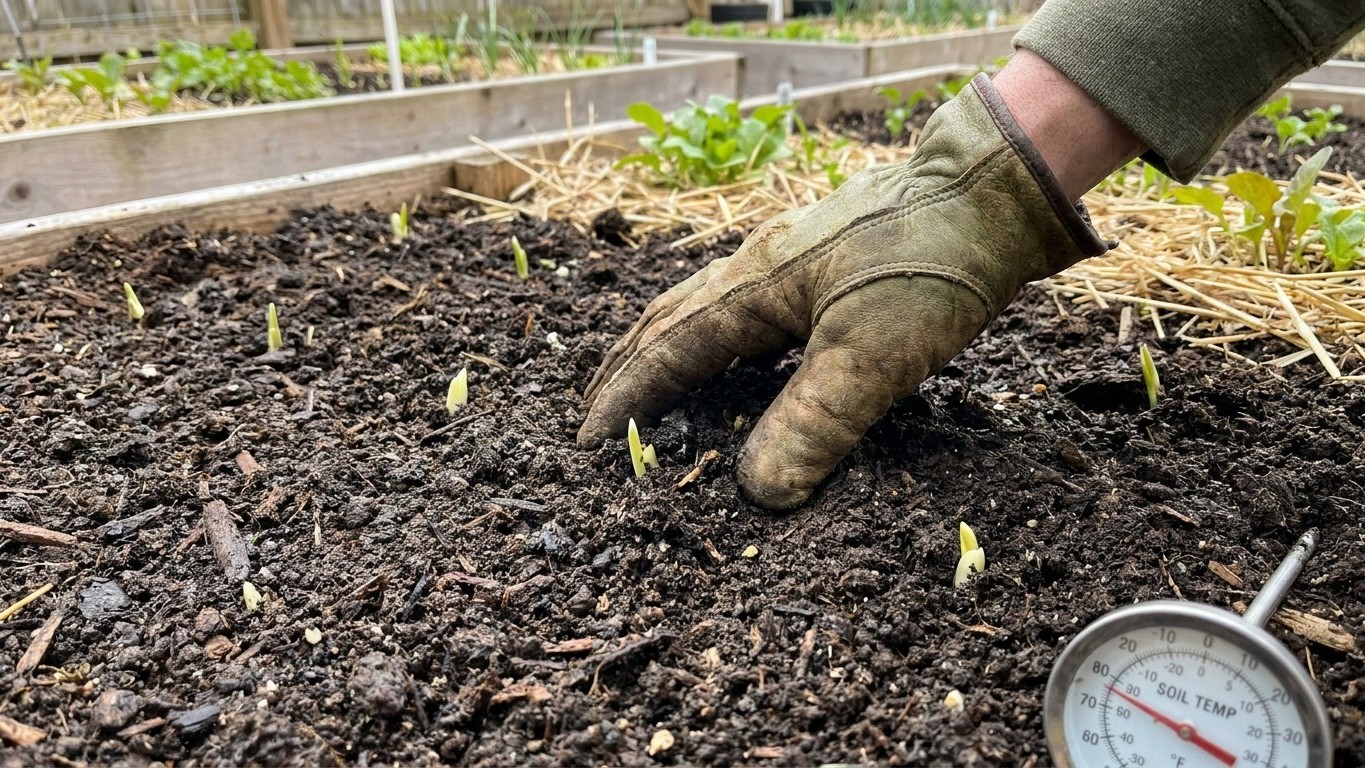

Asian jumping worms don’t wait for a date on the calendar in Quebec, they wait for the soil to warm past a certain point after the frost breaks. That timing lines up loosely with the region’s average last frost, May 6, though the worms themselves answer to dirt temperature, not a fixed day, and the damage they cause often gets misread as a plant problem long before anyone suspects a worm.
Reading the calendar from your last frost

The average last spring frost for the Montreal area sits at May 6, based on Environment and Climate Change Canada’s 1981-2010 climate normals for the MONTREAL/ST-HUBERT A station. That date is a mean, not a promise: in one year out of two, frost actually arrives later than May 6, so treating it as a hard safe date is a mistake gardeners make every spring. Northern and upland parts of the province run weeks behind this figure, since one station can’t speak for a whole province’s climate.
Jumping worm cocoons overwinter in the top few inches of soil and hatch once that soil has warmed enough in spring, a process that trails a week or two behind the frost-free date rather than starting on it. An early, mild spring pulls the hatch forward; a cold, wet one pushes it back, sometimes by a couple of weeks. That’s why a fixed hatch date doesn’t exist for this pest anywhere in its range, Quebec included.
For a gardener, the practical upshot is timing your inspection routine around transplanting rather than around a single day on the wall calendar. Damage from juvenile worms typically becomes visible within a few weeks of soil warming, once feeding activity ramps up in earnest, which is also the window when checking new mulch or nursery soil for the tell-tale granular castings matters most. Any date you calculate by counting backward or forward from the May 6 average is still a range, not a day you can circle in advance.
What it attacks, and what the damage looks like
Most gardeners spot the symptom long before they ever see a worm. The first sign is usually soil, not a leaf: patches of garden bed or lawn that look grainy, dry, and crumbly, often compared to used coffee grounds or loose taco meat. That texture replaces the crumbly, cohesive structure healthy topsoil normally holds, and it happens fast, sometimes within a single growing season in a heavily infested bed.
Plants affected
Jumping worms don’t chew leaves or bore into stems the way an insect pest does. Their damage is indirect but still serious for a home garden:
- Vegetable transplants and seedlings that wilt or fail to establish because their roots can’t grip the degraded soil
- Perennial beds and mulched borders where organic matter disappears at a pace regular decomposition can’t match
- Lawns that thin out and develop bare, spongy patches where the worms have concentrated
- Forest floor and woodland leaf litter, which they can strip down to bare mineral soil in a few seasons
The stage doing the real damage is the actively feeding worm, juvenile or adult, both of which consume organic matter at a rate far above native earthworm species. Adults are the ones that matter most for stopping the cycle, since they’re the only stage that reproduces, laying cocoons in late summer and fall before dying off with the first hard frost. Once those cocoons are in the soil, they’re essentially untouchable until the following spring’s hatch, which is why any control aimed at adults has to happen before autumn, not after.
How Quebec sits in this pest’s range

This site currently documents Asian jumping worms in 2 territories, a narrow footprint that puts Quebec closer to the edge of the pest’s confirmed range than to its core. That narrow count doesn’t mean the risk is low, only that published, territory-specific data is still thin here compared with regions further south and west where the worm has been established and studied longer.
Because no dedicated provincial extension guidance exists yet for this species, the nearest published guidance comes from Vermont, across the border, through University of Vermont Extension. That’s a genuine gap worth naming plainly: Vermont’s soil, growing season, and worm population data describe Vermont, not Quebec, and shouldn’t be read as this province’s own figures.
| Territory | Status on this site | Source of guidance |
|---|---|---|
| Quebec | Documented, narrow range | Nearest guidance drawn from Vermont |
| Vermont | Documented, local extension data | University of Vermont Extension |
What that table doesn’t show is severity or trend, and neither does the underlying data, so no ranking or rate of spread can honestly be claimed for Quebec at this point. What can be said is that a two-territory footprint on a single-species pest usually reflects reporting still catching up with where the worm has actually spread, more than it reflects true absence elsewhere.
What actually works against it
The cheapest and most effective step costs nothing: inspect before you bring anything new into the garden. Bagged mulch, potted nursery stock, and compost are the most common way jumping worm cocoons travel, since the cocoons are tiny, dirt-colored, and easy to miss in a bag of topsoil. Checking new material for the grainy, coffee-ground texture before it goes into a bed stops an infestation before it starts, which is the one point in the whole cycle where prevention actually outperforms any later fix.
Hand-picking works, but only in a specific window. Adult worms are active on the soil surface from midsummer through early fall, and removing them during that stretch prevents them from laying cocoons, since each adult that survives to autumn can leave dozens behind. Once those cocoons are in the ground, hand-picking has nothing left to grab, they’re microscopic, buried, and built to survive a Quebec winter without any help.
Clearing excess leaf litter and thinning heavy mulch layers reduces the moist, food-rich habitat jumping worms favor, which slows their spread through a bed even if it doesn’t eliminate an existing population. Crop rotation, useful against many soil pests, does little here since jumping worms don’t specialize in one crop family, they feed on organic matter broadly rather than targeting a specific plant’s roots or stems.
Solarizing small amounts of mulch or compost, heating it under clear plastic through the hottest part of summer, can kill cocoons in that material before it’s spread on garden beds, since cocoons have a real but not unlimited heat tolerance. What none of these measures do is reach a worm, adult or cocoon, once it’s already established below the surface of an existing bed; at that stage the practical goal shifts from elimination to containment, keeping infested soil and mulch from moving to a new part of the property.
Common questions
Do Asian jumping worms bite or harm pets and people?
No. They pose no direct threat to humans or animals; the damage is limited to soil structure and plant health, not to anything that touches skin.
Can regular earthworms be mistaken for jumping worms?
Yes, and it happens often. Jumping worms move in a distinctive thrashing, snake-like way when disturbed and tend to shed their tail if grabbed, behavior common earthworms don’t show.
Is there a chemical treatment that kills jumping worm cocoons in soil?
No registered product reliably kills cocoons once they’re in the ground; management relies on prevention, hand removal during the active season, and controlling how mulch, compost, and soil move between properties.