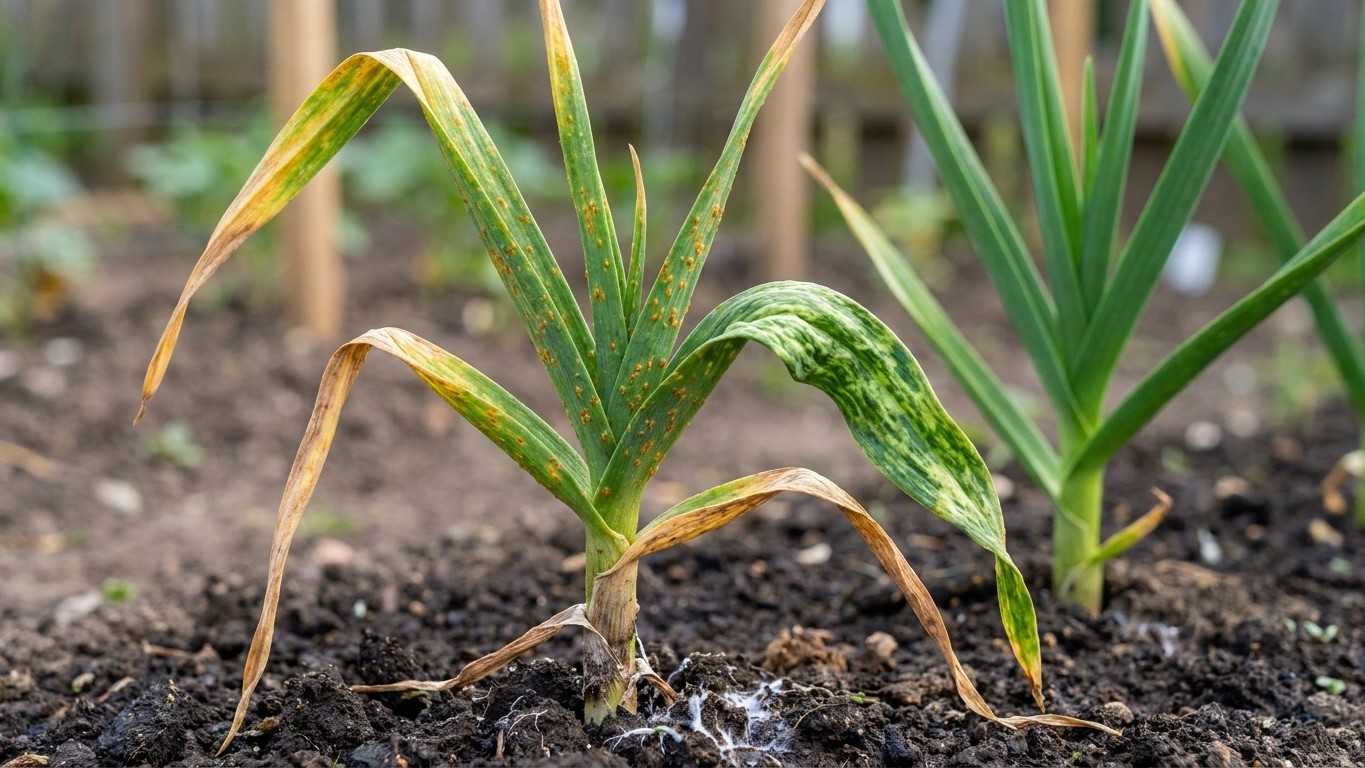

Garlic rarely tells you what’s wrong in words. It tells you in yellow tips, mushy roots, orange dust on the leaves, or a bulb that falls apart in your hand at harvest. Reading those signs correctly, before reaching for any fix, saves a crop and a season. Here’s how to sort what you’re seeing into the right category.
Start with what you can see

Most gardeners come to this question holding a leaf, not a diagnosis. That’s the right instinct. Garlic problems show up in a handful of predictable places, and where the damage appears narrows the list fast.
Leaf tips turning yellow or brown, working down from the top, usually points to water stress or a nitrogen shortfall, both growing conditions rather than a living organism. But scattered yellow streaking or mottling across the whole leaf, especially with a puckered or twisted look, suggests a virus, and viruses in garlic are usually already inside the seed clove before you ever planted it.
Orange or rust-colored pustules dusting the leaf surface are almost always rust, a fungus that spreads leaf to leaf and plant to plant in humid weather. White, cottony growth low on the stem near the soil line is a different fungus (white rot or a related soil pathogen), and it behaves nothing like rust: it doesn’t blow around on wind, it lives in soil and spreads through root contact and contaminated tools.
Stems that flop over early, before the plant has finished bulbing, can mean either overwatering root rot (a fungal problem) or simple heat stress pushing the plant into early dormancy (not a disease at all). The stem itself rarely tells you which. You have to check what’s happening underground.
Roots and the bulb base are where the two categories separate most clearly. Roots that are dark, slimy, and foul-smelling indicate active rot, a living pathogen doing damage right now. Roots that are simply thin, sparse, or dried out, with no discoloration or smell, point to a growing condition: heat, drought, or compacted soil limiting root development.
At harvest, bulbs that split their wrappers or show radial cracking are almost never disease. That’s a water story, usually a dry spell followed by heavy rain or irrigation late in bulbing. Bulbs that are undersized across the whole bed, with no visible spots or rot, often trace back to planting date, day length, or a nutrient the plant couldn’t take up, not a pathogen. But bulbs with soft, watery, or discolored cloves inside, especially with a smell, mean rot organisms got in, often through a wound or during curing in damp conditions.
The single distinction worth carrying through every one of these observations: does the cause spread to the next plant, the next bed, next year’s crop, or does it stay put unless the growing conditions repeat? Insects, fungi, bacteria, and viruses spread. Water, heat, light, and nutrient availability don’t jump from plant to plant. That difference decides everything about what happens next.
The ones that are not a disease at all
A surprising share of what gets called “garlic disease” in a quick search is nothing biological. It’s the plant reacting to how it’s being grown, and no product on a shelf changes that.
Yellow leaf tips are the most common false alarm. Garlic leaves die back naturally from the tip as the plant matures and redirects energy into the bulb. When that dieback happens early or unevenly across a bed, the usual driver is inconsistent watering: dry stretches that stress the plant, followed by heavy watering that the roots can’t process fast enough. The mechanism is simple water-supply mismatch, not infection. Evening out the watering schedule, and mulching to hold moisture steady, resolves it within a couple of weeks.
Bulb splitting works the same way. Garlic bulbs expand as cloves fill out, and the papery wrapper has limited stretch. A dry spell that slows growth, followed by a sudden soak, makes the bulb swell faster than the wrapper can handle, and it splits. It’s a mechanical response to water timing, not a growing defect and not a pathogen. Split bulbs still store shorter than intact ones, but they’re not diseased.
Heat is another frequent stand-in for disease. Garlic bulbs when temperatures run high during bulb formation, or when day length triggers bulbing before the plant has built enough leaf mass. The result is undersized bulbs, sometimes with only a few cloves, and gardeners often assume something attacked the crop. Nothing did. The plant simply didn’t have the resources or the growing window it needed.
Nutrient problems are more nuanced than “missing” nutrients, and this is where a lot of misdiagnosis happens. Garlic showing yellowing that looks like nitrogen deficiency isn’t always short on nitrogen in the soil. Compacted, waterlogged, or overly acidic soil can block roots from taking up nitrogen that’s technically present. The soil test says one thing, the plant shows another, because the limiting factor is uptake, not supply. Loosening compacted soil or correcting pH does more than adding fertilizer in these cases.
None of these four (uneven water, splitting, heat stress, uptake-blocked nutrients) spreads to neighboring plants or carries into next year’s soil. That’s the practical test: if the same symptom doesn’t show up in a plant given different conditions nearby, it’s a growing condition, not disease.
When it is worth acting, and when it is not
Not every mark on a garlic leaf deserves a response, and treating everything the same way wastes effort on problems that were never going to cost you anything.
Some damage is purely cosmetic. Minor leaf tip dieback late in the season, when the plant is already finishing its cycle, doesn’t reduce bulb size or storage quality. Late-season rust that appears after bulbing is essentially complete falls in the same category: unattractive, harmless to the harvest already underway.
Some damage is already done by the time it’s visible. White rot and stem and bulb nematodes both work underground, out of sight, until the bulb is undersized or rotting at harvest. By the time you see the result, the growing season’s outcome is fixed. What matters at that point isn’t this year’s crop, it’s next year’s: these organisms persist in soil for years, so the useful response is rotating away from that bed and avoiding garlic and onions there for several seasons, not treating the current plants.
A few problems do reward acting immediately, mainly the fast-spreading fungal issues caught early. Rust that appears while leaves are still actively growing, or the white cottony growth at the stem base, both spread through the bed while the season is still in progress. Removing and isolating affected plants promptly, and avoiding working in the bed when foliage is wet, limits how far they travel to healthy neighbors. That’s a timing decision, not a treatment decision.
The reasoning that ties this together: ask whether the cause is still active and spreading, whether it already finished its damage before you noticed, or whether it never threatened the yield at all. That answer, more than any product, tells you what to do next.
Match the Symptom to the Cause
Garlic tells you what went wrong if you know where to look. If a scape has pushed up sooner than you expected, that’s not automatically bad news — see what an early scape actually means for the bulb below before you worry. At harvest, a smooth bulb with no seams under the wrapper is a different story, and why a bulb grows as one round clump instead of dividing traces it back to cold exposure. Undersized harvests generally aren’t one mistake but several stacked together, which is why the four factors behind small bulbs is worth checking against your season. A wrapper that’s torn open along the clove lines has its own explanation, covered in why bulbs split before you lift them. Once bulbs are in storage, a green shoot at the clove tip means dormancy broke early — see what went wrong at curing for the cause. And before you diagnose anything from yellow leaves, check whether that yellowing is normal ripening or a real problem.