
Apples grow in Alberta, but only the cultivars bred for prairie winters make it through most years. Environment and Climate Change Canada’s 1981-2010 climate normals put the mean daily minimum of the coldest month at -13.2 °C at the Calgary Int’l A station, and that number is the first filter any apple tree has to pass before you plant it. Check the cold-hardiness rating printed on the nursery tag or catalogue page against that figure before you buy anything, not the fruit description.
Which varieties suit this climate

A lot of the apples sold in big-box garden centres, Honeycrisp, Gala, Fuji, come out of breeding programs built for milder winters than Calgary’s. Planted here, they die back hard most years and rarely settle into a productive shape. The -13.2 °C mean daily minimum recorded for Calgary’s coldest month by Environment and Climate Change Canada’s 1981-2010 normals is the benchmark to hold any candidate variety against, and it rules most commercial dessert apples out on paper before you even get to flavour or ripening date.
What survives that filter is a short list of cultivars bred specifically for the Canadian prairies: ‘Goodland’, ‘Norland’, ‘Parkland’ and ‘September Ruby’, a selection covered in more detail in this Alberta apple Best varieties guide. All four came out of prairie fruit breeding work aimed at exactly this problem, cold hardiness first, dessert quality second, and their published hardiness ratings sit at the extreme end of what a home apple tree is asked to survive in North America.
Winter chill is a separate question from hardiness
Hardiness tells you whether the tree survives the winter. Winter chill tells you whether it flowers properly the following spring, and it is a different number entirely. A low-chill variety bred for the Deep South, dropped into a long, cold prairie winter, does not fail to flower. It flowers thin and ragged because the chill accumulation pattern it expects never matches what it gets. Alberta sits firmly at the long-chill end of the spectrum: winters here are long and consistently cold enough that chill requirement is rarely the limiting factor, hardiness is. Tracking how a tree moves through dormancy, bloom and fruit set here is easier with The Alberta Apple Calendar, Stage by Stage, and it’s one more reason the low-chill southern cultivars sold in some catalogues have no place here, whatever their fruit looks like on the tag.
| Variety | Typical ripening | Notes |
|---|---|---|
| ‘Goodland’ | Late summer | Prairie-bred, dessert use, moderate keeper |
| ‘Norland’ | Early to mid summer | Early prairie apple, tart, good for sauce |
| ‘Parkland’ | Late summer | Small to medium fruit, reliable bearer |
| ‘September Ruby’ | Early fall | Deep red skin, dessert quality |
None of these are the apples you see boxed in a supermarket produce aisle, and that is the point. Growers in coastal British Columbia work from a completely different list, because Growing Apples in British Columbia: Varieties, Timing and Frost Risk covers a climate mild enough to run some of the low-chill and moderate-chill dessert varieties that would flower badly on the prairies. Where no Alberta-specific source names varieties beyond the general prairie-breeding list, treat any other cultivar as unproven here until you have seen it fruit in a garden near you.
Planting a pair that works here
Apples need cross-pollination from a second tree, and the second tree has to flower at the same time and carry fertile pollen. A single ‘Goodland’ planted alone will bloom and drop most of its flowers unset. Pair it with ‘Norland’ or ‘Parkland’, both of which bloom in the same general window on the prairie breeding schedule, and you get the overlap that a solitary tree cannot provide.
Where space is tight, a hardy flowering crabapple works as the second tree instead of a full-size cultivar. Crabapples bred for prairie conditions bloom heavily, carry viable pollen, and take up less room than a second full apple tree, which is why they turn up so often as the pollen partner in prairie orchard plans rather than as a second dessert variety.
One warning worth repeating here rather than assuming you already know it: some apple cultivars carry sterile pollen and cannot pollinate anything, even though they take pollen from other trees perfectly well and fruit heavily themselves. Check the pollen status of any variety before you buy it as your “second tree,” because a garden with two sterile-pollen trees produces flowers and no apples at all, however healthy the trees look.
The frost that costs a crop here

Environment and Climate Change Canada’s 1981-2010 climate normals put the mean last spring frost at Calgary Int’l A on May 21, and the mean first fall frost at the same station on September 16. Both are means, not safe cutoff dates. By definition, in roughly one year out of two the actual frost falls later than May 21 in spring or earlier than September 16 in fall, and stations north or upland of Calgary generally run weeks behind these figures again. Treat both dates as the midpoint of a window, not a promise.
Why a late frost costs the whole crop, not just some fruit
The stage that matters most is not the calendar date but what the buds are doing. Once a flower bud has opened enough to show pink, and especially once it is fully open in bloom, a hard frost kills the flower tissue itself. The tree survives fine. The wood, the leaves, next year’s growth, none of it is damaged. What is gone is this year’s crop, because a killed flower cannot set fruit no matter how good the summer that follows turns out to be.
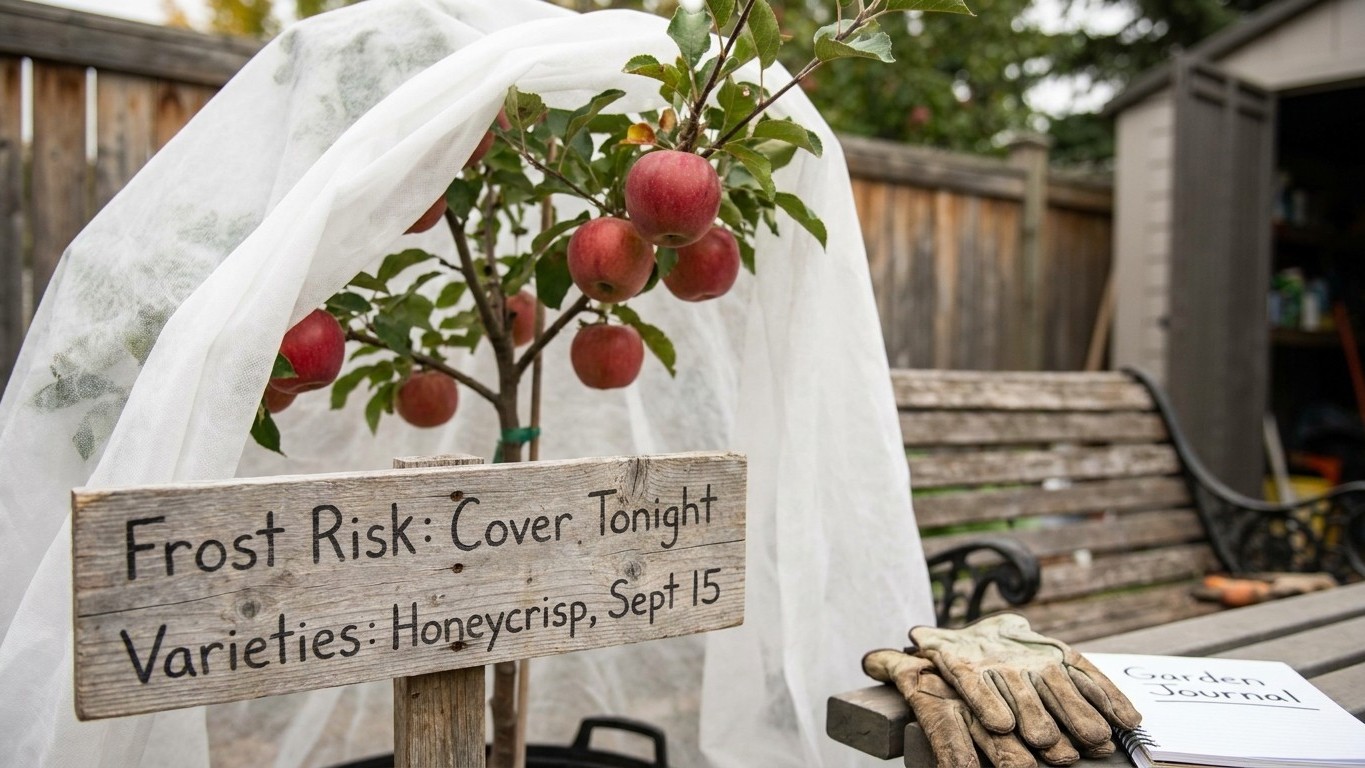
There is not much a home grower can do about a hard freeze across an open orchard, but small measures help on the marginal nights: covering a young or espaliered tree with row cover or an old sheet overnight when frost is forecast during bloom, or running a sprinkler through the coldest hours on a larger planting to keep bud temperature from dropping as far. The more durable protection is timing built into the variety itself. A cultivar that blooms later in the season, checked against the nursery’s own bloom-date listing, spends less time sitting in the risky window around that May 21 mean and is the real hedge against a frost that arrives after the mean date, which growers further north or at higher elevation should expect more often than a Calgary-based average suggests. Growers working an even shorter, colder season, as covered in Growing Apples in Alaska: Varieties, Timing and Frost Risk, face the same problem in a more extreme form and lean even harder on late bloom and site selection.
The apple year in Alberta
Dormancy through fruit set
Through winter and into early spring the tree sits dormant, and this is when to prune, while the wood is still hard and the tree cannot bleed sap or invite disease into a fresh cut. As days lengthen and warm, buds swell and separate into green tip, typically well before the region’s May 21 mean last-frost date at Calgary, since bud movement follows accumulated warmth rather than the calendar itself.
Pink stage follows, when the flower bud shows colour before opening, and this stage often falls right inside the frost-risk window discussed above. This is the point to start checking overnight forecasts closely rather than trusting an average date. Bloom itself needs both trees flowering together, which is why the pairing choices from the section above matter as much as variety selection does. Petal fall marks the end of the pollination window, and fruit set follows within days as the ovary of each successfully pollinated flower begins to swell.
Harvest
Prairie cultivars generally ripen from midsummer into early fall depending on the variety, and the goal is to get fruit off the tree before the season’s mean first fall frost, September 16 at Calgary Int’l A per Environment and Climate Change Canada’s normals, since a hard freeze on the fruit itself softens flesh and shortens storage life even where it does not outright ruin the crop. Checking a specific variety’s typical ripening window against that date, and picking early if a cold snap is forecast, matters more on the prairies than in a longer, milder growing season.
Local help
For a fuller list of cultivars documented to perform in Alberta conditions, and for spray timing suited to local pest and disease pressure, contact Alberta’s Ministry of Agriculture and Irrigation. Provincial staff can also point you toward test plots or demonstration orchards closer to your own district than the Calgary station.
Common questions
Can I grow Honeycrisp or Gala in Alberta?
Not reliably outdoors in most of the province. Their published cold-hardiness ratings do not cover a mean coldest-month minimum as low as the -13.2 °C Environment and Climate Change Canada records for Calgary, and trees planted anyway tend to suffer repeated dieback rather than settling into a bearing shape.
Do I actually need two different apple trees?
Yes, in almost every case. Apples need cross-pollination from a second tree flowering at the same time, and even the rare partly self-fertile cultivar sets a heavier, more reliable crop with a second tree or a hardy flowering crabapple nearby.
What if the frost comes after May 21 where I live?
That is expected roughly half the time, since May 21 is a mean date from Environment and Climate Change Canada’s 1981-2010 normals, not a cutoff. Districts north of Calgary or at higher elevation should plan on the frost window running later still.
Can I grow apples in northern Alberta or at higher elevation?
Check with Alberta’s Ministry of Agriculture and Irrigation for anything documented closer to your own location.
How long until a newly planted tree bears fruit?
Most nursery stock takes a few years to bear a meaningful crop, and prairie cultivars are no exception, so plan for patience rather than fruit in the first season or two regardless of how well the tree establishes.