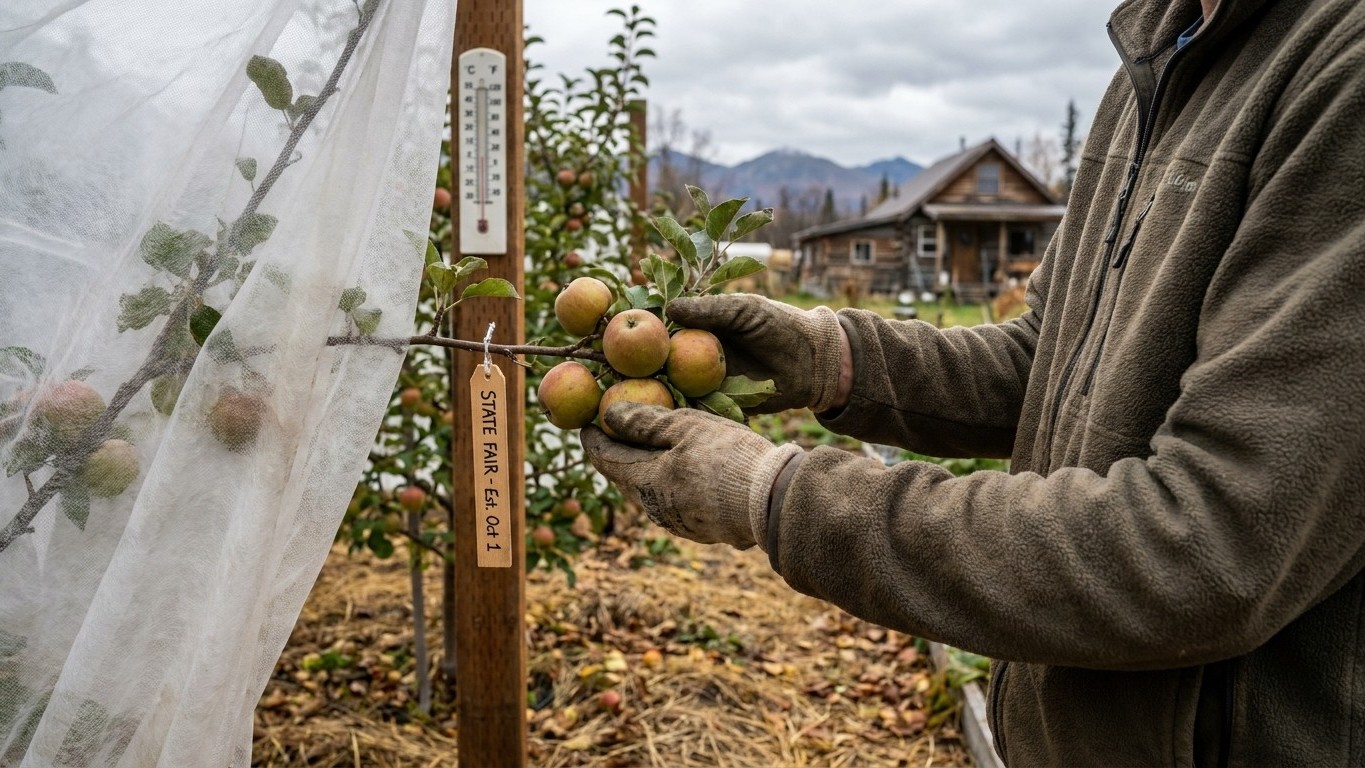

Anchorage’s coldest month averages 11.1°F for its daily low, a figure mild enough for zone 3 apples and some zone 2 ones to overwinter without any wrapping or mounding. That’s the difference nobody mentions when they wave at Alaska’s official hardiness range of zone 1a to zone 8a: the statewide number is nearly meaningless, but the station reading near your own yard tells you almost everything. Southcentral, from Anchorage down through the Kenai and the Mat-Su, is where that math actually works.
Can you grow apples in Alaska
Yes, in the right part of the state and with the right tree. The USDA Plant Hardiness Zone Map, 2023 edition, built on 1991-2020 normals, puts Alaska across an enormous span, from zone 1a in the coldest interior valleys to zone 8a on parts of the southern coastal panhandle. That range is too wide to mean anything for a single garden, so the number that matters is the one measured close to where you’re planting. At the Anchorage reference station, NOAA’s NCEI 1991-2020 climate normals record the coldest month’s average daily minimum at 11.1°F, a winter mild enough for zone 3, and many zone 2, apple cultivars to survive without special protection.
Southcentral Alaska, the band running from Anchorage south through the Kenai Peninsula and Mat-Su Valley, is where most of the state’s home apple growing happens. Longer daylight through the growing season helps offset the short frost-free window: the tree gets fewer days above freezing than a grower in the Lower 48 would expect, but each of those days delivers more hours of light for photosynthesis. That combination is why hardy apples fruit here at all despite a winter that would kill a peach or a sweet cherry outright, and picking the right cultivar for this window is covered in Alaska apple Best varieties, while the Alaska apple Calendar lays out what to do season by season once that cultivar is in the ground.
Where it gets harder
Move away from the coast and the picture changes fast. The Interior around Fairbanks and the valleys further north sit in much colder USDA zones, and a cultivar that survives an Anchorage winter can still die in a Fairbanks one. If you garden outside Southcentral, treat the Anchorage figures above as a starting comparison, not a local forecast, and check your own winter minimums before committing to a cultivar rated for zone 3.
The other filter, separate from cold survival, is whether the tree gets enough winter chill to break dormancy evenly and flower well in spring. Alaska’s winters supply chill in excess almost everywhere apples are grown, so that isn’t the constraint here the way it is in warmer states. A grower in California’s Central Valley faces the opposite problem, not enough chill for a northern cultivar, a subject covered in Growing Apples in California: Varieties, Timing and Frost Risk. In Alaska the concern runs the other way: a cultivar bred for a short, mild Southern winter may break dormancy on an early warm spell and then get caught by a hard freeze that follows.
Which varieties suit this climate

Start from hardiness, not flavor. Cultivars bred on the Canadian prairies and in the northern Midwest, where winters run as cold as or colder than Anchorage’s, are the ones nurseries rate for USDA zone 2 or zone 3, and those names show up again and again in Alaska gardens: ‘Norland’, ‘Parkland’, ‘Rescue’, ‘Trailblazer’, ‘Heyer 12’ and the crabapple ‘Dolgo’. All are diploid, disease-tolerant selections developed for short, cool growing seasons rather than for size or storage life.
Household names like Honeycrisp, Gala and Fuji, the backbone of commercial orchards in Washington State (see Growing Apples in Washington: Varieties, Timing and Frost Risk), are rated for zone 4 or 5 at best and expect a longer, warmer season than Southcentral Alaska provides. They can survive a mild Anchorage-area winter in a sheltered yard, but they rarely ripen a full crop before the season ends.
The second filter: winter chill
Hardiness tells you whether the wood survives January. Winter chill, the accumulated hours of cold a tree needs before it will break dormancy on schedule, is a separate question, and Alaska sits at the opposite end of that scale from where most chill guidance is written. Southern growers worry about not getting enough cold for a high-chill tree. In Southcentral Alaska the chill requirement of almost any apple cultivar is met well before the ground even thaws, so the risk runs the other direction: a low-chill Southern selection can finish its chill requirement in midwinter and start swelling buds during a January warm spell, only to be killed back when the cold returns. Sticking to the northern-bred cultivars named above avoids that trap.
Where you can’t find a documented local recommendation, treat catalogue hardiness and chill ratings as your filter, and confirm locally before planting a cultivar not already common in Southcentral gardens.
| Variety | Type | Published hardiness | Bloom timing |
|---|---|---|---|
| ‘Norland’ | Eating apple | Zone 2 | Early |
| ‘Parkland’ | Eating apple | Zone 2 | Early |
| ‘Rescue’ | Eating apple | Zone 2 | Early to mid |
| ‘Trailblazer’ | Eating apple | Zone 3 | Mid |
| ‘Dolgo’ | Crabapple, pollinizer | Zone 2 | Early |
Planting a pair that works here
Almost no apple variety pollinates itself reliably. Plant two trees that flower at the same time, and make sure at least one of them produces fertile pollen, or you’ll get blossom and no fruit.
Among the cultivars that suit Southcentral Alaska’s winters, the practical pairings are straightforward because most of them bloom early and close together. ‘Norland’ and ‘Parkland’ flower within the same window and are a common backyard pairing in Anchorage-area gardens. Where space allows only one full-size eating apple, the crabapple ‘Dolgo’ works as a second tree: it blooms early, produces abundant fertile pollen, and its small fruit is usable for jelly even if you never eat one off the tree.
The sterile-pollen trap
Some apple cultivars, mostly larger commercial dessert varieties bred for size and storage rather than for the home orchard, carry an extra set of chromosomes and produce little or no viable pollen of their own. A tree like that still needs a pollinizer, but it can’t serve as one itself. None of the hardy cultivars named above are documented as this type, but if you add a variety you haven’t grown before, check the nursery tag for a note on ploidy or pollen fertility before assuming it can pollinate its neighbor.
Bees do the actual work, and Southcentral Alaska’s cool, often damp early summer can limit their flying days during the short bloom window. Planting the two trees close together, within about 50 feet, and avoiding wind-exposed sites, gives the bees less distance to cover on the good days.
The frost that costs a crop here

The frost that matters most to an Alaska apple grower isn’t the hard freeze that kills a tender annual. It’s the light freeze that arrives after the buds have opened into the pink stage or into bloom.
At the Anchorage reference station, NOAA’s NCEI 1991-2020 climate normals put the last spring freeze at 32°F in the window of May 3 to May 12, based on the 30-70% freeze-probability band. That’s a range, not a date: some years the last freeze lands at the early edge, some years at the late edge, and a garden in a cold pocket nearby can run later than the reference station.
Why the tree survives but the crop doesn’t
A freeze at green tip does little damage. A freeze once the buds show pink, and especially once the blossoms are open, kills the flower tissue itself while leaving the woody structure of the tree completely unharmed. The tree leafs out fine, looks healthy all summer, and simply carries no fruit, because the flowers that would have become apples were already dead before they had a chance to set. This is the single most common way a home orchard in Southcentral Alaska loses an entire year’s crop without the grower realizing anything happened until harvest never comes.
There is no way to warm an entire orchard on a frost night, but a few things narrow the risk on a small planting:
- Cover small trees with frost cloth or a bedsheet on a night when a freeze is forecast during bloom.
- Site trees on a slight slope or the high side of the yard, since cold air pools in low spots on a still night.
- Delay pruning cuts that would push earlier bloom, and hold off on heavy spring nitrogen for the same reason.
The more durable fix is variety choice. A cultivar that blooms later in the local sequence, such as ‘Trailblazer’ compared with the earlier-flowering ‘Norland’ and ‘Parkland’, has a better chance of opening its blossoms after the last-freeze window has closed rather than during it. Where the local freeze window runs into mid-May the way it does at the Anchorage reference station, a few days of later bloom is the margin that saves the crop most years.
The apple year in Alaska
Every stage below is keyed to the Anchorage-area frost dates from NOAA’s NCEI normals, not to a calendar month, because a warm or cold spring shifts the whole sequence by a week or more in either direction. Southcentral Alaska’s frost-free window runs about 143 days at the Anchorage station, so the entire green-tip-through-harvest sequence has to fit inside a season a little less than five months long.
Dormancy
From fall leaf drop through winter, the tree needs no attention beyond a wrap or guard against browsing moose and vole damage at the base. This is also the window for structural pruning, done while the tree is fully dormant and before any sap movement.
Green tip to pink
As days lengthen and soil warms, buds swell and show green, then pink, tissue. This stage typically arrives in the weeks before the last-freeze window closes, so it usually runs through late April into early May in Southcentral Alaska. Pink bud is the point to start watching the forecast closely, because the flower tissue inside is now exposed to freeze damage.
Bloom and petal fall
Full bloom follows pink by a matter of days and, in most years, lands close to or just after the Anchorage last-freeze window of May 3 to May 12 recorded by NOAA’s NCEI normals. This is the highest-risk stretch of the whole season: a freeze now costs flowers, not wood. Petal fall marks the end of the frost-sensitive window for that year’s crop.
Fruit set and summer growth
Small fruit swell through the long daylight of June and July. Thin overcrowded clusters to one or two fruit each if you want larger apples rather than a heavy set of small ones, standard practice on any hardy cultivar.
Harvest
Early-season cultivars like ‘Norland’ and ‘Parkland’ color up in late summer, well ahead of the first fall freeze that NOAA’s NCEI 1991-2020 normals place at September 22 to October 1 for the Anchorage area. Pick before a hard freeze rather than after: a light frost on the tree does little harm to the fruit, but a hard freeze followed by a thaw softens it fast.
Local help
For variety trial results and spray timing specific to your part of the state, the University of Alaska Fairbanks Cooperative Extension Service, the USDA-recognized land-grant extension for Alaska, is the resource to check before you plant or spray. Contact the UAF Cooperative Extension Service for district office contacts and current publications, since recommendations differ between Southcentral, the Interior and Southeast.
Common questions
Will a Honeycrisp tree survive in Anchorage?
It may survive a mild winter in a sheltered spot, but survival isn’t the same as a good crop. Honeycrisp is rated for a warmer, longer season than Southcentral Alaska reliably provides, so expect thin fruit set and slow ripening even in a year the tree comes through fine.
Why did my apple tree bloom heavily but set no fruit?
The most common causes are a missing or mismatched pollinizer, a sterile-pollen variety planted alone, or a cold, wet bloom week that kept bees from flying. Check first whether you actually have two different cultivars flowering at the same time, not just two trees of the same variety.
Is the Alaska Interior around Fairbanks too cold for apples?
The Interior sits in much colder USDA zones than Southcentral. Treat any cultivar rated for zone 2 as a trial rather than a sure thing there, and start with one tree in a warm microclimate before planting more.
How long until a newly planted apple tree bears fruit?
Most hardy cultivars sold as young whips take a few years of establishment before the first real crop, and a short, cool growing season can stretch that further. Don’t judge a tree’s suitability off its first bloom or two.
Can I grow an apple tree in a container and bring it inside for winter?
You can, but it usually backfires. Apple trees need their winter dormancy and cold exposure to flower properly the following spring, and moving one into a heated space partway through winter can disrupt that cycle rather than protect the tree.