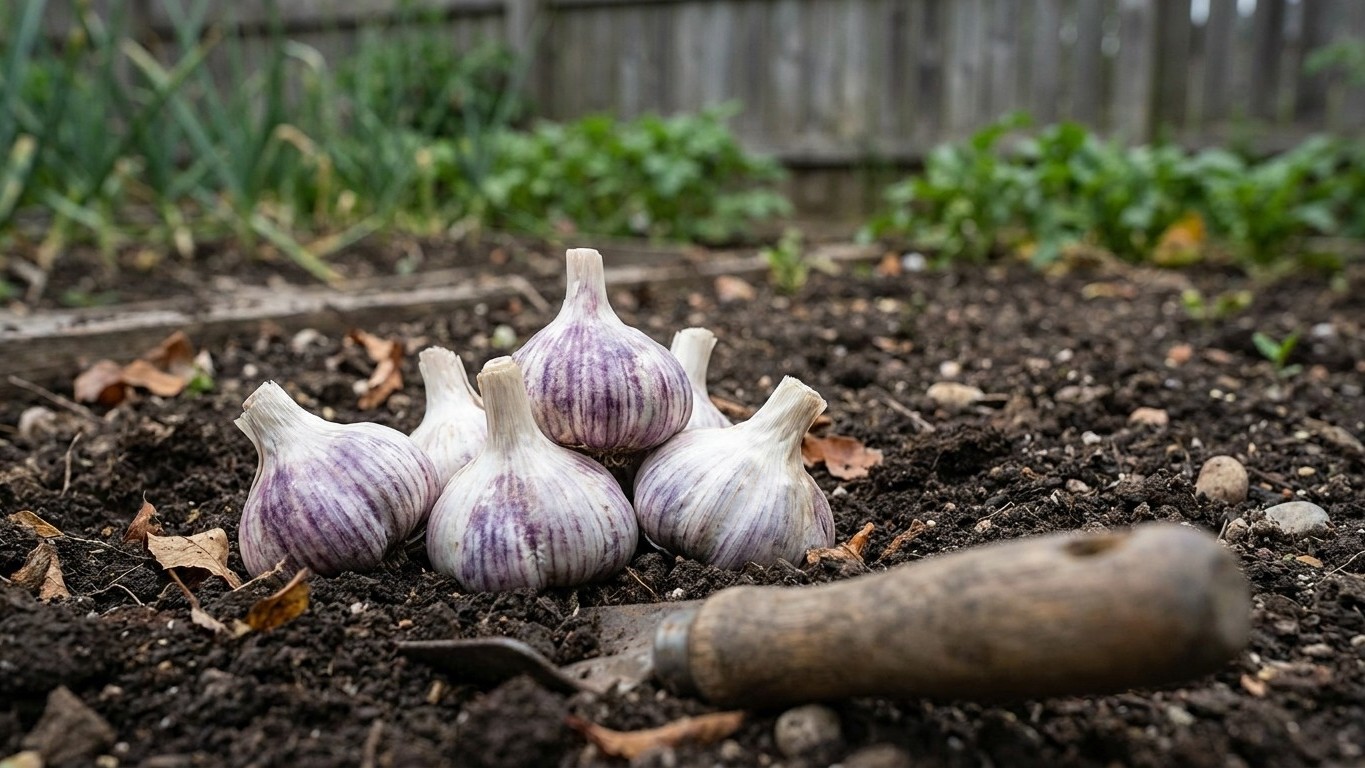

Blue Music is a Porcelain hardneck garlic, grown for its big plump bulbs, easy-peel cloves and a smooth, mild flavor with enough richness for everyday cooking without overpowering heat. It needs a real run of winter cold to split into separate cloves at all, and where that cold doesn’t show up reliably, it just won’t divide the way it should. Check your winter’s typical stretch of weather below 40°F against your seed source’s chilling recommendation before you order stock, and if you garden somewhere mild, plan now to either refrigerate cloves before planting or choose a softneck instead.
What Blue Music actually is

Blue Music belongs to the Porcelain group, the same family as Music and German White, and it is a true hardneck: a rigid central stalk called a scape pushes up in early summer and forces the plant to put its energy into a handful of large cloves rather than dozens of small ones. Catalogue descriptions typically list Blue Music at four to six plump cloves per bulb, wrapped in a smooth white skin often washed with a faint blue-gray blush, which is where the name comes from.
The flavor, per most seed catalogue descriptions, is hot and full-bodied raw, mellowing into a rich, almost sweet flavor once roasted, a profile typical of Porcelain types and one of the reasons cooks seek them out over milder softnecks. Cloves peel easily thanks to their size, a genuine advantage at the cutting board.
Storage is the tradeoff. Porcelain hardnecks keep for a few months in a cool, dry spot but nowhere near as long as a softneck braid will hold, so treat a Blue Music harvest as something to work through in fall and early winter rather than stock meant to last a full year. If you want to see how it stacks up against other hardnecks and softnecks before committing a bed to it, the Garlic Varieties guide lays out those tradeoffs by group.
What Blue Music tastes like, and what to do with it
Porcelains have a reputation for punch — the same rigid scape that limits a hardneck to a handful of fat cloves also tends to concentrate flavor into something sharp and lingering raw. Blue Music doesn’t follow that script. Its flavor comes through smooth and mild, with enough richness to carry a dish but none of the overpowering heat the family is known for. That’s worth taking at face value rather than assuming it splits the difference with its hotter porcelain relatives: this is a variety that breaks from type, not one that averages out to “medium.”
What that means at the counter is straightforward. Where a fiery porcelain needs to be tamed — cooked down, roasted, or used sparingly to avoid dominating a dish — Blue Music’s cloves can go in raw or lightly cooked without the sting. Mince it into a dressing, work it raw into a compound butter, or finish a sauce with it off the heat, and the garlic flavor stays present but doesn’t take over. That makes it a better match
Will it get the cold it needs where you are
Garlic is not like a tomato that just needs warmth to ripen. A hardneck clove has to sit through a real stretch of cold once it’s in the ground or it never splits at all: you dig up one smooth, round bulb instead of a head of cloves. Porcelain types such as Blue Music sit on the demanding end of that scale, generally wanting somewhere close to six weeks with temperatures staying below 40°F before the clove will divide properly. That threshold is what to check against your own winter before you order seed stock.
| Territory | Station | Limiting factor | What it means for Blue Music |
|---|---|---|---|
| California | Los Angeles | 0 weeks below 40°F (6 needed) | Cloves won’t split without pre-chilling |
| Texas | Houston | 0 weeks below 40°F (6 needed) | Same shortfall; refrigerate cloves or switch type |
| Florida | Jacksonville | 0 weeks below 40°F (6 needed) | Same shortfall; refrigerate cloves or switch type |
| Prince Edward Island | Charlottetown | 1,569 growing degree-days | Cold is plentiful; season heat is tight, use an early type under plastic mulch |
| Alaska | Anchorage | 917 growing degree-days | Not enough cumulative warmth for a full-season Porcelain outdoors |
| Nunavut | Rankin Inlet | 159 growing degree-days | Outdoor bulbing unrealistic without a tunnel or greenhouse |
In much of the warmest tier of the country, the needed cold simply doesn’t arrive. California‘s Los Angeles station, Texas‘s Houston station and Florida‘s Jacksonville station all run through winter with effectively zero weeks below 40°F, and Louisiana’s New Orleans station shows the same pattern. Hawaii’s Honolulu station and Arizona’s Phoenix station fall into the same camp for a different reason: sustained cold simply never settles in at all. In every one of these places, Blue Music will grow, root and leaf out just fine, it just won’t build a divided head unless you intervene.
The fix in those states is not to give up on garlic, it’s to change what you plant or how you plant it. Refrigerate the cloves for several weeks before setting them out, which tricks the plant into behaving as though it already had its winter, or grow a softneck from the Artichoke or Silverskin groups instead, since those types ask for far less chill and are the sensible pick anywhere a reference station shows this kind of shortfall. Growers weighing Blue Music against another cold-hungry hardneck should know that Purple Stripe types like Chesnok Red face a similar demand for real winter, so the same warm-climate workarounds apply.
At the cold end of the country, chilling is not the limiting factor. Prince Edward Island, Alaska, Alberta and Nunavut all deliver plenty of weeks below 40°F, sometimes for months at a stretch. Their limit instead is cumulative heat across the whole growing season, measured in growing degree-days rather than chill hours, as the table above shows. A high tunnel or unheated greenhouse that adds warmth without removing the winter chill is what makes a full bulb possible that far north, particularly in Territories like Nunavut where degree-day totals fall well short of what a full-season Porcelain needs to bulk up properly.
When to put the cloves in
Garlic goes in the ground in fall and comes out the following summer, and the exact week depends entirely on how fast your ground freezes, not on a date circled on a calendar. The goal is to let the clove grow enough root to anchor itself before winter locks the soil, without pushing so much top growth that a hard freeze burns it back. That means working backward from your area’s first fall frost rather than picking a fixed day.
In the coldest territories, set-out happens early because the freeze arrives early. Growers near Whitehorse in the Yukon plant in early August for a mid-April first harvest the following year; those near Calgary in Alberta, and near Yellowknife in the Northwest Territories, both go in around late August for a bulb lifted in early May. Prince Edward Island, at the Charlottetown station, plants later still, in late September, since its frost arrives later in the season.
Warmer regions run the calendar in nearly the opposite direction, planting later in the year because the ground stays workable and frost-free for longer. Growers near Houston, Texas set out from early to late November for bulbs ready by early August, and the Jacksonville, Florida and New Orleans, Louisiana stations follow a similar pattern, with New Orleans running from late November into mid December.
Sources genuinely disagree on how early is too early. Some extension services push for planting close to the First Frost so top growth stays minimal over winter, while others favor a few extra weeks of root time even if a leaf tip shows before freeze-up, reasoning that a plant with more root mass generally outperforms one that went in too late. Check your state or provincial extension service for its specific recommended window rather than splitting the difference yourself, since the right call depends on how wet and how cold your particular soil runs in early winter.
Hardneck or Softneck: what this one asks of you
Blue Music is a hardneck, full stop, and that decides a lot about how the season runs. A hardneck sends up a rigid flowering stalk called a scape in early summer, and that scape needs to be cut off while it’s still curled, usually before it straightens out, so the plant puts its energy into the bulb instead of the stalk. Skip that step and you’ll still get a harvest, just a smaller one.
Hardnecks like Blue Music also trade quantity for size: expect four to six large cloves per bulb rather than the dozen-plus small ones a softneck produces. Those big cloves peel easily, which is the tradeoff cooks like, but the bulbs don’t store as long and they can’t be braided the way a softneck’s pliable neck allows.
- Hardneck (Blue Music): produces a scape, fewer and larger cloves, easy peeling, shorter storage, needs real winter cold
- Softneck (Artichoke or Silverskin types): no scape, many small cloves, harder to peel, stores much longer, tolerates mild winters
That last line is the one worth sitting with. Hardnecks like Blue Music are built for places with a genuine winter, which is exactly why the cold requirement discussed above matters so much. If your climate can’t deliver that stretch of cold, no amount of good soil or feeding makes up for it, and a softneck is simply the better tool for the job. Growers comparing options across the Porcelain and Purple Stripe groups will find the same rule holds: these are winter-hungry types built for regions that actually deliver one.
Growing and curing it without losing the crop
Plant cloves root-down, pointed tip up, about two inches deep and six inches apart, in a bed that drains well, since sitting in wet soil over winter rots cloves before they even root. Mulch heavily right after planting, three to four inches of straw is typical, because an overwintered crop needs that layer to buffer freeze-thaw cycles in the soil, not just to suppress weeds the way it would on a spring-planted crop.
Reading the season
Once the scape appears in early summer, cut it and use it in the kitchen like a mild green garlic. Stop watering the bed a couple of weeks before you expect to lift, since wet soil right up to harvest stains the wrappers and invites rot in storage. The classic sign of readiness is the lower leaves browning while several upper leaves stay green, not the whole plant collapsing at once.
- Lower third to half of leaves brown and dry
- Upper leaves still green, not yet yellowing
- Wrapper skins on a test bulb feel tight, not loose
Lift with a garden fork rather than pulling by the stalk, which tears the wrapper and shortens storage life. Cure the whole plant, stalk and roots still attached, in a shaded, airy spot out of direct sun for a few weeks until the outer wrappers turn papery and the neck dries fully. Only then trim the roots and stalk and move bulbs into storage. Lifting too early or curing in direct sun both cost you the same thing: a bulb that looks fine at harvest but shrivels or rots within weeks in the pantry.
Common questions
Can I plant Blue Music garlic in spring instead of fall?
You can, but the bulbs usually come up small and often undivided, since spring planting skips the long cold stretch the clove needs to split. Spring planting only really works if you pre-chilled the cloves in a refrigerator for several weeks first, mimicking the winter they missed.
Why did my Blue Music bulbs come up round with no cloves inside?
That’s a classic sign of insufficient chilling, the same problem covered above for warm-winter states. The clove sprouted and grew a leafy plant but never got the cold signal to divide, so it just grew fatter as one round bulb instead of separating into cloves.
Is Blue Music different from regular Music garlic?
Both are Porcelain hardnecks with similar culture and similar cold needs, and catalogue descriptions differ mainly on wrapper color, with Blue Music showing more of a blue-gray blush on the outer skin compared to the plain white of standard Music. Growing conditions and timing for the two are effectively the same.
Can I plant garlic cloves from a grocery store bulb instead of buying seed stock?
You can try, but it’s a gamble. Grocery garlic is often treated to slow sprouting, may carry diseases not common in seed stock, and is rarely labeled by variety, so you won’t actually know if what you’re planting behaves like a Porcelain at all. Buying certified seed garlic from a supplier is the more reliable route if you specifically want Blue Music’s traits.