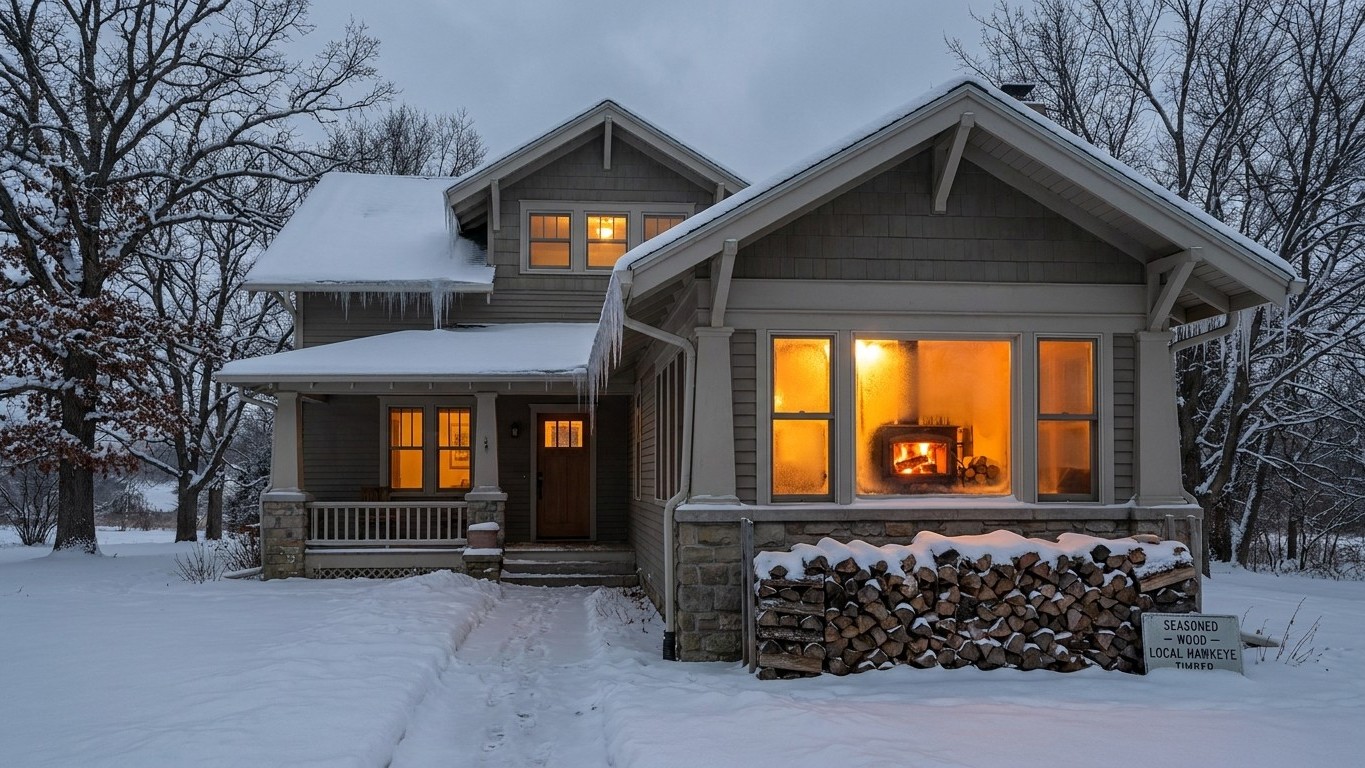

Winters in Iowa mean months of furnace runtime and, for a good share of households, a wood stove or fireplace insert doing real work. What that costs depends less on any single cold snap than on how long the cold sits, how dry your firewood really is, and how much heat a cord actually delivers once it’s burning.
How cold it gets, and for how long

In Des Moines, the coldest month averages a daily low of 13.8°F, according to NOAA’s 1991-2020 Climate Normals. That’s not the record low, and it’s not some abstract yearly average. It’s the typical overnight temperature during the harshest stretch of winter, and it’s the number that tells you how hard a heating system has to work, night after night, for weeks at a time.
Thirteen degrees isn’t brutal by Northern Plains standards, but it’s cold enough that a furnace or a wood stove doesn’t get a break. The heating season in Iowa typically runs from October through April, with the real strain concentrated from December through February. A house here isn’t dealing with one or two arctic blasts and then a thaw. It’s dealing with a sustained cold season where the thermostat rarely gets a rest, and where a wood-burning setup needs enough seasoned fuel on hand to carry through weeks, not days, of sub-freezing nights.
That distinction matters for anyone sizing a heating plan. A climate that sits near freezing for four straight months asks for steady, reliable output over a long haul. It’s a different problem than a short, sharp cold snap followed by milder weather, and it changes how much firewood, propane, or furnace capacity a household actually needs to get through to spring without running short in February, the month when reserves usually run thinnest.
What a cord of wood is worth here
A cord of well-seasoned hardwood delivers roughly 20 million BTU, according to Michigan State University Extension. That’s the figure worth memorizing before you buy anything, because a cord itself is a volume measurement, not a weight, and that’s exactly where firewood buyers get shorted. A cord is a stack measuring 4 feet by 4 feet by 8 feet, which works out to 128 cubic feet of stacked wood, air gaps included.
| Measurement | Value |
|---|---|
| Stack dimensions | 4 ft x 4 ft x 8 ft |
| Total volume | 128 cubic feet |
| Heat output (seasoned hardwood) | about 20 million BTU |
Density is the variable that decides how far that stack actually goes. Two cords of the same dimensions can hold very different amounts of usable heat depending on species, because denser wood packs more actual wood mass into the same 128 cubic feet, with less air between the pieces. That’s the whole trick behind buying firewood smart: volume tells you how much space it takes up, not how much heat it holds.
MSU frames that 20 million BTU figure in terms a homeowner can actually use: one well-seasoned cord of hardwood is roughly equivalent to 145 gallons of #2 fuel oil, or 215 gallons of LP gas. For an Iowa household stacking wood to get through a four-month heating season, that comparison is the fastest way to judge whether a wood stove is pulling its weight against a propane tank or a fuel oil delivery.
None of that holds if the wood isn’t actually seasoned. Green wood spends a large share of its potential heat just boiling off water trapped inside the cell structure, before it ever warms a room. A cord of unseasoned wood might carry the same 128 cubic feet of stacked logs, but a fraction of the deliverable heat, because so much of the fire’s energy goes into evaporation instead of warmth.
How long wood takes to dry in Iowa
Firewood needs to reach roughly 20 percent moisture content or lower before it burns efficiently, per Michigan State University Extension. Green wood, freshly cut, can carry over 60 percent moisture, meaning more than half its weight is water. Getting from one number to the other isn’t instant, and it isn’t the same everywhere. Humidity, summer heat, and airflow all decide how fast a stack actually dries.
Split green wood generally reaches that 20 percent target after one full summer of seasoning, provided it’s split and stacked properly, not left in rounds. Splitting exposes more surface area, and stacking with gaps lets air move through the pile instead of trapping moisture against the bark. Iowa’s warm, often humid summers can season wood over a single season if it’s handled right, but a pile of unsplit rounds tossed against a fence won’t dry evenly no matter how long it sits.
Red oak is the named exception worth knowing. MSU notes it dries more slowly than most hardwoods because of its cell structure, so wood buyers and cutters shouldn’t assume oak is ready on the same timeline as ash or maple. There’s no fixed number of months that applies across every species, every stack, and every yard. It depends on how the wood was split, how it was stacked, and how much sun and wind actually reach the pile.
Burning too soon has consequences beyond a weaker fire. Wet wood produces less usable heat because so much energy goes toward boiling off water instead of warming the house, but it also creates more creosote buildup in the flue. That buildup is the main driver behind chimney fires, and it means a stove burning unseasoned wood needs its chimney swept more often than one burning properly dried fuel. It’s not a dramatic risk if it’s caught early, but it’s a maintenance cost that traces directly back to firewood that went into the stove too green.
Where to check before you buy
Iowa spans a wide range of terrain and microclimates, and the figures above describe Des Moines specifically, the NOAA reference station for the state. Elevation, tree cover, and local exposure can shift both the cold-season numbers and which species are actually available for firewood in a given county.
For guidance tailored to a specific part of the state, including which hardwood species are commonly sold locally and how to judge a seller’s claims about seasoning, Iowa State University Extension and Outreach is the resource worth checking before any wood purchase.
Burn restrictions are also worth confirming locally. Some counties and municipalities set seasonal rules on open burning or wood-stove use during air quality alerts, and those rules aren’t fixed. They’re set at the local level and can change from year to year depending on conditions, so a call to the county extension office or local fire authority before burning season starts is a small step that avoids a fine or a wasted trip for wood that can’t legally be burned that winter.