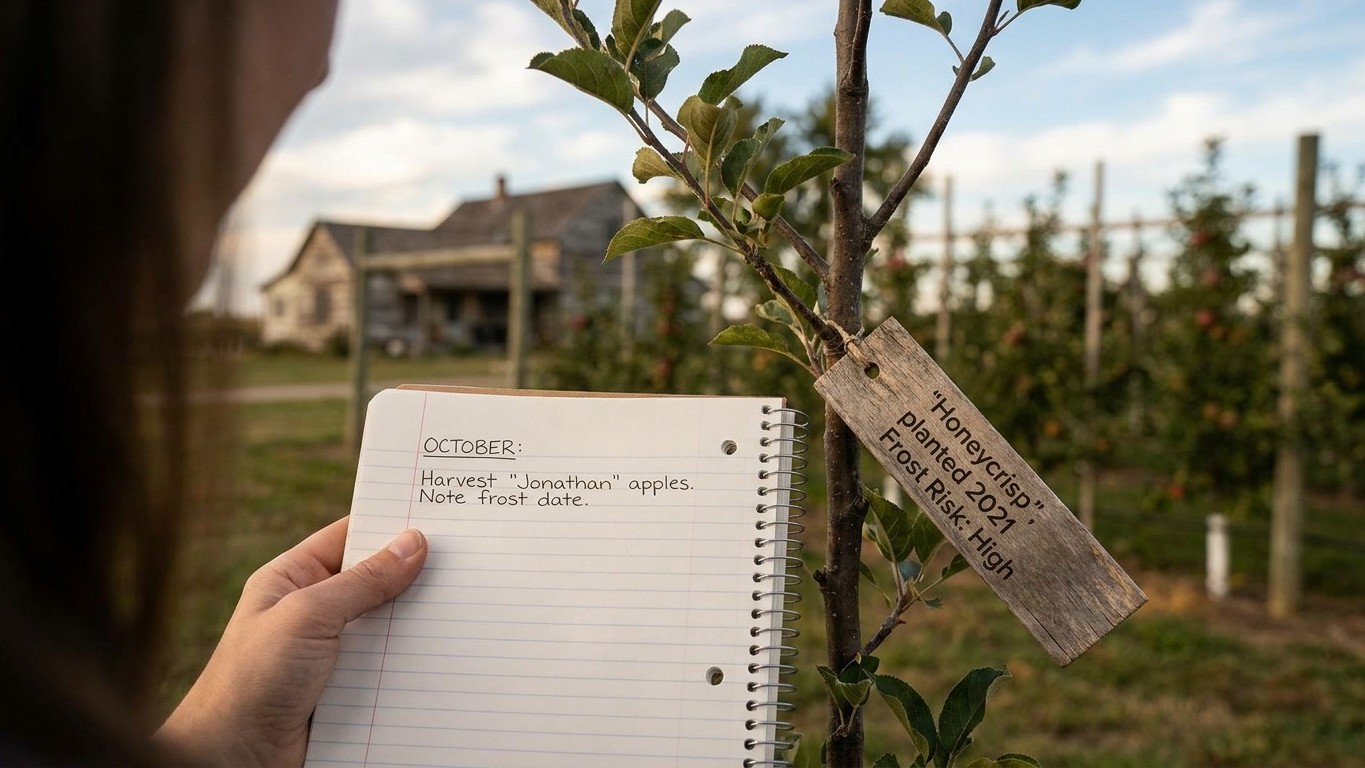

Kansas can grow apples almost anywhere in the state. USDA’s 2023 Plant Hardiness Zone Map, built on the 1991-2020 climate normals, places the state across zones 5b to 7a, well within the cold tolerance of standard orchard apple stock. The one decision that actually matters is timing: pick a variety that blooms after your area’s typical last spring freeze, since a hard freeze on open blossom, not winter cold, is what costs Kansas growers their crop most years.
Can you grow apples in Kansas
An April frost in the Flint Hills can strip a full bloom overnight, and the grower who planted a variety chosen for taste rather than timing loses the whole crop before June. It happens every few years to someone who picked trees off a nursery catalog without checking when they flower against Kansas’s last frost dates. The fix isn’t luck or a warmer year — it’s matching variety and site to this state’s particular swing between hard winters and early false springs, a rhythm laid out in The Kansas Apple Calendar, Stage by Stage.
Where in Kansas it’s easiest
The eastern third of the state, roughly the Kansas City to Wichita corridor and south into the Flint Hills, has historically supported the most orchard acreage, helped by slightly higher rainfall and less punishing wind than the High Plains. That doesn’t rule out the west. Western Kansas sits at the colder edge of the 5b to 7a range and often runs drier, so a western orchard needs supplemental irrigation and wind protection more than it needs a different hardiness rating.
What the numbers mean for your site
A hardiness zone and a coldest-month average are both regional averages, not a guarantee for any one yard. Low spots that collect cold air, exposed hilltops, and elevation changes of even a few hundred feet can shift the effective zone by half a step in either direction. Before ordering trees, check your own county’s conditions against the K-State Research and Extension resources, since a shelterbelt, a slope, or proximity to a pond changes the local picture more than the state map suggests.
Which varieties suit this climate

Once winter survival is settled, the second filter is chill: the number of cumulative hours between roughly 32°F and 45°F a tree needs each winter before it can break dormancy and bloom evenly. Get this wrong and the tree doesn’t die, it just blooms thin, late, or ragged, which is nearly as costly as losing the tree outright. This is where choosing from The Best Apple Varieties for Kansas makes the difference between a tree that merely survives and one that produces reliably.
Matching chill to Kansas winters
Kansas sits toward the moderate-to-high end of the national chill spectrum, closer to the needs of northern Midwest orchards than to the Deep South. Low-chill cultivars bred for the Gulf Coast, needing roughly 300 hours of chill or less, tend to break bud too early in a Kansas winter and get caught by a return freeze. Cultivars catalogued with a moderate-to-high chill requirement are the safer match here, and several are also proven diploid producers with published hardiness that spans the state’s zones.
| Variety | Published hardiness zone | Chill needs | Notable trait |
|---|---|---|---|
| ‘Liberty’ | 4-8 | Moderate to high | Scab-immune, low-spray |
| ‘Enterprise’ | 4-8 | Moderate to high | Scab-resistant, late harvest |
| ‘Jonathan’ | 4-8 | Moderate | Old Midwest favorite, tart |
| ‘Gala’ | 5-8 | Moderate | Early ripening, reliable bloom |
| ‘Arkansas Black’ | 5-8 | Moderate to high | Very late, long-keeping fruit |
None of these figures come from a Kansas-specific trial. They’re the hardiness and chill data published by nurseries and university variety guides nationally, and days-to-harvest or chill-hour numbers can shift by a week or two either way depending on the season. No Kansas extension publication in the sources checked for this article names a state-specific variety list, so treat the table above as a starting shortlist to cross-check against your own site rather than a local recommendation.
For comparison, growers in Michigan are working with a longer, more reliably cold winter that pushes chill requirements higher across the board, while far to the north in Saskatchewan growers lean on crabapple-derived cultivars bred for a season Kansas never actually experiences. Kansas’s chill needs sit well below either of those, closer to the mid-range varieties most Midwest catalogs already stock.
Planting a pair that works here
Apples need cross-pollination from a genetically different variety blooming at the same time, and at least one of the two trees has to produce viable pollen. This is where a lot of new orchards in Kansas go wrong: a homeowner plants a single tree, or plants two trees that happen to bloom weeks apart, and gets flowers with nothing to pollinate them.
Good pairings for this climate
Among the varieties suited to Kansas’s zones and chill range, ‘Enterprise’ and ‘Liberty’ bloom in the same midseason window and both carry fertile, viable pollen, making them a straightforward pair for a small home orchard. ‘Gala’ paired with ‘Jonathan’ works similarly, since both are diploid and bloom close enough together to overlap most years.
Watch for triploid varieties such as ‘Jonagold’ and ‘Mutsu’ (also sold as ‘Crispin’). These produce showy blossom but sterile or near-sterile pollen, so they need a second variety to pollinate them and cannot return the favor. Plant one of these and it will need two other trees nearby, not just one, to set a reliable crop. A flowering crabapple planted within bee range is a common workaround where space for three full-size trees isn’t available.
The frost that costs a crop here

NOAA’s 1991-2020 climate normals put Wichita’s last spring freeze, the date by which there’s a 30 to 70 percent chance of a 32°F reading, somewhere between April 4 and April 18. That’s a reference-city figure only. Rural and suburban gardens across Kansas commonly see their own last frost run one to two weeks later than the airport-station date, and higher ground pushes it later still, so treat this window as a starting point to check against your own county rather than a hard date.
What to do when frost threatens bloom
The critical fact most guides skip: a frost that hits after the buds show pink color kills the open or nearly open flowers, not the tree. The wood survives, the leaves come out fine, and the tree looks completely healthy through summer. There’s just no fruit, because the flower parts that would have become apples were frozen and dropped before pollination could happen.
Site selection is the first defense. Avoid planting in low spots where cold air pools overnight, since a frost pocket in a backyard can run several degrees colder than open ground fifty feet away. For a small planting, covering trees with row cover or an old sheet on a forecast frost night, or running overhead sprinklers through the coldest hours to keep buds coated in an insulating layer of ice, both buy a few degrees of protection. Neither is practical for a full-size orchard block.
The more durable fix is variety choice. A late-blooming cultivar pushes its pink and bloom stages later into spring, past the point where most of that April frost risk has passed, and that timing advantage matters more in a state where the last-frost window itself runs into mid-April at the reference station and later almost everywhere else.
The apple year in Kansas
Apple timing is better tracked by the tree’s own stage than by the calendar, because a warm March or a cold April shifts every stage by a week or more in either direction. Anchor each stage against the reference-city frost dates above and adjust for your own site.
Stage-by-stage in a Kansas orchard
| Stage | Typical window relative to frost dates | What to do |
|---|---|---|
| Dormancy | Through winter, before green tip | Prune, apply dormant oil before buds swell |
| Green tip | Weeks before Wichita’s April 4-18 last-frost window | Watch weather, hold off on early fertilizer |
| Pink | Days to a couple weeks before bloom, often still inside frost risk | Frost protection matters most here |
| Bloom | Straddling the last-frost window in most years | Ensure pollinator activity, avoid spraying insecticide on open flowers |
| Petal fall / fruit set | Shortly after bloom, once frost risk has mostly passed | Thin fruit clusters, resume regular spray schedule if needed |
| Harvest | Before NOAA’s October 23-November 2 first-fall-frost window at Wichita | Pick by variety-specific color and ease of separation from the spur |
Late-season keepers such as ‘Arkansas Black’ hang on the tree longest and are the ones most likely to bump up against that fall frost window, so growers holding fruit late into October should watch the forecast the same way they watch it in spring.
Local help
For county-specific spray timing, disease pressure, and any variety trial data collected closer to your own region, contact K-State Research and Extension. Local extension agents can also confirm your county’s realistic frost dates against the Wichita reference figures used throughout this article, since that gap is often the difference between a bloom that survives and one that doesn’t.
Common questions
Do I need to spray my apple trees in Kansas?
Most orchard apple varieties need some disease and pest management here, since Kansas’s humid eastern half supports apple scab and cedar-apple rust pressure similar to other Midwest states. Scab-resistant cultivars like ‘Liberty’ and ‘Enterprise’ cut the spray schedule down significantly but rarely eliminate it entirely.
Can I grow apples without a second tree for pollination?
A handful of apple varieties are marketed as self-fertile, but even those set a heavier, more reliable crop with a second compatible variety nearby. A lone tree with no pollinator partner within bee range, including a neighbor’s tree or a crabapple, typically produces little to no fruit.
How old is an apple tree when it starts fruiting?
This depends heavily on rootstock and variety rather than anything specific to Kansas. Dwarf and semi-dwarf trees on modern rootstock commonly begin bearing a light crop a few years after planting, while standard-size trees on seedling rootstock take longer.
Will a late frost that kills the bloom also hurt the tree?
No, and this is the point most new growers miss. A frost that hits open blossom kills that year’s flowers and potential fruit, but the tree’s wood, buds for next year, and overall health are unaffected as long as the freeze wasn’t severe enough to damage the bark or cambium.
What’s the difference between hardiness zone and chill hours for choosing a variety?
Hardiness zone tells you whether the tree’s wood survives winter without dying back, while chill hours tell you whether it accumulates enough cold to break dormancy and bloom evenly the following spring. A variety can be perfectly winter-hardy for Kansas and still bloom poorly if its chill requirement doesn’t match the state’s actual winter cold accumulation.