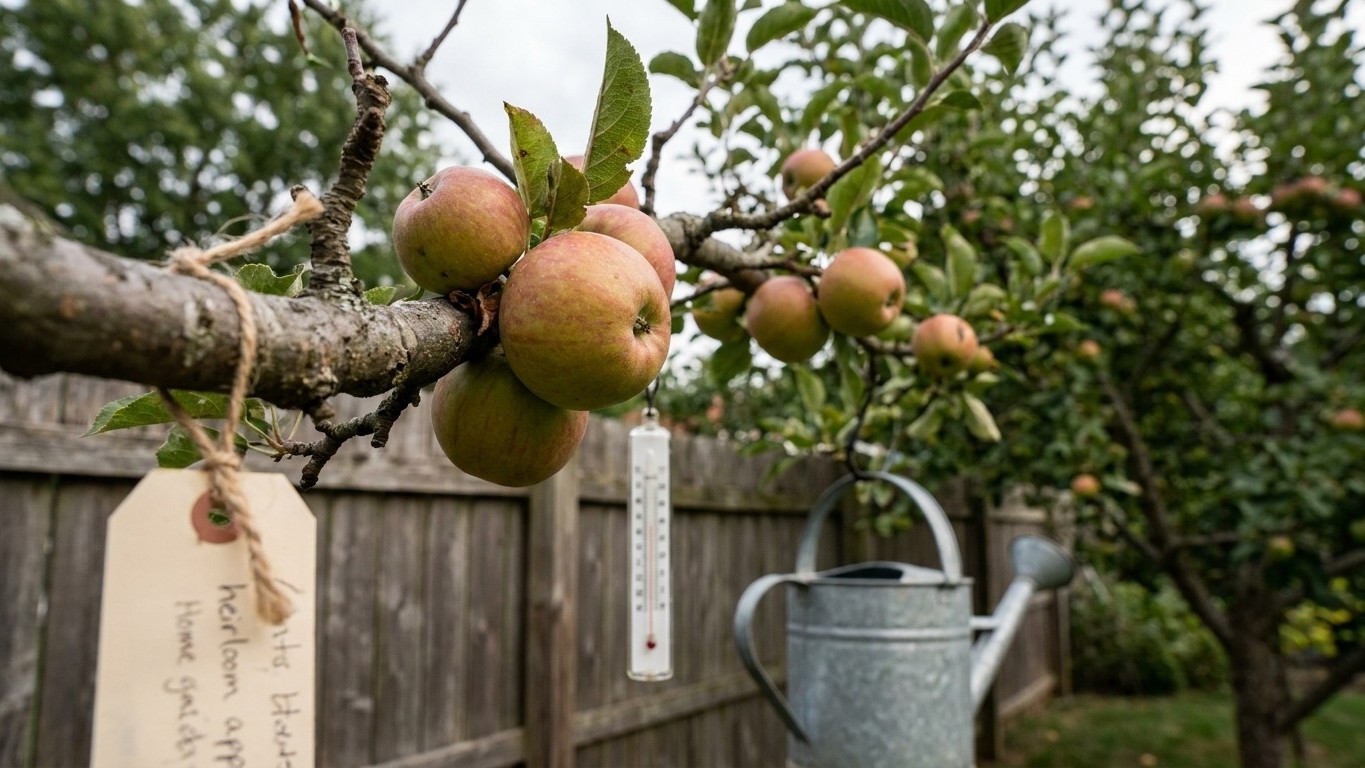

Apples grow well across Maryland if you choose a variety suited to the state’s zone range and moderate winter chill. NOAA’s 1991-2020 climate normals put the coldest-month average low at 24.4°F at the Baltimore reference station, mild enough that hardiness is rarely the limiting factor here. Check your county against the USDA Plant Hardiness Zone Map before ordering a tree, since Maryland spans zones 5b to 8a and a variety bred for the Deep South will struggle here regardless of how well it survives the cold.
Can you grow apples in Maryland
Garrett County apple trees break dormancy weeks behind trees in Baltimore, and that gap is the whole story of growing apples in Maryland. This isn’t one climate wearing one state’s name — it’s a mountain frost pocket, a mild river corridor, and an even milder shore, each asking for different varieties and different timing. Plant for your actual county, not for the state’s average zone number, and the rest gets much easier.
The catch is that “Maryland” is not one climate. Garrett and Allegany counties, up in the western mountains, sit at a noticeably colder and later end of the state’s frost calendar than the Baltimore corridor, and the Eastern Shore runs milder still. A grower in Oakland or Grantsville should treat the state’s zone range as a starting point, not a promise, and lean toward the hardier, later-blooming end of the variety list rather than whatever a big-box nursery happens to stock — the Maryland apple Calendar lays out how those bloom and frost timelines shift county by county.
Where it gets harder, and where it still works
The mountainous west is the part of Maryland where apple growing takes more care. Cold pockets, a shorter frost-free window, and exposure to late spring freezes all argue for hardy, later-flowering cultivars and a planting site with good air drainage, not flat low ground where cold air pools overnight. None of that rules the region out. It just narrows the variety list and rewards a grower who plants on a slope rather than in a hollow.
Central and southern Maryland, closer to the Baltimore-Washington corridor and the Chesapeake, carry the mildest and most forgiving conditions in the state for tree fruit. That is also where the coldest-month figure above was measured, so treat it as a Baltimore-area number and expect the western counties to run several degrees colder in a typical January.
Which varieties suit this climate

Two filters matter here, and guides that only mention one of them set gardeners up to fail. For a rundown of cultivars that satisfy both, see this guide to Maryland apple Best varieties. The first filter is hardiness: does the tree survive the winter minimum where you live. The second, and the one most often skipped, is winter chill: does the tree get enough accumulated cold hours to break dormancy cleanly and flower in a tight, productive bloom rather than a ragged, partial one.
Maryland sits toward the moderate-to-high end of the chill scale for apples, not the low end. That distinguishes it sharply from the Deep South, where growers plant low-chill cultivars bred for a short, mild winter, a topic covered in growing apples in Mississippi. It also distinguishes it from the harder winters further north, where extra-hardy rootstock and short-season ripening matter more than they do here, as discussed in growing apples in Wisconsin. Maryland’s winters reliably deliver a full chill reset for varieties bred anywhere in the moderate-chill range, which is most of the classic mid-Atlantic apple list.
Varieties with a published hardiness range that covers this state
Several widely sold cultivars have catalogue-listed hardiness ranges that comfortably cover Maryland’s 5b-8a span, and disease resistance published on the tag or in the nursery catalogue matters as much as hardiness in a humid mid-Atlantic summer. Scab, the most common apple disease in wet eastern climates, is worth screening for before you buy.
| Variety | Ripens | Approx. chill hours* | Disease resistance |
|---|---|---|---|
| Liberty | Early to mid fall | 800-900 | Scab, fire blight, cedar apple rust |
| Enterprise | Mid to late fall | ~800 | Scab, fire blight |
| William’s Pride | Late summer | ~600 | Scab |
| GoldRush | Late fall, good keeper | 800-900 | Scab |
| Honeycrisp | Early fall | 800-1000 | Little natural resistance, needs a spray program |
| Jonagold | Mid fall | 800-900 | Moderate; triploid, sterile pollen |
*Published nursery chill-hour figures vary a little by source and are estimates rather than guarantees, the same way a seed packet’s days-to-maturity figure shifts a week or two with the season. No Maryland-specific extension list of recommended apple cultivars is cited in this piece; check the state extension service directly for one before placing an order.
Planting a pair that works here
Apples do not self-pollinate reliably. You need two compatible varieties that bloom at overlapping times, and at least one of them has to shed viable pollen. That second condition trips up a lot of first-time buyers, because a handful of popular varieties, Jonagold and Arkansas Black among them, are triploid and produce little or no usable pollen of their own. A triploid tree can still bear a full crop, but it cannot pollinate its neighbor, so it needs two other trees nearby that bloom together and can pollinate both it and each other.
For a straightforward two-tree planting in Maryland, pair varieties from the same bloom window and confirm at least one is a normal diploid pollen source. Liberty and William’s Pride bloom close enough together for reliable cross-pollination, and both carry solid scab resistance, a real advantage in a humid mid-Atlantic spring. Enterprise and GoldRush make another workable pair for a slightly later bloom window, useful where a late frost is a recurring worry.
Whatever two varieties you land on, check the bloom-time overlap and pollen fertility listed on the nursery tag or catalogue page before you buy, not after the trees are in the ground. A tree that blooms two weeks off from its partner, or one that turns out to be a sterile triploid with no third tree nearby, will flower reliably and still set little or no fruit.
The frost that costs a crop here

The frost that matters for apples in Maryland is not the one that kills the tree. It is the one that hits after the buds have opened enough to show pink and lands on open blossoms. At the Baltimore reference station, NOAA’s 1991-2020 climate normals put the last spring freeze in the window of April 3 to April 16, based on the 30 to 70 percent probability band for a 32°F freeze. Mountain counties like Garrett and Allegany run weeks later than that range, and the Eastern Shore tends to run earlier and milder, so treat the Baltimore window as a reference point, not your own calendar.
Why the tree survives and the crop doesn’t
An apple tree in full dormancy shrugs off a hard freeze that would kill an open flower outright. Once the buds swell and show pink, the tissue inside is far less cold-tolerant, and an open blossom is more fragile still. A freeze that lands during bloom can wipe out the flowers, and with them the whole year’s crop, while the tree itself leafs out fine a week later and looks perfectly healthy all summer. That gap between “the tree is fine” and “there is no fruit” is what catches new growers off guard.
There is not much a home grower can do to stop a hard freeze once blossoms are open, short of covering small trees with frost cloth overnight or running an orchard-scale wind machine, neither of which is practical for a backyard planting. The real protection is timing: a variety that blooms later in the spring gives the last frost more time to pass before the flowers are exposed. Where the local frost window runs late, as it does in the Maryland mountains, that later-blooming trait matters more than any other single feature on the variety tag.
The apple year in Maryland
Apple management runs on the tree’s own stage, not the calendar, and each stage should be read against this region’s own frost dates rather than a fixed date on the wall.
- Dormancy, through the winter, is when to prune and to order or plant bare-root trees.
- Green tip, as buds swell and show the first green, is the point to plan the season’s first disease spray if scab or rust has been a problem.
- Pink bud, when the unopened flower shows color, is the stage most exposed to a late frost, and it typically arrives close to the Baltimore-area last-frost window of April 3 to April 16 in a normal spring, earlier in mild years, later up in the mountains.
- Bloom is the open-flower stage, the single most frost-sensitive point in the whole year.
- Petal fall marks the end of the pollination window and the start of fruit set.
- Fruit set, a few weeks after bloom, is when to thin clusters down to one or two fruit each, which improves size and cuts down on limb breakage later.
- Harvest runs from late summer into fall depending on variety, well ahead of NOAA’s first fall frost window of October 26 to November 5 at the Baltimore station, though a late-keeping cultivar like GoldRush can hang on the tree closer to that date.
Local help
For a locally screened variety list and a spray calendar tuned to Maryland’s disease pressure, the University of Maryland Extension is the right first call. Extension offices also handle soil testing and can confirm which pests are active in your county before you commit to a spray program, which saves buying the wrong product for a problem you don’t actually have.
Common questions
Can I grow apples on the Eastern Shore of Maryland?
Yes. The Eastern Shore runs milder than the Baltimore reference figures used above, which works in an apple grower’s favor for frost timing but means winter chill is worth double-checking against the variety’s published requirement rather than assuming it.
Do I really need two apple trees?
Almost always, yes. A lone apple tree with no compatible pollinator nearby, including a neighbor’s tree within bee range, typically sets little to no fruit even if it flowers heavily every spring.
What if my county freezes later than the Baltimore dates given here?
Treat the Baltimore window as a starting reference and expect the mountain counties to run weeks later, per the caution built into NOAA’s own normals. Lean toward later-blooming varieties and watch your own buds rather than the calendar.
Is Honeycrisp a good choice for a Maryland backyard?
It grows here, but it carries little natural disease resistance and needs a real spray program to avoid scab and other fungal problems in a humid mid-Atlantic summer. A scab-resistant cultivar like Liberty or Enterprise is a lower-maintenance choice for a first tree.
How long before a new apple tree bears fruit?
Most nursery apple trees on standard dwarfing rootstock start bearing a light crop within a few years of planting, though the exact timing depends on rootstock, variety, and how hard the tree was pruned early on. Check the rootstock description at purchase, since it affects this more than the variety does.