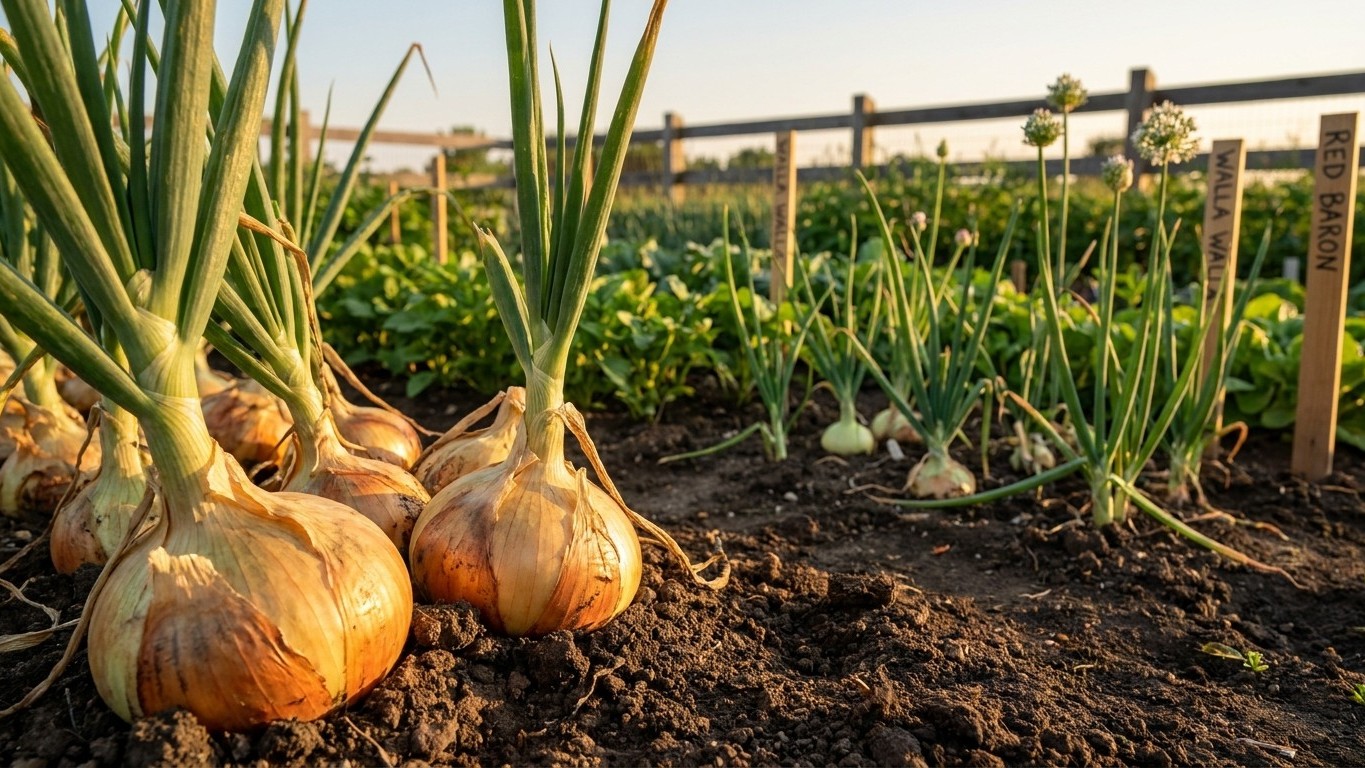

Minneapolis-Saint Paul sits at 44.88 degrees north, and on the longest day of the year the sun keeps that city lit for 15 hours and 25 minutes. That single number decides which onions will bulb in Minnesota gardens and which ones will spend all season making leaves. Long-day and intermediate-day varieties work here. Short-day types, the ones sold in big-box garden centers every spring, do not. Below, the varieties that actually bulb, the ones to avoid, and when to get them in the ground.
How long your longest day is

Two numbers matter more than anything else in this whole discussion: 44.88 degrees north, the latitude of the Twin Cities, and 15 hours 25 minutes, the amount of daylight that city gets on the summer solstice. An onion plant does not check a thermometer to decide when to stop growing leaves and start building a bulb. It checks the length of the day. Once daylight hours cross the threshold a variety is bred to respond to, the bulbing switch flips, whether the soil is warm or not.
Clemson Cooperative Extension’s Home and Garden Information Center puts the short-day trigger at roughly 12 hours of daylight. Minnesota blows past that number by more than three hours at the peak of summer, which means short-day onions here start bulbing while the plant is still small and underdeveloped. Intermediate-day varieties need something in the 12 to 14 hour range, comfortably inside what this state delivers. Long-day varieties hold off until 14 to 16 hours, and 15 hours 25 minutes covers that range too, just not the very top end of it.
That’s the whole story in one sentence: Minnesota’s summer daylight supports intermediate-day and long-day onions, and rules out short-day ones entirely. Everything else in this article, the variety names, the planting calendar, the storage outlook, just fills in the details around that one fact.
One caveat worth repeating: Minnesota is a big state, and 44.88 degrees is the latitude of one city near its southern edge. International Falls, up on the Canadian border, sits well north of that and gets noticeably more daylight at the solstice. A gardener up there is working with an even wider margin for long-day varieties, and should check their own latitude rather than assume the Twin Cities figure applies exactly to their yard.
Which varieties bulb in Minnesota
Twenty-three documented varieties on this site list a latitude range that covers 44.88 degrees north, which means their catalogued day-length requirement matches what the Twin Cities and most of Minnesota actually receives. That’s a wide field to choose from, spanning long-day and intermediate-day types:
- Ailsa Craig (long-day, 38-60N)
- Barolo (long-day, 38-55N)
- Blush (long-day, 38-55N)
- Bridger (long-day, 35-50N)
- Cabernet (intermediate-day, 35-45N)
- Calibra (intermediate-day, 35-45N)
- Elsye (intermediate-day, 32-45N)
- Expression (intermediate-day, 32-45N)
- Frontier (long-day, 40-50N)
- Monastrell (intermediate-day, 35-46N)
- New York Early (long-day, 38-50N)
- Patterson (long-day, 38-55N)
- Powell (long-day, 43-47N)
- Red Carpet (long-day, 40-45N)
- Red Long of Florence (intermediate-day, 38-50N)
- Red Long of Tropea (intermediate-day, 35-48N)
- Redwing (long-day, 43-65N)
- Rossa di Milano (long-day, 38-50N)
- Safrane (long-day, 42-50N)
- Scout (intermediate-day, 32-46N)
- Sierra Blanca (intermediate-day, 32-45N)
- Talon (long-day, 42-50N)
- Walla Walla Sweet (long-day, 35-55N)
Now the part that actually saves a gardener from a wasted season. Five documented varieties list a latitude range that sits entirely below 44.88 degrees, which means their catalogued day-length trigger fires well before Minnesota’s summer sun ever gets to it:
- Candy (intermediate-day, 33-40N)
- Gabriella (short-day, 20-35N, no page of its own on this site)
- Madalyn (short-day, 20-35N, no page of its own on this site)
- Red Rock (short-day, 30-36N, no page of its own on this site)
- White Castle (short-day, 30-38N, no page of its own on this site)
Plant one of those in a Minnesota garden and the plant does not know it’s in the wrong place. It grows exactly as bred: it hits its 12-hour trigger in early summer, starts bulbing before the top growth has built up enough leaf mass to feed a real onion, and produces something the size of a golf ball, or smaller. Push past that and the small, thin-skinned bulb sits in ground that’s still warm and wet for weeks after it should have been cured and stored, and it rots. A gardener who bought a mesh bag of sets at a hardware store last spring and ended up with marble-sized onions has likely already lived this exact sequence. It’s a variety mismatch, not a mistake in watering or feeding.
When to plant onions in Minnesota
Planting time follows day length, and day length is regional, so the calendar that works in Georgia or Texas has no bearing here. In short-day country, gardeners plant onions in the fall, let them overwinter as small plants, and let spring’s lengthening days trigger bulbing before the summer heat arrives. Minnesota does the opposite. With long-day and intermediate-day varieties, the goal is to get as much leaf growth established as possible before the long June and July days flip the bulbing switch, and that means starting early in the year, not the autumn before.
NOAA’s 1991-2020 climate normals put the average last spring frost at the Twin Cities station between April 17 and April 30, and the average first fall frost between October 11 and October 23. Those are 30 to 70 percent freeze probability windows, meaning they describe an average year, not a guarantee. A hard frost outside that window is entirely possible, and northern Minnesota, from Duluth up through the Iron Range and the Canadian border counties, runs two to three weeks tighter at both ends. A gardener near Bemidji or International Falls should shift the whole calendar earlier in fall and later in spring than these Twin Cities figures suggest.
In practice, that frost window means onion transplants or sets go in the ground in the weeks before and around the average last frost date, since young onion plants tolerate a light freeze far better than the mature bulb does later in the season. Waiting until the soil is reliably frost-free wastes leaf-growing time the plant needs before the solstice does its work. Gardeners starting from seed indoors typically begin eight to ten weeks before that April transplant window, which puts seed-starting in late winter, a detail worth checking against each variety’s own days-to-transplant guidance rather than a single fixed date for the whole state.
Sweet onions or onions that keep
The flavor and the shelf life of an onion trace back to the same chemistry, and a Minnesota garden lands on a specific point on that spectrum. University of Missouri Extension’s guidance on growing and harvesting onions puts it plainly: as a rule, sweet onions do not store as well as the more pungent types. The compounds responsible for onion’s sharp bite are volatile sulfur compounds, and those same compounds are what protect a bulb during months in storage. A variety bred to be mild has fewer of them, which is exactly why it tastes better sliced raw on a sandwich in July, and exactly why it goes soft by December.
Day length lines up with this trade-off almost too neatly. Short-day varieties, the ones that don’t work in Minnesota anyway, tend to run sweeter and shorter-keeping. Long-day and intermediate-day varieties, the ones that do bulb here, skew toward sharper flavor and longer storage life. That’s not a rule this state chose. It’s a side effect of which varieties are physically capable of bulbing under 15 hours 25 minutes of June daylight in the first place.
What that means for a Minnesota pantry: onions harvested here in August will generally have more bite than a supermarket sweet onion, and that bite is doing real work. Cured properly and kept cool and dry, a long-day or intermediate-day onion grown in this state can reasonably be expected to still be sound in March, well past the point a sweeter southern variety would have gone soft. No variety on the list above should be marketed to a reader as both sweet and long-storing; the two traits work against each other, and a gardener choosing seed for this state should decide up front which one matters more this season, fresh eating or a onion that lasts through a Minnesota winter.