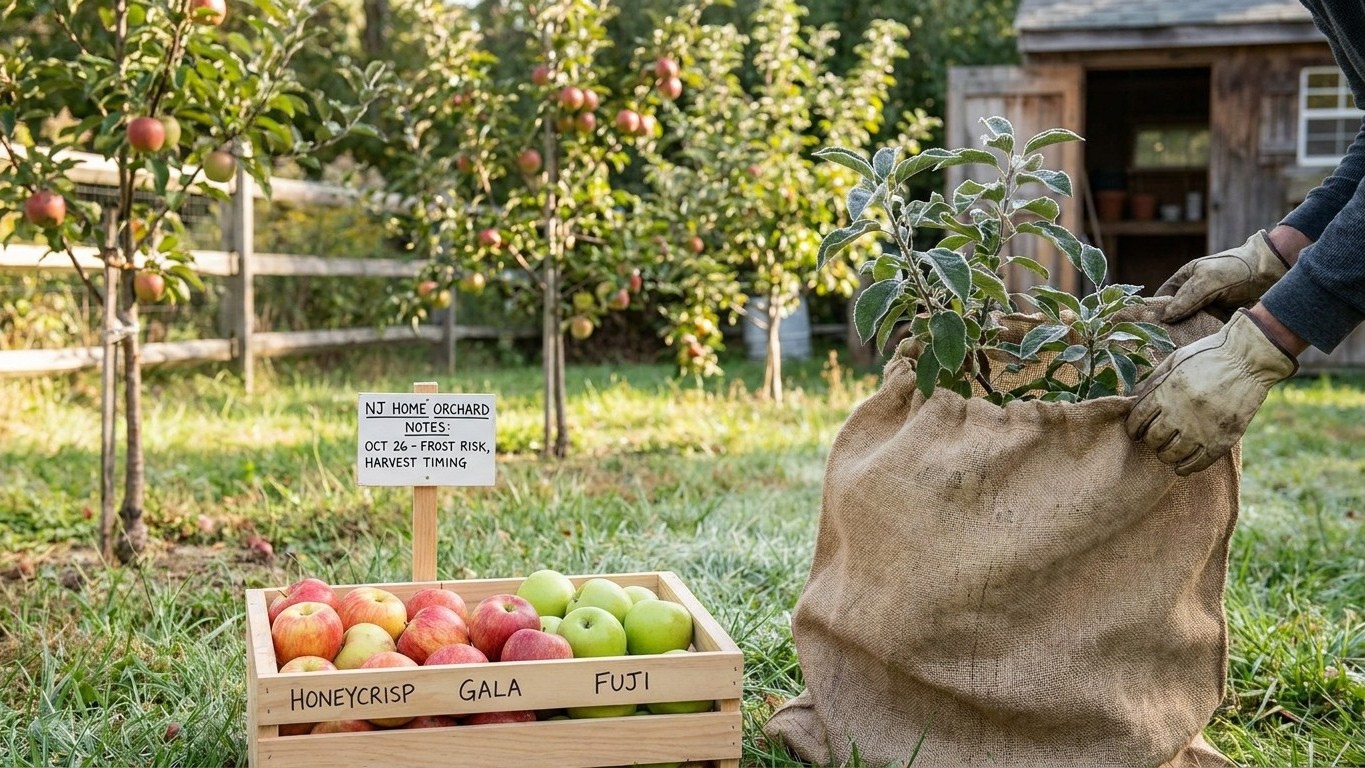

New Jersey’s cold enough to make an apple tree rest all winter and mild enough to wake it up strong every spring — that’s the whole reason the state works for this fruit. But whether your own harvest is heavy or thin comes down to one thing the variety tag won’t tell you: does your yard hold frost in a low spot, or drain cold air away on a slope? Walk your property before you order a single tree, and find out which one you’ve got.
Can you grow apples in New Jersey
New Jersey sits inside USDA zones 6a to 7b, according to the 2023 Plant Hardiness Zone Map built on 1991-2020 climate normals. That is a wide band for one state, and it matters which end of it your property falls on. Newark, the reference station NOAA uses for the state’s official normals, records an average minimum temperature of 24.5°F in the coldest month, a figure that describes the northern lowlands more than the coast or the highlands.
The northwest corner of the state, through Sussex and Warren counties and up onto the ridges of the Highlands, runs colder and sits at the low end of that range, closer to zone 6a. Standard apple cultivars are bred to survive zone 6a winters without trouble, so this is not marginal apple country, it is simply the cold end of a state that spans two full zones. South Jersey, from the Pine Barrens down through Cumberland and Cape May, runs milder and pushes into 7b, which widens the choice of cultivar rather than restricting it.
What the coldest-month figure actually tells you
The 24.5°F figure from NOAA is a mean daily minimum, not a record low and not a single hard freeze event. It tells you what an apple tree’s roots and dormant wood have to shrug off most winters near Newark, and it is the number that rules a species in or out long before frost dates or bloom timing matter. For apples, it rules the whole state in. The harder local question is not whether the tree survives winter, but whether your particular yard sits in a frost pocket that delays bud break or catches a late freeze the airport station never sees.
Because Newark’s figures come from one station, expect your own garden to run a week or two colder in spring and warmer in fall if you are inland, at elevation, or away from the coast’s moderating effect. Rutgers Cooperative Extension can tell you which zone your specific county falls into and whether local frost records differ meaningfully from the Newark figures used here. For a season-by-season breakdown of what to expect, The New Jersey Apple Calendar, Stage by Stage walks through each stage from dormancy to harvest.
Which varieties suit this climate

Once hardiness is settled, the second filter is winter chill, the number of cold hours a tree needs before it will break dormancy and flower — a point covered in more depth in The Best Apple Varieties for New Jersey properly. A cultivar bred for the Deep South planted in New Jersey will break dormancy erratically and bloom thin and ragged over weeks instead of in one flush. A cultivar bred for chill this state actually gets will flower tightly and on schedule. New Jersey’s winters, cold enough to average 24.5°F minimums at Newark in the coldest month, sit toward the moderate-to-high end of the chill scale, which rules out low-chill southern selections such as ‘Anna’ or ‘Dorsett Golden’ and points instead toward standard-chill cultivars bred for the mid-Atlantic and Northeast.
‘Liberty’ and ‘Enterprise’ are both scab-immune selections bred at Cornell and Purdue-Rutgers-Illinois programs respectively, hardy through zone 4 to 8, which covers New Jersey’s full range with room to spare. ‘Honeycrisp’, hardy zone 3 to 8, does well here too, though it is more prone to fire blight than the scab-resistant pair and benefits from an open, well-pruned canopy. ‘GoldRush’, hardy zone 5 to 8, ripens late and stores exceptionally well, a useful trait given how mild the shoulder seasons run in the southern part of the state.
| Variety | USDA zone range | Bloom timing | Disease resistance |
|---|---|---|---|
| ‘Liberty’ | 4-8 | Mid-season | Scab, rust and fire blight resistant |
| ‘Enterprise’ | 4-8 | Mid to late | Scab resistant |
| ‘Honeycrisp’ | 3-8 | Mid-season | Susceptible to fire blight |
| ‘GoldRush’ | 5-8 | Late | Scab resistant |
Days-to-maturity figures on nursery tags are counted from a young tree’s first bearing year, not from bloom, and they shift by a week or two with the season, so treat catalog numbers as a starting estimate rather than a calendar promise. No New Jersey-specific extension variety list was available to draw from here, so the cultivars above are named on their published hardiness and chill ratings rather than a local recommendation. Gardeners farther south work from an entirely different chill baseline, which is why the choices look different in Growing Apples in Tennessee: Varieties, Timing and Frost Risk.
Planting a pair that works here
Apples are mostly self-sterile. You need two trees that flower at overlapping times, and at least one of them has to produce pollen that actually works, because a handful of popular cultivars are triploid and carry sterile pollen despite blooming normally themselves. ‘Stayman’ and ‘Jonagold’ both fall into that trap: plant either one alone with a single partner and you may get blossoms with nothing to pollinate them.
For New Jersey’s zone 6a-7b range, ‘Liberty’ and ‘Enterprise’ make a reliable pair. Both are diploid, both carry fertile pollen, and their bloom windows overlap closely enough that a single spring’s bees can do the whole job. ‘Honeycrisp’ blooms in the same mid-season window and works as a third tree or as a substitute partner for either one, though its fire blight susceptibility means it should not be your only backup if disease pressure runs high in a wet spring.
If you already own a triploid
A triploid tree like ‘Stayman’ still needs two other trees nearby, one to pollinate it and a second, fertile diploid to pollinate that first one in turn, since the triploid’s own pollen cannot close the loop. That is a three-tree minimum in a small yard, which is why most home orchards in this state are better served by sticking to two solid diploid partners. The full mechanics of which cultivars carry sterile pollen and which combinations fail are laid out in more depth on the pollination pages for neighboring climates, including Growing Apples in New York: Varieties, Timing and Frost Risk, where the same triploid traps come up.
The frost that costs a crop here

Near Newark, NOAA’s 1991-2020 climate normals put the last spring freeze in the window of March 29 to April 6, based on the 30 to 70 percent probability band for a 32°F freeze. That is the airport station’s figure. Suburban and rural gardens across the state typically see their own last frost run a week or two later, and gardens at elevation or in low-lying frost pockets can run later still, so treat the Newark window as an early estimate rather than a guarantee for your own yard.
The frost that actually costs a New Jersey grower a crop rarely kills the tree. Apple wood tolerates real cold, but once the flower buds show pink and open into bloom, a freeze in that window kills the blossoms themselves. The tree leafs out fine that summer, looks completely healthy, and simply carries no fruit, because the flowers that would have become apples were destroyed weeks earlier. That gap between “the tree survived” and “the crop survived” is the one thing that catches first-time growers off guard.
What actually helps
- Cover small trees with frost cloth on a night a hard freeze is forecast after buds show pink.
- Avoid planting in the lowest part of a slope, where cold air pools and frost settles hardest.
- Delay pruning until late winter rather than fall, since heavy fall pruning can push earlier bloom the following spring.
- Choose a late-blooming cultivar such as ‘Enterprise’ or ‘GoldRush’ where your own frost record runs later than Newark’s.
A late-blooming variety is the closest thing to real insurance where the last frost lingers into April. Growers just across the state line deal with a similar timing squeeze, covered in more detail in Growing Apples in New York: Varieties, Timing and Frost Risk, since the same 30 to 70 percent freeze-probability band shapes bloom risk there too.
The apple year in New Jersey
Apple timing is read off the tree’s stage, not a date on the calendar, and each stage should be anchored against your own local frost window rather than the month printed on a nursery tag.
Dormancy through green tip
Through the winter, while temperatures near Newark are still averaging 24.5°F minimums by NOAA’s normals, the tree needs no attention beyond structural pruning on a dry, above-freezing day. Green tip, the first sign of leaf tissue pushing through the bud scales, generally shows before the March 29 to April 6 last-frost window closes, which is exactly why a hard freeze at this stage rarely does lasting damage: the tissue exposed is still small and cold-hardy.
Pink through petal fall
Pink bud, when the unopened flower shows color, is the stage that turns frost from a non-event into a crop-ending one. This typically arrives around or just after the tail end of the region’s last-frost window, which is why a late freeze that slips past early April can still catch blossoms that have already opened. Petal fall marks the point where the risk drops sharply, since a fertilized flower has already set the beginning of a fruit and tolerates cold better than an open bloom does.
Fruit set through harvest
Once fruit set is visible, usually a small green nub replacing the spent blossom, the grower’s job shifts to thinning crowded clusters and watching for pest and disease pressure through summer. Harvest for most standard cultivars in this state runs from late summer into fall, well ahead of NOAA’s first fall-frost window of November 4 to November 16 at Newark, though a late-season keeper like ‘GoldRush’ is bred to hang on the tree deep into that window without frost damage to the fruit itself.
Common questions
Can I grow apples in south jersey where it’s warmer?
Yes, and the milder end of the state, toward 7b on the USDA map, actually widens your cultivar choice rather than limiting it. The main tradeoff is that a warm winter occasionally fails to deliver enough chill for a very high-chill selection, though standard cultivars like ‘Liberty’ and ‘Enterprise’ are not affected.
Do I really need two different apple trees?
Almost always, yes. A small number of self-fertile cultivars exist, but even those set a heavier crop with a second tree nearby, and if either tree you’re considering is a triploid like ‘Stayman’ or ‘Jonagold’ you need a third tree in the mix since triploid pollen does not work.
Why did my apple tree bloom but not set fruit?
A late frost after pink bud is the most common cause, since it kills the open flowers while leaving the tree looking healthy. Poor pollination from a mismatched or sterile-pollen partner, or a cold, wet stretch during bloom that kept bees from flying, are the other usual suspects.
How many years until an apple tree actually fruits?
Most nursery-grafted trees on standard rootstock begin bearing a light crop three to five years after planting, with full production taking longer. Dwarf and semi-dwarf rootstocks tend to bear a year or two sooner than standard rootstock, though rootstock choice is a separate decision from the cultivar itself.
Is my backyard too cold or too warm for apples?
Almost certainly neither. New Jersey’s full range, USDA zones 6a to 7b, sits comfortably within what standard apple cultivars tolerate, and the state’s coldest-month averages near Newark, at 24.5°F, are well within safe limits. The more useful question is your own county’s frost timing, which Rutgers Cooperative Extension can help you pin down.
Local help
For a variety list built specifically for New Jersey soils and pest pressure, and for current spray timing guidance, Rutgers Cooperative Extension is the right first call. Their county offices can also confirm your specific USDA zone and how far your local frost dates run from the Newark figures. Find your county office and current publications through Rutgers New Jersey Agricultural Experiment Station.