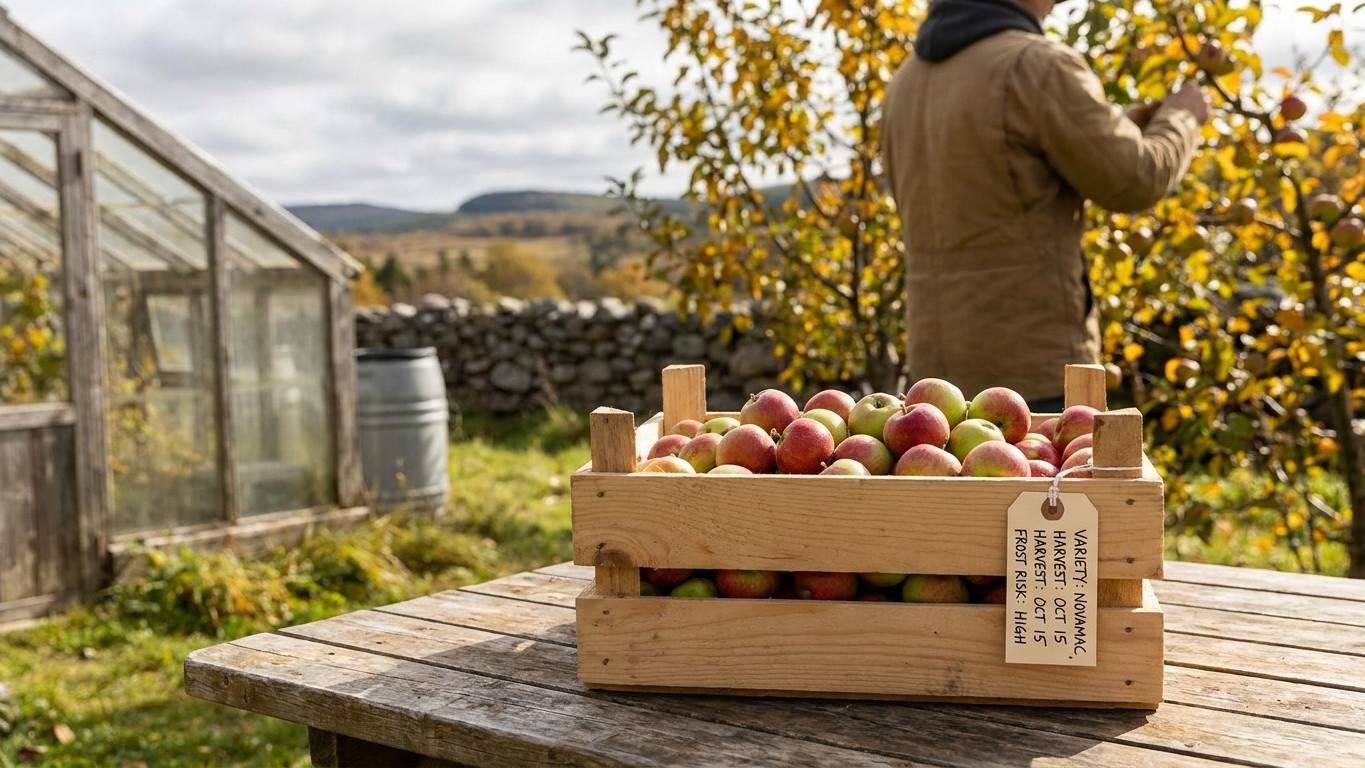

Apples grow in Newfoundland and Labrador, but only in the mildest coastal pockets and only with varieties bred for genuine cold-climate survival. Environment and Climate Change Canada’s 1981-2010 climate normals put the mean daily minimum for the coldest month at St. John’s at -8.7 °C, cold enough to rule out most orchard apples sold in mainstream catalogues. Start by checking your own site against that figure, and against a spring frost that at St. John’s averages May 30, before you buy a single tree.
Which varieties suit this climate

The first filter is straightforward survival. A tree that cannot take a St. John’s winter is not worth planting regardless of how the fruit tastes. Varieties bred at Canadian prairie research stations for zone 2 to zone 3 conditions, far colder on paper than coastal Newfoundland but tested against exactly the kind of prolonged deep cold that ECCC’s -8.7 °C figure describes, are the realistic starting list here. ‘Norland’, ‘Parkland’ and ‘Goodland’ are the three most commonly cited in Canadian cold-climate nursery catalogues, all bred to fruit reliably where standard dessert apples fail outright. ‘September Ruby’ is a hardier sport of the McIntosh line, and ‘Dolgo’ crabapple is close to bulletproof for cold, doubling as a heavy pollen source. For a fuller rundown of these and other options, see The Best Apple Varieties for Newfoundland and Labrador.
The second filter is chill, and it works the opposite way from what a warm-climate guide would tell you. Winter chill is the number of cold hours a tree needs before it will break dormancy and bloom evenly. A low-chill variety bred for Georgia or the Carolinas gets confused in a climate this cold, but that is not really the risk in Newfoundland. This territory sits at the long-chill, short-summer end of the spectrum, so chill accumulation is never in short supply. The actual constraint is heat after bloom: a cool, foggy coastal summer does not hand a late-ripening variety enough warmth to finish its fruit, which is why the early and mid-season cultivars above are named more often than late-season dessert types in cold-climate catalogues generally.
Treat the names above as catalogue-hardiness matches rather than a local endorsement, and confirm current local performance with the extension service before ordering in quantity. Once a variety is chosen, The Newfoundland and Labrador Apple Calendar, Stage by Stage lays out what to expect through the growing season. Growers further north and inland face a harder version of the same problem: in the Northwest Territories the season narrows further still, and the workable shortlist there shrinks mostly to crabapples, covered in Growing Apples in Northwest Territories: Varieties, Timing and Frost Risk.
| Variety | Catalogue hardiness | Bloom timing | Pollen |
|---|---|---|---|
| ‘Norland’ | Zone 2b-3 | Early | Fertile, diploid |
| ‘Parkland’ | Zone 2 | Early to mid | Fertile, diploid |
| ‘Goodland’ | Zone 3 | Mid | Fertile, diploid |
| ‘September Ruby’ | Zone 3 | Mid | Fertile, diploid |
| ‘Dolgo’ crabapple | Zone 2 | Wide window, mid | Abundant, fertile |
Planting a pair that works here
Apples are not reliably self-fertile. You need two trees that flower in the same window and at least one of them needs pollen that actually works, which rules out relying solely on triploid varieties such as ‘Gravenstein’, ‘Baldwin’ or ‘Jonagold’ as your only second tree. Triploids produce showy blossom but sterile pollen, so a planting of two triploids side by side can bloom beautifully and still set almost no fruit.
Among the cold-hardy names that suit this climate, the practical pairing is straightforward. ‘Norland’ and ‘Parkland’ overlap closely enough in bloom timing to pollinate each other, and both carry fertile, diploid pollen. Where bloom overlap feels like a gamble, because coastal fog can shift flowering by several days from one side of a property to the other, adding a ‘Dolgo’ crabapple to the planting is cheap insurance. It blooms across a wide window, produces pollen in quantity, and will fertilize nearly anything flowering nearby, which matters more in a climate where a short cold snap can compress or scatter the bloom period unpredictably.
Site selection does some of this work before the trees ever flower. A south-facing slope with open air movement and no low spot for cold air to pool will bloom a little later and a little more evenly than a sheltered hollow that feels warmer on a still day but traps frost on a clear night. Plant the pollinizer within about 50 to 100 feet of the main tree, since bee traffic drops off with distance, and coastal wind here already gives pollinators fewer flying hours than an inland orchard gets.
The frost that costs a crop here

Environment and Climate Change Canada’s 1981-2010 normals put the mean last spring frost at St. John’s on May 30. That word mean matters: it is the midpoint of a spread of years, not a safe cutoff, and in roughly one year out of two the actual last frost falls later than May 30. Inland and upland districts away from the moderating coast will typically run behind that date by a further margin the St. John’s record cannot capture.
What a pink-bud frost actually kills
Apple buds move through stages each spring: dormant, green tip, pink, full bloom, petal fall. Once a bud reaches the pink stage, the flower parts inside are exposed and far less cold-tolerant than the dormant wood around them. A frost at or after pink kills the blossoms themselves. The tree survives, leafs out, and looks perfectly healthy all summer, but with no living flowers there is no fruit that year. This is the single most common way a Newfoundland apple planting loses an entire season without the grower realizing why until harvest never comes.
What you can do about it
Once buds have opened past green tip there is not much that saves a full-size tree from a hard frost, but a few things shift the odds:
- Choose a site with open slope and air drainage, not a low pocket where cold air settles overnight
- Delay watering and fertilizing in early spring, since lush new growth pushes bud stages forward faster
- Cover young or dwarf trees with row cover or old sheets on a forecast clear, cold night near bloom
- Favor a later-blooming variety over an earlier one where frost risk runs into the bloom window most years
That last point is the real long-term protection. A variety that blooms a week or two later than ‘Norland’ has a better chance of flowering after the frost risk has passed, rather than during it. This is the same logic that plays out in reverse in warmer growing regions: in Idaho, where the frost-free season runs long enough that bloom timing barely factors into variety choice, growers can plant almost any dessert apple without worrying about this calculation at all, a comparison worth reading in Growing Apples in Idaho: Varieties, Timing and Frost Risk.
The apple year in Newfoundland and Labrador
Every stage below is set by temperature and bud development, not by a date on the calendar, so use ECCC’s frost normals as anchors rather than fixed instructions.
Dormancy through fruit set
Trees sit fully dormant through winter, tolerating the deep cold that gives St. John’s its -8.7 °C coldest-month minimum. As temperatures climb in spring, buds move to green tip, the first visible swelling, then to pink, when the flower parts are exposed and frost-vulnerable. Full bloom in this territory typically arrives close to or after the May 30 mean last frost date, which is exactly why the risk described above is worth planning around rather than ignoring. Petal fall follows within days of bloom, and fruit set, the point where fertilized flowers actually begin swelling into fruit, happens over the following one to two weeks. From there the fruit sizes through summer on whatever heat the coastal season provides.
Harvest
Early varieties such as ‘Norland’ typically finish ripening well before the season ends. Mid-season types like ‘Goodland’ and ‘September Ruby’ need more of the summer’s heat and run closer to the calendar’s edge. ECCC’s normals put the mean first fall frost at St. John’s on October 17, again a midpoint rather than a guaranteed date, so treat late-hanging fruit as being at some risk once that window opens, and pick a mid-season variety over a late one if your site runs cooler than the reference station.
Local help
For a variety list matched to current local trial results, and for spray timing calibrated to actual pest and disease pressure on the island and in Labrador, the province’s Forestry and Agrifoods Agency is the right first call. It is also the source to check before assuming any national or catalogue-level advice applies unchanged to your particular coastline or valley.
Common questions
Can I grow apples in Labrador, not just on the island?
Crabapples such as ‘Dolgo’ are the most likely candidates to survive there, but confirm current performance with the province’s extension service before planting.
How many years before a hardy apple tree bears fruit?
Most hardy varieties on standard rootstock take several years of establishment before their first meaningful crop, and dwarfing rootstock generally bears sooner than a full-size tree. Cold-climate cultivars bred for short seasons are not necessarily faster to bear, so budget patience regardless of variety.
Do I need two trees, or will one self-pollinate?
Plan for two trees. Apples are not reliably self-fertile, and a single tree, even a variety marketed as partly self-fruitful, will generally set a heavier and more consistent crop with a compatible pollinizer nearby.
Will fall frost ruin fruit still hanging on the tree in October?
It can, though the fruit itself tolerates a light frost better than open blossom does in spring. Once temperatures drop hard and repeatedly near or after the region’s mean first fall frost, texture and storage life start to suffer even if the apple looks fine on the tree.
Are crabapples worth planting instead of dessert apples?
They are worth planting alongside dessert apples rather than instead of them. ‘Dolgo’ and similar crabapples tend to be hardier than named dessert varieties, and they double as a dependable pollen source, which makes them a low-risk addition to a small planting rather than a replacement for it.