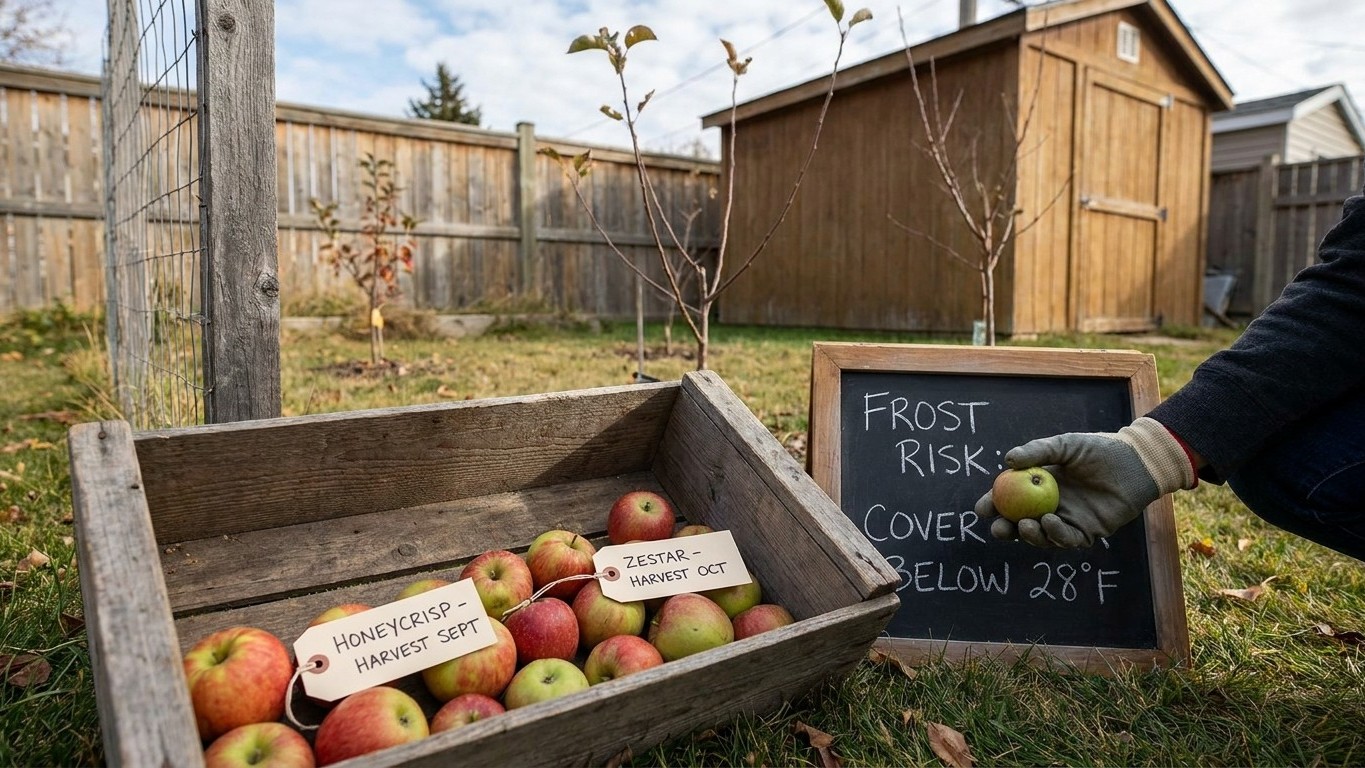

Apples grow in Saskatchewan, but the window is tight. At the Saskatoon SRC station, Environment and Climate Change Canada’s 1981-2010 climate normals put the average last spring frost at May 18 and the average first fall frost at September 18, leaving roughly four months to ripen a crop. That short window means variety choice has to start with cold hardiness and bloom timing rather than flavor. Before you order a tree, check its published hardiness zone and its days-to-maturity figure against a Saskatchewan apple Calendar, and pick one bred specifically for prairie winters rather than a nursery favorite grown for a milder climate.
Which varieties suit this climate

Saskatchewan gives apple trees roughly four months between the average last spring frost on May 18 and the first fall frost on September 18, and that’s the whole window a tree gets to bloom, set fruit, and ripen it. Yes, apples grow here — but only if you pick a tree built for that math, not one bred for someone else’s mild winter and long autumn. Before you order anything, check the variety’s hardiness zone and days-to-maturity against your own last-frost date, and buy prairie-bred stock like Norland or Goodland instead of a garden-center favorite grown for flavor alone.
Norland, an early red apple developed at Morden, is one of the most widely planted apples in the region and ripens in late summer. Goodland, also from Morden, bears a larger fruit with a red blush over green-yellow skin and tends to start cropping young. Parkland carries similar hardiness with a red-striped finish. Battleford, named for the federal research station that bred it, produces a smaller, tart apple valued mainly for toughness rather than dessert quality. September Ruby and the University of Saskatchewan’s Prairie Sensation are newer selections aimed at better eating quality without giving up hardiness. For a fuller rundown of these and other options, see The Best Apple Varieties for Saskatchewan.
| Variety | Ripens | Fruit | Bred for |
|---|---|---|---|
| Norland | Late summer | Medium, bright red | Prairie hardiness, early crop |
| Goodland | Early fall | Large, red blush over green-yellow | Hardiness, young bearing |
| Parkland | Fall | Medium, red-striped | Hardiness |
| Battleford | Fall | Small, tart, red | Extreme hardiness |
| September Ruby | Early fall | Medium-large, dark red | Eating quality plus hardiness |
Hardiness only answers half the question. The other filter is winter chill, the amount of sustained cold a tree needs before it breaks dormancy evenly and blooms on schedule. A low-chill apple bred for a mild winter, the kind sold for Georgia or coastal California gardens, satisfies its chill requirement during the first cold snap of a prairie winter and then risks pushing bud during a January thaw, weeks before real spring arrives. Apples that work in Saskatchewan sit at the opposite, long-chill end of the scale. They need a long, uninterrupted cold season and hold dormancy through it without breaking early. Every variety named above fits that end of the range. No provincial or state extension source in these figures names a specific recommended list for this territory, so treat the varieties above as catalog-hardy choices to confirm against your own nursery’s zone rating before ordering.
Planting a pair that works here
An apple tree needs a second tree blooming at the same time to set fruit, and in Saskatchewan that means picking two varieties whose bloom windows overlap during a short, compressed spring. Norland, Goodland, Parkland and Battleford all bloom within roughly the same few weeks in a normal year, so any two of them planted close enough for bees to move between them will generally cross-pollinate. A single tree of one variety, planted alone, may flower reliably every spring and still set little or no fruit.
The complication is pollen fertility, not just bloom timing. Some well-known apples, including classic triploids like Gravenstein and Jonagold, produce pollen that is effectively sterile. It can receive pollen from another variety, but it can’t fertilize one in return. Plant one of those without a second, fertile-pollen variety nearby and you get a full bloom with no crop, year after year. None of the prairie-bred hardy varieties named above are commonly listed as triploid, which is one more reason to build a two-tree planting around them rather than around a milder-climate favorite added for its flavor alone.
Most apple varieties, including the hardy prairie ones above, are only partially self-fertile at best, so plan for two trees from the start instead of adding a second one later once you notice a light crop. A hardy ornamental crabapple works as a stand-in pollinizer too, and it tends to bloom reliably enough in this climate to cover for a main variety in a year when bloom timing runs unusually late. Growers working through the same pairing problem in an even harder climate narrow the choice down to fewer varieties still. See Growing Apples in Yukon: Varieties, Timing and Frost Risk for how that plays out where the season is shorter yet.
The frost that costs a crop here

At the Saskatoon SRC station, Environment and Climate Change Canada’s 1981-2010 climate normals put the average last spring frost at May 18. That figure is a mean, not a guarantee. In roughly half of all years the last frost falls later than that, sometimes by a couple of weeks, and a district north or east of Saskatoon, or one sitting in a low frost pocket, tends to run behind that date as a matter of course. Treat May 18 as the middle of a window to plan around, not a date to plant to.
What actually gets lost to a late frost isn’t the tree. Once the buds have opened to the pink stage, the flower tissue inside is exposed, and a hard freeze at that point kills the blossoms outright while leaving the wood, the leaves that follow, and the tree itself completely undamaged. The result is a tree that looks perfectly healthy all summer and simply carries no apples, because the flowers that would have become fruit were killed weeks earlier, often before anyone was watching the forecast for frost.
After petal fall, the risk drops fast. A newly set fruitlet tolerates noticeably more cold than an open flower before it’s damaged, so a frost that would have wiped out a full bloom does far less harm once petals have dropped and the young fruit has started to swell.
- Cover young trees with a sheet or row cover on the coldest nights around bloom, not after the forecast turns cold
- Plant on a slope or high spot so cold air drains away from the blossoms overnight instead of pooling
- Choose a later-blooming variety so the flowers open closer to, or after, the average last frost
- Hold off on pruning cuts near the graft union until frost risk has passed, since fresh cuts are more cold-sensitive
Neither covering nor site selection buys much margin once the flowers are fully open in a hard freeze. The more reliable fix is choosing a variety that blooms later in the window to begin with, so that even a frost close to the May 18 average finds the buds still tight rather than showing pink. Among the prairie-bred varieties, a later bloom date is more useful protection here than any amount of covering on the night itself.
The apple year in Saskatchewan
From dormancy to bloom
The apple year here runs on the tree’s own stage, and the calendar only tells you roughly where that stage is likely to fall given Saskatoon’s frost dates. Trees sit fully dormant through winter and into early spring, showing no growth at all as long as temperatures stay below freezing. Green tip, the first sign of a bud splitting to show a sliver of leaf, typically shows up several weeks before Environment and Climate Change Canada’s average last frost of May 18, which is exactly why growers get caught out. Green tip feels like the season starting, but the buds still have to pass through pink before they’re vulnerable to a frost that kills the crop rather than just slowing it down.
Pink stage follows green tip, usually a week or two later depending on how warm the spring runs. This is the point where the flower parts are visible but not yet fully open, and it’s also the point where a hard frost starts doing real damage. Full bloom generally lands close to, or a little after, the May 18 average, which is part of why a later-blooming variety carries a real advantage in this climate rather than a marginal one.
Bloom through harvest
Petal fall marks the end of the vulnerable window. Once petals drop and the young fruitlets begin to swell, the risk from frost drops sharply, and this is the point to check that pollination actually took place, since a poor bloom overlap between two varieties shows up here as flowers that dropped without setting fruit. Fruit set follows over the next few weeks, and a grower with a heavy set can thin the smallest fruitlets by hand for larger, better-colored apples from the rest.
Harvest for the earliest hardy varieties, like Norland, starts in late summer, while later ones such as Parkland and Battleford hang into early fall. Environment and Climate Change Canada’s Saskatoon normals put the average first fall frost at September 18, so anything still on the tree by mid-September is racing that date. A grower with a later-ripening variety should plan to pick before a hard freeze rather than after one, since a freeze softens and browns the fruit even where it does no harm to the tree itself. A longer growing season, like the one described in Growing Apples in Iowa: Varieties, Timing and Frost Risk, isn’t a fair comparison here. Iowa’s frost-free window runs considerably longer, which is exactly why its variety list includes apples that would never finish ripening on the prairies.
Local help
For a current variety list, rootstock advice and spray timing suited to your own district, Saskatchewan’s provincial extension service is the right first call rather than a generic seed catalog. Advice differs across the province, so it helps to mention a nearby town when you get in touch, and staff can flag which hardy varieties are seeing new disease pressure this season, something no printed guide keeps current. Start at the Saskatchewan Ministry of Agriculture’s agribusiness and farmers page and ask for current fruit tree recommendations for your area.
Common questions
Is it actually too cold to grow apples in Saskatchewan?
No, but it does rule out most varieties sold outside the prairies. Saskatoon’s coldest month averages a daily minimum of -20.7 °C according to Environment and Climate Change Canada, and only varieties bred for that kind of winter, such as Norland, Goodland and Parkland, hold up reliably.
Can one apple tree produce fruit by itself?
Rarely a full crop. Most apples, including the hardy prairie varieties, are only partially self-fertile, so a lone tree typically blooms fine but sets little fruit. Plant a second variety with an overlapping bloom window, or a hardy crabapple, from the start.
When is it safe to plant a new apple tree in spring?
There’s no single safe date, since Saskatoon’s average last frost of May 18 is a midpoint, not a guarantee, and it can fall later in half of all years. Wait until the soil has thawed and worked easily, and hold off transplanting during an active cold snap even after that average date has passed.
Will a May frost kill my apple tree outright?
Not the tree itself, in most cases. A hard frost after the buds reach pink stage kills the exposed flowers, so the crop is lost for that year while the wood, leaves and tree structure carry on unaffected.
Is Honeycrisp worth trying in Saskatchewan?
It’s borderline. Honeycrisp’s published hardiness rating covers milder zones than the prairie-bred varieties above, and no source in these figures confirms how it performs specifically around Saskatoon. If you want to try it, plant it alongside, not instead of, a proven hardy variety like Norland or Goodland.