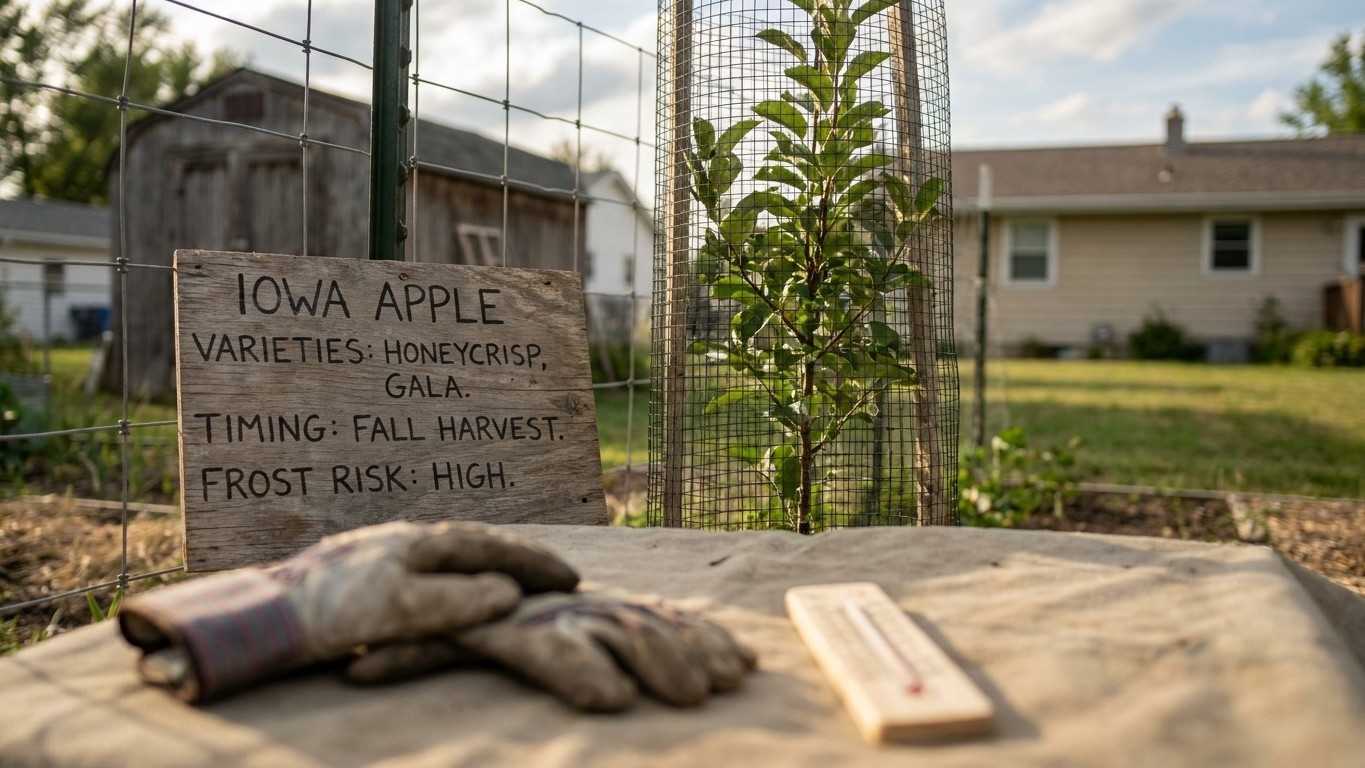

Yes. USDA’s 2023 Plant Hardiness Zone Map puts Iowa at zones 4b to 6a, and NOAA’s 1991-2020 climate normals for Des Moines record a mean daily minimum of 14.3F in the coldest month, cold but well within an apple tree’s range when the variety is matched to it. Northern Iowa sits at the harder end of that spread, southern Iowa at the milder end, and the two call for different cultivars. Before you order a tree, check the USDA zone rating on its tag against 4b if you garden north of Mason City or 6a if you’re near the Missouri line.
Can you grow apples in Iowa
Zone numbers, not state borders, decide whether an apple tree survives an Iowa winter. Des Moines sits near 5a/5b, Decorah and the northeast corner drop into 4b where a hard January, not a hot July, is what kills a tree, and Council Bluffs edges toward 6a with a longer frost-free run. That spread means a cultivar safe in one county can split bark in another. Slope matters too: cold air sinks into river valleys, so a rise above the Des Moines or Cedar floodplain runs warmer on a still night than the zone map alone would suggest.
That 14.3F figure is mild by Iowa standards. Des Moines sits near the middle of the state’s zone range, close to 5a/5b territory, and Ames and Cedar Rapids share a broadly similar winter. Decorah and the far northeast corner run colder, into zone 4b, where winter survival, not summer heat, is the limiting factor for an apple tree. Council Bluffs and the far southeast, closer to zone 6a, have a milder winter and a longer frost-free stretch, which widens the list of cultivars that will reliably survive there.
The practical takeaway is that a single state-wide answer doesn’t exist. A tree rated hardy to zone 5 will winter through most of central and southern Iowa without trouble, but the same tree planted near the Minnesota border risks bark split and cambium damage in a hard January. Match the hardiness zone on the nursery tag to your own county, not to the state average, and when in doubt, plant for the colder end of your local range rather than the milder one, using a guide to Iowa apple Best varieties to narrow down cultivars suited to your zone.
Site matters as much as latitude. A hillside with good air drainage runs several degrees warmer on a still winter night than a low field nearby, because cold air sinks and pools. Iowa’s river valleys, the Des Moines, the Cedar, the Skunk, tend to collect that cold air, so an orchard site on a gentle slope above the valley floor buys real protection even within the same USDA zone. This matters more for apples than for many crops, because a single hard freeze at the wrong bud stage does more damage than an entire cold winter, a risk best understood through The Iowa Apple Calendar, Stage by Stage, which the frost section below also covers.
Which varieties suit this climate

Hardiness rating is the first filter, and it rules out a long list of southern-bred varieties before you even taste one. ‘Haralson’, bred in Minnesota and hardy into zone 3, is about as tolerant of an Iowa winter as an apple gets, and it’s a fixture in older Iowa orchards for that reason. ‘Cortland’, ‘Liberty’ and ‘Zestar!’ are all rated to zone 4 and cover the state from Decorah to the Missouri line. ‘Honeycrisp’, bred at the University of Minnesota, is rated to zone 3 and does well through the whole state, though its skin is thin enough to bruise if handled roughly at harvest. ‘State Fair’ and ‘Wealthy’ round out the cold-hardy end of the list, both bred for northern winters.
Hardiness and chill are different questions
Hardiness only answers whether the tree survives the winter. The second question is winter chill, the number of cold hours a tree needs before it will break dormancy and bloom cleanly in spring. A variety bred for the Deep South needs very little chill; planted in Iowa it satisfies that requirement by December and then risks pushing bud during a January or February warm spell, straight into the next hard freeze. Iowa sits at the long-chill end of the country, the opposite problem from a southern grower’s, and every variety named above was bred in a Minnesota or Iowa program for exactly that long, cold dormancy rather than imported from a milder catalogue.
| Variety | Hardiness rating | Bloom timing | Pollen |
|---|---|---|---|
| ‘Haralson’ | Zone 3 | Mid-season | Fertile |
| ‘Honeycrisp’ | Zone 3 | Mid-season | Fertile |
| ‘Cortland’ | Zone 4 | Mid to late | Fertile |
| ‘Liberty’ | Zone 4 | Mid-season | Fertile |
| ‘Zestar!’ | Zone 3 | Early to mid | Fertile |
| ‘State Fair’ | Zone 3 | Early | Fertile |
Confirm the zone rating against your own county before ordering. Farther south, the pressures reverse: the Growing Apples in Kansas: Varieties, Timing and Frost Risk guide covers a state where summer heat, not winter cold, decides which cultivars set fruit. Farther north, growers in Growing Apples in Quebec: Varieties, Timing and Frost Risk work with an even longer chill requirement and a shorter frost-free season than any part of Iowa sees.
Planting a pair that works here
An apple tree needs a second, different variety blooming at the same time nearby, because almost none of the cultivars above will set a full crop on their own pollen. Bees carry pollen from one tree to the other, so plant two varieties within a short distance and check that their bloom windows overlap. Looking at the table above, ‘Haralson’ and ‘Cortland’ bloom close enough together to pollinate each other reliably, and ‘Liberty’ pairs well with either since its bloom sits in the same mid-season window.
Watch for one trap: a handful of well-known apples, including some ‘Jonagold’ and ‘Winesap’ selections, carry sterile pollen even though their own flowers look normal. A tree like that needs a partner of its own but can never be the partner for another tree, so an orchard built entirely around one of these and a single other cultivar can end up with no fertile pollen source at all. None of the cold-hardy varieties named above for Iowa have that problem, but it’s worth checking before you add a third, unusually showy variety you fell for at the nursery.
Crab apples are the quiet fix when space is short. A single flowering crab, chosen for a long bloom period, will pollinate several full-size apple varieties at once and takes up a fraction of the room a second standard tree needs. If you’re planting in a small yard rather than an orchard row, that’s often the more practical answer than a matched pair of full-size trees.
Plant both trees the same spring if possible, so neither gets a head start that throws off the bloom match years later, and keep them no more than fifty feet apart for good bee traffic. A dwarf and a standard tree can still pollinate each other. What matters is the overlap in bloom date, not the tree’s eventual size.
The frost that costs a crop here

NOAA’s NCEI 1991-2020 climate normals put the last spring freeze at the Des Moines reference station in a window of April 12 to April 24, the range in which a 32F freeze has a 30 to 70 percent chance of occurring. Iowa State Extension’s county-level records, built from 1950-2021 data, run about four days later in spring than that airport figure, so treat the NOAA window as the early, optimistic end of what a given county will actually see, especially away from Des Moines itself.
Bud stage, not the date, decides the damage
The date on the calendar matters less than the stage the tree is in when a freeze hits. A tree in full winter dormancy shrugs off temperatures far colder than 32F without damage. Once the buds swell and show pink, though, the flower tissue inside has lost most of that cold tolerance, and a freeze at or near 32F at that stage kills the flowers, not the tree. The bark, wood and next year’s buds survive. The crop for this year does not, and the tree will look perfectly healthy all summer with almost nothing to pick in the fall.
There’s not much a home grower can do about a freeze already forecast except reduce its severity at the tree. Covering a small tree overnight with a sheet or frost cloth, watering the ground beforehand so it radiates a little heat back overnight, and siting the orchard on a slope rather than a low spot where cold air pools all help by a few degrees, sometimes enough to save a bloom that would otherwise be lost. The more durable fix is choosing a variety that blooms later in the first place. Of the cultivars in the table above, ‘Liberty’ and ‘Cortland’ bloom into the back half of the local bloom window, a real edge over an early bloomer like ‘State Fair’ in a year when the last frost lands late.
Keep in mind that 30 to 70 percent is a probability band, not a guarantee either way. In roughly three years out of ten, Des Moines will see a freeze after April 24, and in another three years out of ten, the last freeze will already have passed before April 12. Plan around the whole window, not the midpoint, and expect the real date at your own site to land later than the airport figure if you’re north of Des Moines or in a low-lying valley.
The apple year in Iowa
An apple tree’s calendar is really a sequence of stages, and the stage matters more than the date on the wall, because a warm March or a cold April shifts every stage by a week or two either way. Anchor your own expectations on the Des Moines frost window above and adjust for your county.
- Dormancy: leaf drop through winter. Prune while fully dormant, on a day above freezing, well before any bud movement.
- Green tip: the first sign of growth, typically weeks before the last-frost window opens. Buds show a sliver of green; finish any dormant spray program by this point.
- Pink: buds swell and show color but haven’t opened. This stage usually falls close to the start of the April 12 to April 24 window, and it’s where the flower tissue turns frost-vulnerable.
- Bloom: full flower, the highest-risk stage for frost loss, and the stage that needs a fertile pollinator variety nearby and active bee traffic.
- Petal fall: petals drop and tiny fruitlets appear. A late freeze here can still thin or kill young fruit even after the flower itself is gone.
- Fruit set: the tree sheds some fruitlets naturally in early summer. Thin the rest by hand to one apple per cluster for better size.
- Harvest: timing depends on variety, from late summer for ‘Zestar!’ to well into fall for ‘Haralson’, but all of it should be picked before the first fall freeze, which NOAA’s 1991-2020 normals put at October 14 to October 25 for the Des Moines area.
The gap between the last spring frost window and the first fall frost window at Des Moines, roughly six months, is the growing season a tree there works with. Farther north that window is shorter on both ends, one more reason an early or mid-season variety suits more of the state reliably than a late-season one that needs every week of those six months to ripen fully.
Local help
For a variety list built specifically for your county, current spray timing, and diagnosis of a pest or disease on your own tree, the Iowa State University Extension service is the right first call. Their horticulture staff can also confirm your exact frost dates against the airport-based NOAA figures used here, since county-level records often differ from the nearest airport station by several days in either direction.
Common questions
Can I grow an apple tree in a pot on my patio in Iowa?
You can with a dwarf rootstock, but a potted tree’s roots see the full winter cold with none of the insulation that ground soil provides. Move the pot into an unheated garage or bury it against a wall for winter, or plan on losing the tree in a hard January.
My apple tree is five years old and still hasn’t bloomed. What’s wrong?
Most apple trees need three to five years of growth before they bloom reliably, so five years without a flower is on the edge of normal rather than clearly a problem. Check first that it isn’t grafted onto a seedling rootstock, which delays bearing longer than a dwarfing rootstock does, and rule out a nitrogen-heavy fertilizer program, which pushes leafy growth at the expense of flower buds.
Do I need to spray my apple tree every year?
It depends on the variety and the disease pressure in your yard, not on a fixed calendar. ‘Liberty’ carries strong resistance to apple scab and needs far less fungicide than an unnamed old tree of unknown parentage, and the Iowa State Extension service can help identify what’s actually on your tree before you spray anything.
Can two apple trees 150 feet apart still pollinate each other?
Honeybees will fly that far, but pollination rates drop the farther apart the trees are, and a crowded orchard row sets a noticeably heavier crop than two trees at opposite ends of a large lot. If your lot forces that kind of distance, a smaller in-between crab apple can help carry pollen the rest of the way.
Will a wild crabapple down the road pollinate my apple tree?
It might, if its bloom overlaps with yours and it’s within bee range, but a wild seedling crab blooms on its own schedule and you have no way to confirm the timing in advance. A named flowering crab planted in your own yard, chosen for a known bloom window, is a far more reliable bet than counting on one you don’t control.