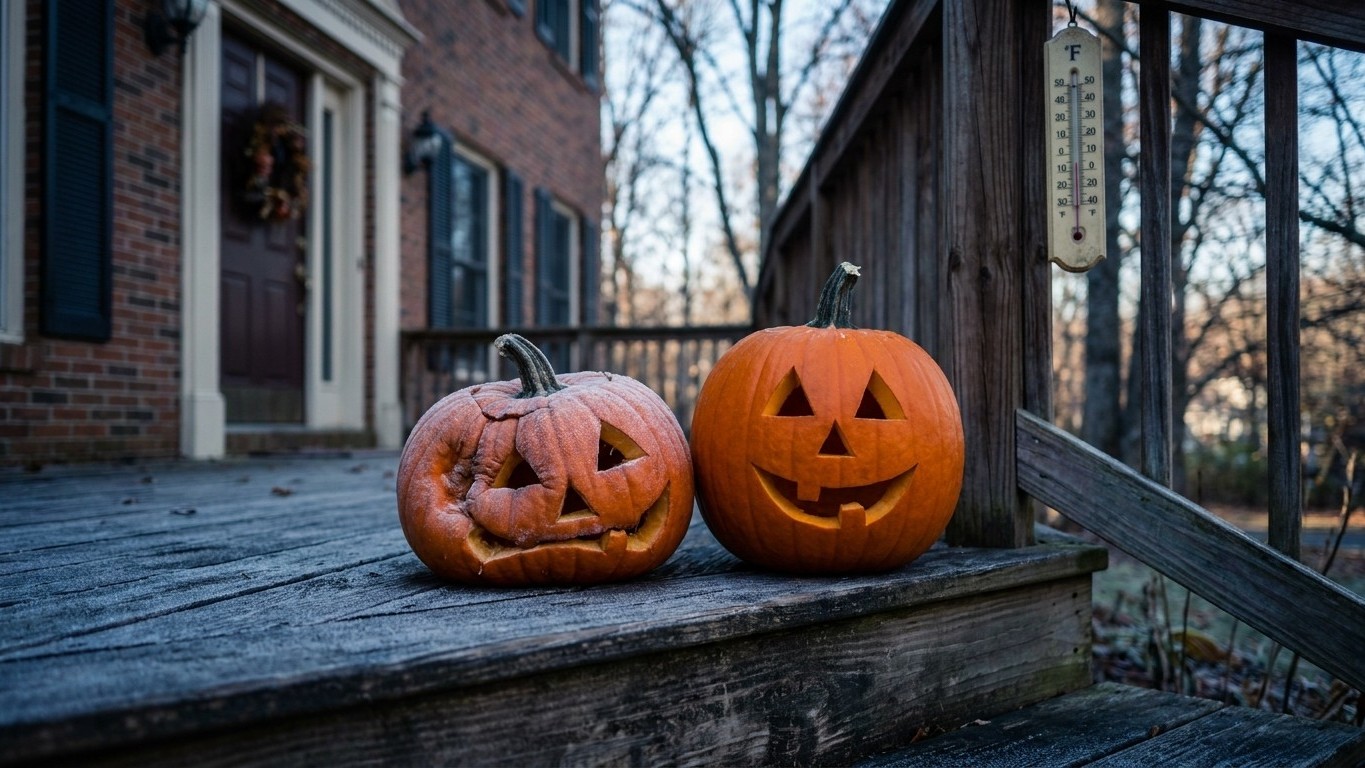

Charleston’s mean first fall frost lands somewhere between October 18 and November 1, which means West Virginia’s frost window doesn’t fall neatly before or after Halloween. It straddles it. That single fact changes how you should think about a pumpkin sitting out on a porch or step through the last week of October, and it points to a fairly narrow carving window rather than a wide-open one.
The short answer

In and around Charleston, the average date of that first 32°F freeze runs from October 18 to November 1, according to NOAA’s 30-year climate normals. Notice what that range does: it puts Halloween itself, October 31, right in the middle of the danger zone. Some years the freeze shows up nearly two weeks early. Other years it holds off until the day after trick-or-treating is over. Neither outcome is unusual here. That’s what a mean frost date actually tells you, an average built from three decades of data, not a promise for this particular year.
For a pumpkin, that uncertainty matters less for the vine (it’s already been cut) and more for how the flesh behaves once it’s exposed to a cold snap. A whole, uncarved pumpkin tolerates a light frost reasonably well. A carved one, with its rind breached and its interior open to the air, is far more sensitive to a hard freeze followed by a thaw. That freeze-thaw cycle is what turns a firm jack-o’-lantern into a collapsed one almost overnight.
Given that spread, the practical window in the Charleston area is to carve within roughly the last week before Halloween, not two or three weeks out. If you’re higher up in the mountains, tighten that further. The station data behind that October 18 to November 1 range comes from a river valley station, and valleys hold heat longer than ridgelines and higher elevations do. Across much of the rest of the state, especially in the eastern highlands and anywhere above a few thousand feet, frost tends to arrive noticeably earlier than it does in Charleston. If you garden or live at elevation, treat the early end of that range, or even earlier, as your working assumption rather than the midpoint.
So the short version: carve close to Halloween, not weeks ahead of it, and if you’re in higher terrain, lean toward the earlier side of that frost window when deciding how long a carved pumpkin can safely sit outside.
Frost or heat: which one gets it here
A whole pumpkin keeps best between 45 and 50°F, cool and dark, according to University of Illinois Extension. That’s a narrow band, and the question for any state is which direction local weather tends to push past it, toward heat or toward cold. In West Virginia, the answer isn’t close. This is a cold-risk state, not a heat-risk one, and the numbers back that up.
The cold end
West Virginia’s coldest month has a mean daily minimum of 26.1°F, per NOAA’s 1991-2020 climate normals for Charleston. That’s a statewide signal of how far below freezing this climate regularly sits once winter sets in, and it explains why the fall frost transition here is neither late nor gentle. By late October, overnight temperatures across most of the state are already trending well below that 45-50°F storage sweet spot, and in the higher counties they’re trending toward or below freezing outright. A pumpkin left uncovered on a stoop overnight in late October in Pocahontas or Randolph County, for instance, is flirting with real cold, not just a cool evening. That’s the risk that matters here: chilling and freezing, not warmth.
The warm end
Heat damage, the kind that concerns pumpkin growers in the Deep South or the desert Southwest, isn’t a meaningful worry in West Virginia in October. Daytime highs by late month have generally dropped enough statewide that a stored pumpkin isn’t at risk of overheating or softening from warm afternoons the way it might be somewhere with a much longer, hotter fall. If you’re deciding which end of that 45-50°F band to guard against here, the answer is simple: watch the cold side, not the heat side.
Where to keep it until you carve
Given a climate where cold arrives early and heat isn’t the issue, the goal is finding a spot in or around a typical West Virginia home that gets as close to 45-50°F and dark as possible, without exposing the pumpkin to a hard freeze once temperatures drop the way they do here by late October.
- An unheated garage or mudroom. These spots often run cooler than the main house but stay buffered from the kind of overnight freeze that hits an open porch, especially useful once nighttime lows start approaching the coldest-month range this state sees later in the season.
- A basement or root cellar. Older homes throughout the state, particularly in rural counties, often have below-grade space that holds a steady, cool temperature year-round, close to that ideal storage band and naturally dark.
- An enclosed, unheated porch, monitored closely. This works fine early in the season, but once the local forecast starts flirting with the state’s typical frost window, an enclosed porch without insulation can dip below safe range on a clear, cold night.
- Away from any fruit bowl or vegetable bin. Ripening fruit like apples gives off ethylene gas, which ages a pumpkin faster and shortens how long it holds up before you even pick up a knife.
- Away from direct heat sources. Furnace vents, space heaters, and sunny south-facing windows all push a stored pumpkin out of that cool range from the other direction, and in a heated West Virginia home in October, that’s an easy mistake to make.
Checking this against your own county
Charleston’s frost data is a useful benchmark, but West Virginia’s terrain changes fast over short distances, and a mean frost date from one river valley station won’t hold for a ridge twenty miles away. For county-specific timing and local growing conditions, contact WVU Extension, which maintains offices in individual counties across the state. If you’re gardening or timing a pumpkin patch visit around your area’s actual frost risk, rather than relying on a statewide average, that’s the office to ask.
Common questions
How long does a carved pumpkin actually last?
No university extension publishes a specific shelf life for a carved pumpkin, and none has tested or endorsed preservation tricks like bleach dips or petroleum jelly coatings. What’s actually documented is simpler: choose a firm pumpkin with no soft spots, keep it whole for as long as possible, and carve it close to the day you plan to display it. That’s the extension-backed guidance, and it’s less exciting than a magic formula, but it’s what the research actually supports.
Does a light frost ruin an uncarved pumpkin?
A whole pumpkin generally tolerates a light, brief frost without immediate damage, since its rind is intact. The bigger risk in West Virginia is a hard freeze followed by warmer air, which causes soft, mushy spots to develop as the flesh breaks down internally.
What should I look for when buying a pumpkin here?
University of Illinois Extension recommends choosing one with 1 to 2 inches of stem still attached, no soft spots or blemishes, and enough heft for its size. Shape doesn’t matter for quality. Never lift or carry a pumpkin by the stem itself; if it snaps off, that exposed spot becomes an entry point for rot.
Should I worry more about the mountains than Charleston?
Yes. Charleston’s river-valley location keeps it warmer later into fall than most of the state. Higher-elevation counties in the eastern and southern highlands typically see frost earlier, so anyone gardening or displaying pumpkins at elevation should plan for an earlier cutoff than the Charleston data alone would suggest.