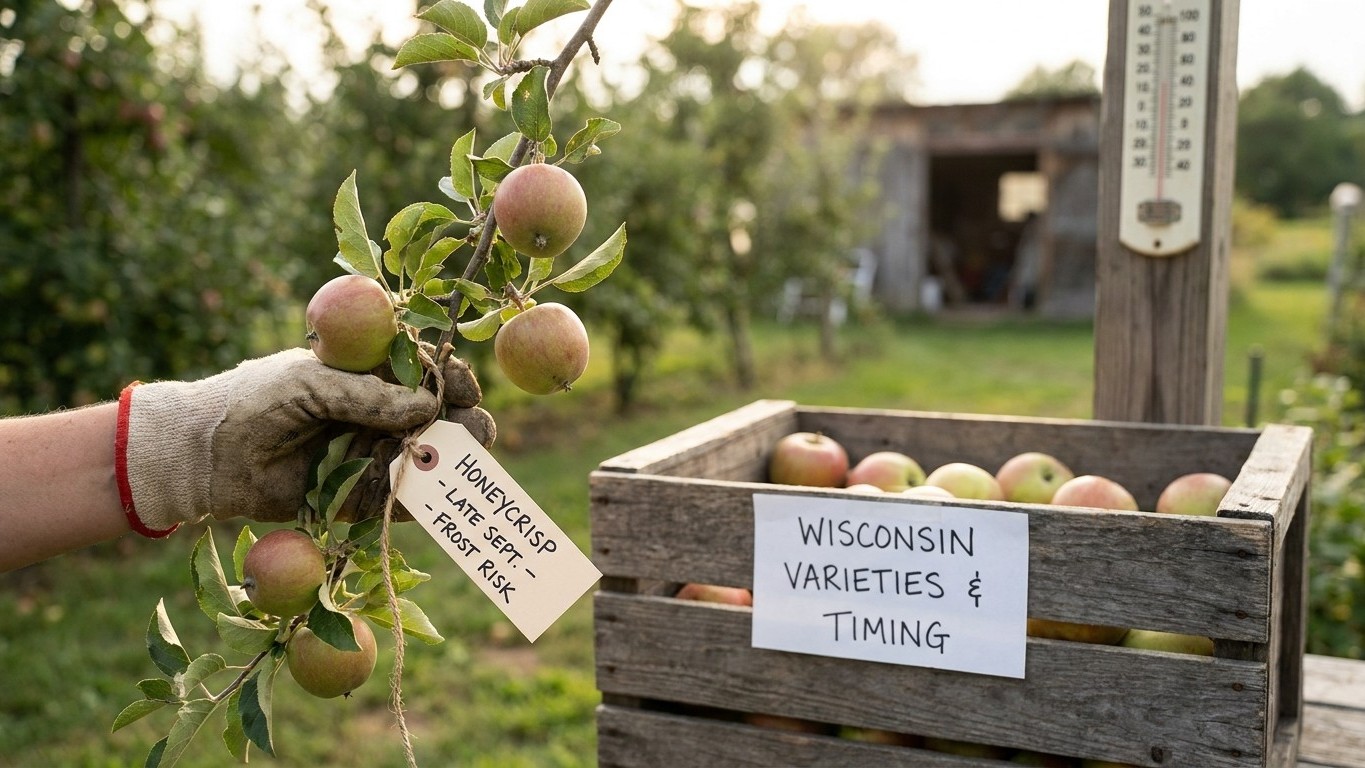

Apples grow well across Wisconsin, but which apples depends on where in the state you are. USDA’s 2023 hardiness map (based on 1991-2020 normals) runs the state from zone 3b in the northern highlands to zone 6a near Lake Michigan, and NOAA’s NCEI climate normals put the Milwaukee-area coldest-month average low at 15.6°F. Check your county’s zone against the number printed on the tree tag before you buy, not after you plant.
Can you grow apples in Wisconsin
It comes down to your zip code on the plant tag, not just the state you live in. Wisconsin runs from zone 3b up north to zone 6a right along the Lake Michigan shore, and that gap is wide enough to decide whether a given apple tree makes it through winter or not. Check your county’s zone against the number printed on the nursery tag before you buy a single tree, and see The Best Apple Varieties for Wisconsin to narrow down your options by region.
Zone and winter minimum, and why they differ by county
That 15.6°F figure belongs to Milwaukee specifically, and it describes the mean minimum of the coldest month, not the record low a hard winter can produce. Inland and northern counties run colder than the lakeshore, because Lake Michigan holds summer heat well into early winter and buffers the shoreline against sharp drops. A grower near Bayfield or Rhinelander is working with a meaningfully colder winter than one near Racine or Kenosha, even though both addresses read “Wisconsin” on a map.
The practical effect is that the zone number on the plant tag matters more here than it would in a milder state. Varieties bred and proven through decades of cold-climate trial work, mostly out of Minnesota, are the safe default for most of Wisconsin, while gardeners right along the lake have a little more room to try cultivars that would struggle thirty miles inland.
Where it’s hardest, and why it still works
None of this rules out any part of the state. Even the northern highlands, solidly in zone 3b, grow apples successfully when the variety was actually bred for that kind of cold rather than merely tolerant of it. University breeding programs in the upper Midwest have spent close to a century selecting for exactly this, because growers in Minnesota, Wisconsin and the Dakotas kept demanding it.
The one place to stay genuinely cautious is an exposed site with no windbreak, where winter desiccation and late frost both bite harder no matter what zone the map says. Site selection decides as much of the outcome as cultivar choice does. A gentle slope that drains cold air away from the trunk, backed by a windbreak on the northwest side, will carry the same tree through a rough winter that a flat, wide-open field would lose. Timing matters just as much once the tree is in the ground, and The Wisconsin Apple Calendar, Stage by Stage walks through what to expect season by season.
Which varieties suit this climate

Two separate filters decide whether an apple variety belongs on your property: winter hardiness and winter chill. They are not the same thing. Hardiness is whether the wood survives the cold. Chill is whether the tree has banked enough hours below about 45°F to break dormancy evenly and flower properly the following spring. Plant a variety selected for the wrong chill range and you get a thin, ragged bloom rather than a dead tree.
Wisconsin sits at the high end of that chill range. Winters here are long enough that chill accumulates reliably in every county, every year, and it is never the factor holding a Wisconsin apple crop back. That’s the opposite problem faced by growers much further south, where a mild winter can leave a tree short of the chill it needs (see how growers work around that shortfall in Growing Apples in Louisiana: Varieties, Timing and Frost Risk). In Wisconsin, hardiness is the filter that actually matters, and chill can mostly be set aside.
The varieties below are named for their published hardiness ranges from nursery catalogs and the breeding programs that released them, not from a Wisconsin-specific endorsed list. We haven’t found a single state source that ranks cultivars by county, so treat these as a well-documented starting point and confirm current local performance with your county extension office.
Honeycrisp

Bred at the University of Minnesota and hardy to roughly zone 3, Honeycrisp blooms midseason and ripens late, typically September into October depending on the season. It’s the variety most nurseries in the region stock first, and for good reason: the hardiness rating matches almost the entire state.
Haralson

An older Minnesota release, hardy to about zone 3, with midseason bloom and a September-to-October harvest. Haralson is tart, dense-fleshed and has a long track record in exactly this climate, which counts for something a newer variety hasn’t had time to prove.
Zestar!

Also a University of Minnesota release, hardy to roughly zone 3, but distinct for blooming and ripening early: harvest typically runs in August, well ahead of the others here. That earlier ripening window also means it clears the tree before fall frost becomes a concern almost anywhere in the state.
Cortland

Hardy to about zone 4, Cortland blooms midseason and harvests September into October. It’s slightly less cold-tolerant on paper than the Minnesota varieties above, which matters more in the northern highlands than it does near the lakeshore.
| Variety | Published hardiness | Bloom timing | Typical harvest |
|---|---|---|---|
| Honeycrisp | Zone 3 | Midseason | Late September–October |
| Haralson | Zone 3 | Midseason | September–October |
| Zestar! | Zone 3 | Early | August |
| Cortland | Zone 4 | Midseason | September–October |
Planting a pair that works here
Apple trees need a genetically different variety blooming at the same time nearby, with pollen that is actually fertile, to set a full crop. Plant one tree alone and you’ll get scattered fruit at best, because most apple varieties can’t fertilize their own flowers.
Among the varieties above, Honeycrisp and Haralson make a workable pair: both bloom midseason, both are diploid with fertile pollen, and both are proven to the same cold. Zestar!, blooming earlier than the others, pairs better with another early bloomer or a crabapple with a matching early bloom window than with a late-season variety whose flowers open after Zestar!’s have already dropped.
The trap to watch for is the small group of apple varieties, Jonagold and Baldwin among the better-known ones, that carry three sets of chromosomes instead of two. These triploid varieties produce weak or sterile pollen. They still need a pollinizer themselves, and they can’t act as one for a neighboring tree. If a nursery tag doesn’t say plainly that a variety produces viable pollen, treat it as a triploid until you’ve confirmed otherwise, and plant a known diploid alongside it either way.
The frost that costs a crop here

NOAA’s NCEI 1991-2020 climate normals put the last spring freeze for the Milwaukee-area station between April 16 and April 29, the window in which a 32°F freeze has a 30 to 70 percent chance of occurring. Inland and northern counties typically clear their last freeze later than this, and the immediate lakeshore, buffered by Lake Michigan, can lag behind it too. Eastern states with a similarly narrow spring frost window face the same seasonal gamble with different varieties, as covered in Growing Apples in Connecticut: Varieties, Timing and Frost Risk.
The detail that catches new growers off guard: a frost that hits after the buds show pink, or after the blossoms have opened, does not kill the tree. It kills the flowers. The wood, the leaves and next year’s buds are usually fine. But the flowers open only once a season, and a hard freeze at that stage can wipe out the entire year’s crop on an otherwise healthy tree. You won’t know it happened until June, when the fruitlets that should have formed simply aren’t there.
There’s not much a home grower can do to protect a full-sized tree from a hard freeze at bloom. Covering small or newly planted trees overnight when a frost is forecast during the pink or bloom stage helps, and running overhead sprinklers during the freeze event is a commercial technique that most backyard setups can’t replicate. The more reliable protection is upstream of the frost event: choosing a variety that blooms later in the window, so that more of the risk has already passed by the time its flowers open. Where the last-frost window itself runs late, as it can well into the calendar in parts of the state, a late-blooming cultivar is doing real work for you every single year, not just in the bad ones.
The apple year in Wisconsin
Track the tree by its stage, not by the date on the calendar. The frost dates above shift the stages earlier or later depending on how the season is running, but the sequence itself doesn’t change.
- Dormancy: through late winter. This is the window for pruning, while you can see the tree’s structure clearly and before sap starts moving.
- Green tip: buds swell and show the first green, typically in the weeks leading up to the last-frost window. Dormant oil sprays for overwintering pests go on before this stage ends.
- Pink: buds show color but haven’t opened. This stage often lands right at the start of Milwaukee’s April 16 to April 29 last-frost window (NOAA NCEI), which makes it the most frost-exposed point in the whole year.
- Bloom: flowers open. Frost risk is at its worst here, since open blossoms are more exposed than tight pink buds. This is also when you need a second variety flowering nearby for pollination.
- Petal fall: petals drop and the first fungicide cover sprays for scab typically go on, since wet petal-fall weather is prime infection timing.
- Fruit set: tiny fruitlets appear. Thin crowded clusters down to one or two fruits each here, for larger, better-colored apples later.
- Harvest: timing depends on the variety, from August for Zestar! to well into October for Cortland, and should wrap up before the first fall freeze, which NOAA’s NCEI normals put at October 17 to October 29 for the Milwaukee-area station, with inland and northern counties freezing meaningfully earlier.
Wisconsin’s cooperative extension keeps guidance keyed to this same stage sequence rather than fixed calendar dates, which is the more useful way to plan spray timing and pruning windows year to year.
Local help
For a variety list vetted for your specific county, and for current spray-timing guidance tied to your local weather, contact University of Wisconsin-Madison Division of Extension. Extension offices track scab and fire blight pressure locally and can tell you what’s actually showing up in orchards near you this season, which a national catalog description never will.
Common questions
Do I need two different apple trees to get fruit?
Almost always, yes. A handful of apple varieties are marketed as partially self-fertile, but even those set a heavier, more reliable crop with a second, different variety blooming nearby. Plan for two trees from the start rather than adding a pollinizer later.
How long before a new apple tree actually produces apples?
Most standard and semi-dwarf trees take three to five years to bear a meaningful crop, and full production takes longer still. A tree that blooms in its first or second year is worth pinching those blossoms off, since fruiting too early can stunt the tree’s structural growth.
Are dwarf apple trees hardy enough for Wisconsin winters?
The top graft can be just as hardy as a standard tree, but dwarfing rootstocks vary in root hardiness, and roots aren’t insulated by soil the way a trunk is protected by its own bark and by snow cover. A semi-dwarf rootstock is generally the safer bet than a fully dwarfing one in a hard winter, especially on an exposed site.
Can crabapples pollinate my apple trees?
Yes, as long as the crabapple blooms at the same time as your apple tree and produces viable pollen, which most ornamental crabapples do. This is a useful trick on a small lot where you don’t have room for two full-sized apple trees.
My tree bloomed but the buds turned brown and dropped, what happened?
That’s almost always frost damage to the open or partly open flowers, not a disease. The blossom tissue browns and drops within a day or two of a freeze at bloom, while the rest of the tree stays green and healthy. There’s no fix for that year’s crop once it happens, only next year’s variety choice or frost protection to consider.