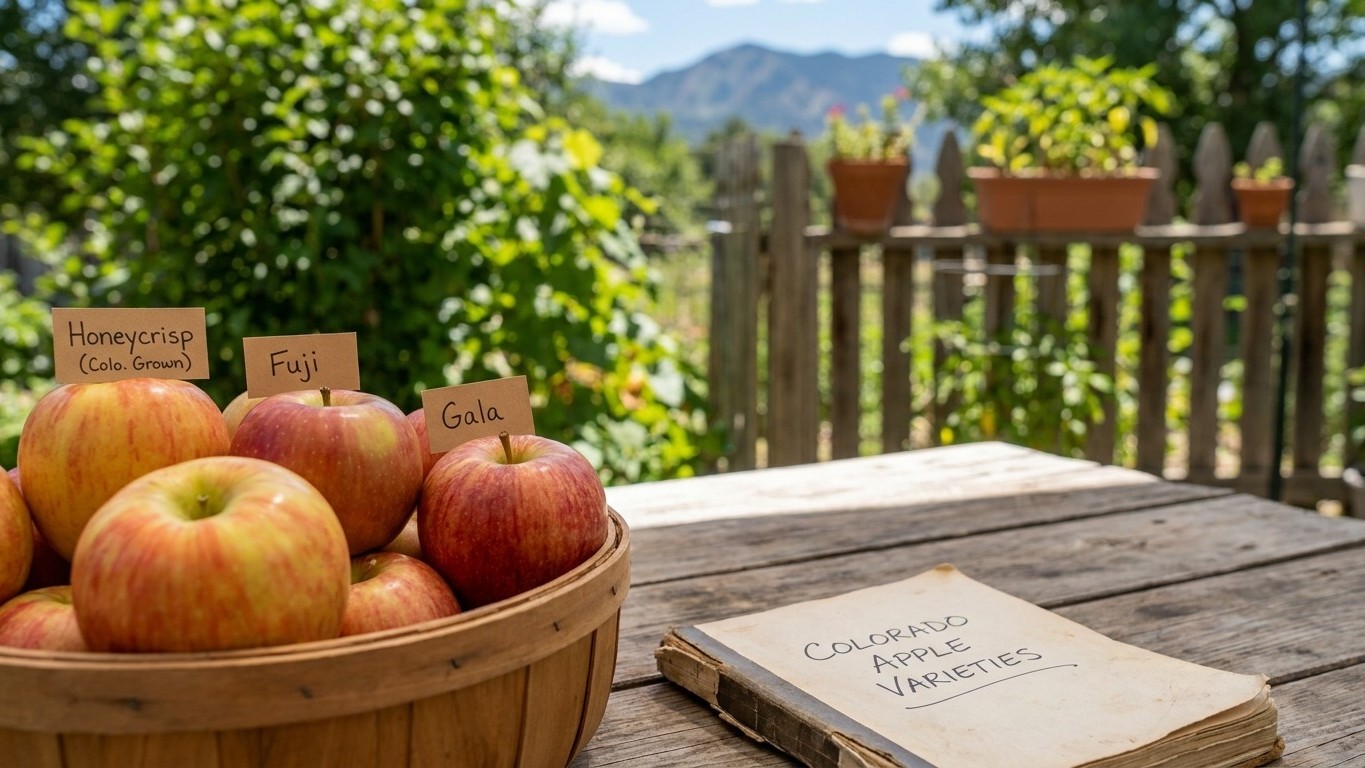

Colorado doesn’t have one best apple — it has a best apple for your exact hillside, because the tree in front of you has to clear two separate hurdles before flavor even matters: surviving your coldest winter night, and blooming late enough to miss the last spring frost. Get the rootstock hardiness and the chill-hour number wrong for your elevation, and no amount of taste-testing at the nursery will save the crop. So before you buy anything, ask for both figures and check them against what your own yard actually does, not what the tag promises.
The short answer for Colorado
For a reference point at Denver, the NOAA station used for these normals, the coldest month averages a nightly low of 17.1°F, and the last spring freeze falls between May 1 and May 11 according to NOAA’s 1991-2020 climate normals. The first fall freeze, by the same record, lands between September 30 and October 12. Any apple tree planted in this part of the state has to survive that winter minimum and needs a bloom date that lands after the frost window closes, or a late frost takes the blossoms and there’s no crop that year.
That answer depends on where in Colorado you’re standing. Denver’s numbers describe the urban Front Range plains at roughly 5,280 feet. A mountain valley a few thousand feet higher runs a shorter, colder season and can see frost even in July, while the Western Slope’s fruit country runs on its own separate frost calendar entirely. None of the three follow Denver’s dates, so treat the figures above as a Front Range baseline, not a statewide rule.
The other half of the answer is winter chill, the number of cold hours a tree needs before it flowers normally in spring. Hardiness tells you whether the tree survives the winter, and chill tells you whether it blooms correctly once spring arrives, and the two are independent of each other. A grower has to satisfy both before a variety name means anything.
Working through it

Start with hardiness. Denver’s 17.1°F average low for the coldest month, per NOAA’s 1991-2020 normals, is a mild reading next to a mountain valley or a high park where the same average runs several degrees colder. An apple rootstock and scion combination that shrugs off a Front Range winter is not automatically safe two hours away at higher elevation. Growing Apples in Colorado covers the site checks worth running before you plant, things like slope, air drainage and wind exposure, all of which shift the cold a tree actually experiences beyond what one station reading tells you.
Hardiness comes first
A tree that cannot survive the winter minimum at your site is off the list regardless of anything else it offers, flavor, disease resistance, or a long track record elsewhere. Ask for the rootstock’s documented hardiness rating before you ask about fruit quality. Rootstock hardiness and scion hardiness (the fruiting variety grafted onto it) are reported separately by nurseries, and both have to clear your local winter, not just one of them.
Chill is the second filter, and it cuts the other way
Winter chill works against the calendar in the opposite direction from hardiness. A variety bred for a long, cold, reliable winter can sit in a state that dips just as cold but warms and cools unevenly through the season, and it can end up short on the accumulated chill hours it expects, which shows up the following spring as uneven or delayed bloom. This region’s specific chill accumulation is not something NOAA’s frost and temperature normals report, and no source in our records ties a chill-hour figure to a Colorado town. That is a gap worth closing directly with Colorado State University Extension for your county before you commit to a cultivar.
What to check before choosing a fruit tree
What it can give you is the filter to run any candidate through: rootstock hardiness against your site’s coldest month, published chill requirement against your area’s typical winter pattern, and bloom timing against the May 1 to May 11 last-frost window NOAA records for Denver, adjusted for your own elevation and region. A nursery tag or an extension fact sheet that names varieties for your county has already done the local homework.
| Bloom timing category | Risk against Denver’s May 1-11 frost window | What it costs you |
|---|---|---|
| Very early bloomer | High, blossoms open before the window reliably closes | Frequent blossom loss in an average year |
| Mid-season bloomer | Moderate, some years catch a late freeze | Occasional light crop years |
| Late bloomer | Low, blossoms usually open after the window closes | Shorter effective season for fruit to mature |
What changes across Colorado
Denver’s figures describe one station on the plains at roughly 5,280 feet. The Front Range foothills and the high mountain valleys nearby sit at a much higher elevation and run a shorter frost-free season by a wide margin. Mountain towns can see a freeze in July in a hard year, far outside anything the Denver record predicts, which rules out any variety that needs a long, uninterrupted run of warm weeks to finish ripening.
The Western Slope, on the far side of the Continental Divide, runs a separate weather system entirely. Fruit growing country there, including the valley around Grand Junction and Palisade, sits at lower elevation than the mountain towns and follows a different frost pattern shaped by the Colorado River valley, which is part of why that area has a long-standing commercial fruit industry.
Low-lying valleys anywhere in the state, mountain or plains, collect cold air on clear nights and can run several degrees colder at ground level than a slope just a few hundred feet higher. Planting in a low spot near a creek or at the bottom of a hillside means treating your actual frost dates as later in spring and earlier in fall than a station reading a few miles away would suggest, and checking with Colorado State University Extension for anything specific to your elevation.
The mistakes this climate punishes
The first mistake is choosing a variety for how it performed somewhere else, without checking its bloom timing against Denver’s May 1 to May 11 last-frost window from NOAA’s 1991-2020 normals, or the equivalent window for your own location. An early bloomer that flowers before that window reliably closes loses its blossoms to a late freeze more years than not, and the damage shows up right at bloom time, not at harvest, when it’s too late to do anything but wait for next year.
The second is planting a long-chill variety and assuming a cold Colorado winter automatically satisfies it. Chill accumulates from steady cold, not from a winter that swings between hard freezes and warm spells, and a variety that needs a long unbroken cold stretch can come up short even where the coldest month’s average, like Denver’s 17.1°F reading, looks plenty cold on paper. The shortfall shows up as blossoms that open unevenly or weeks late the following spring, well after you’ve already committed a season’s care to the tree.
The third is feeding or watering heavily late in the season, which pushes soft new growth right as the first fall freeze approaches. NOAA’s 1991-2020 normals put that freeze at Denver between September 30 and October 12, and a tree still putting on tender growth when that date arrives takes tissue damage a hardened-off tree would shrug off. Stop nitrogen feeding and taper watering by late summer so the tree has time to harden before the freeze window opens, not after it’s already passed.
Checking this against your county
Every figure in this article is anchored to Denver’s NOAA station, and Colorado’s elevation range means your county’s actual frost dates, winter lows and growing season can differ from that reading by weeks. Colorado State University Extension (extension.colostate.edu) keeps county-level fact sheets and can point you to a named apple variety list suited to your specific elevation and region.
Before you plant, ask your local extension office for the frost dates recorded closest to your actual site, not just your county seat, and for its published chill guidance if one exists for your area. The Colorado Apple Calendar, Stage by Stage walks through applying those local dates once you have them, stage by stage from dormancy through harvest, rather than by calendar month alone.
Common questions
Can apples even survive at high elevation in Colorado?
Yes, in many mountain towns, but the growing season runs shorter and the frost risk runs later into spring and earlier into fall than the Denver figures in this article. Ask Colorado State University Extension for a hardiness and frost reading specific to your elevation before you choose a rootstock.
Do I need two apple trees for pollination?
Most apple varieties need cross-pollination from a different variety blooming at the same time, so a single tree often sets little to no fruit on its own. Check the pollination requirement on the nursery tag for whatever cultivar you’re buying, since a few varieties are partly self-fertile and most are not.
My tree bloomed fine but never set fruit, what happened?
The two most common causes are a late frost that killed the open blossoms and a lack of an overlapping pollinator variety nearby. A frost event is easy to miss after the fact because the blossoms can brown and drop within a day or two, well before you’d think to connect it to a cold night weeks earlier.
How do I find a rootstock hardy enough for my specific site?
Ask the nursery for the rootstock’s documented cold hardiness rating and compare it against the coldest-month low for your area, not just the statewide reputation of “cold-hardy” rootstocks in general. Colorado State University Extension can also point you toward rootstocks with a track record in your county, which matters more than a national catalog description.