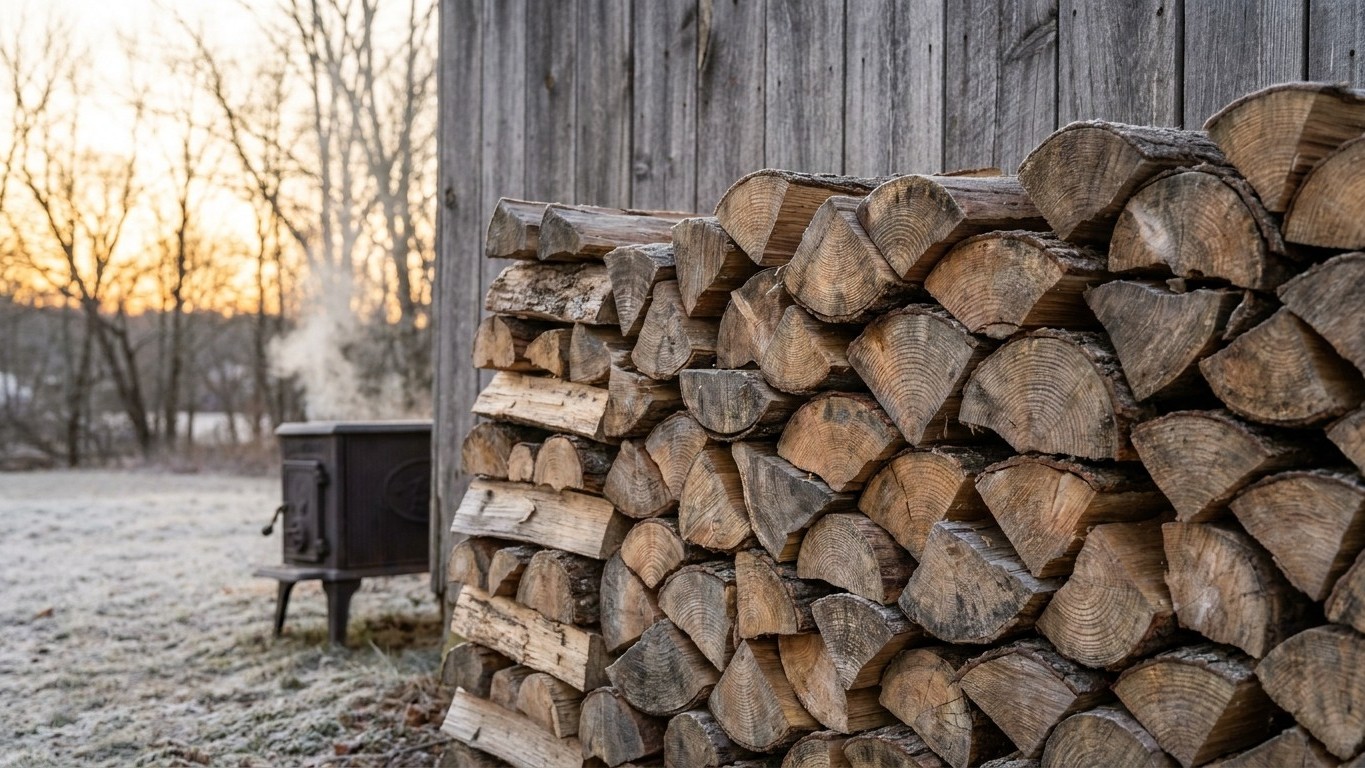

Connecticut winters bottom out at an average low of 24.4°F in the coldest month, measured at the Bridgeport reference station. That single number decides how much firewood a household actually needs, which species are worth chasing, and how much lead time seasoning wood demands before the cold arrives.
How cold it actually gets here

The figure comes from NOAA’s Climate Normals for 1991-2020, and it isn’t the record low or some dramatic cold snap. It’s the average daily minimum for the coldest month at Bridgeport, which sits close to the coast and runs milder than inland Connecticut towns like Litchfield or Winsted. Inland, that number drops lower on many nights. But even at the coastal reference point, 24.4°F means the thermometer regularly sits eight degrees below freezing before dawn, night after night, for weeks at a stretch.
That’s cold enough that firewood in Connecticut is not a decorative hobby. A figure above 40°F would mean a different category of heating, something closer to ambiance and the occasional weekend fire. Below freezing on the coldest nights changes the math entirely. A wood stove or insert running through a Connecticut January has to carry a house through hours of sustained cold, not just take the edge off a chilly evening.
What that means in practice: overnight burns matter more here than in a milder state. A stove loaded before bed needs to still be producing coals by 6 a.m., because the house has spent eight or nine hours losing heat into 24-degree air outside. That’s a different job than a fire lit for a couple of hours after dinner. It also means the difference between a dense, well-seasoned load and a light, half-dry one shows up directly in the thermostat reading at breakfast, not just in how quickly the fire burns down.
For anyone using wood as a supplement to oil, propane, or electric heat, the impact is smaller but still real. A cold snap that dips well below that 24.4°F average, which happens most winters, is exactly when a backup heat source earns its keep. For anyone leaning on wood as a primary heat source, the same nights are the ones that decide whether the stack in the yard was cut generously enough back in spring.
None of this means Connecticut winters rival northern Vermont or Maine. They don’t. But they’re cold enough that the choices covered in the rest of this guide, which species to burn, how much to stack, and when to start drying it, aren’t optional refinements. They’re the difference between a warm house in February and a cold one.
Which woods are worth the effort here
A cord is a fixed volume, a stack measuring 4 feet by 4 feet by 8 feet, or 128 cubic feet, no matter what species fills it. That matters because density is what turns that fixed volume into usable heat. A cord of dense hardwood packs far more wood fiber, and far fewer air gaps, into the same stack than a cord of a lighter species. Michigan State University Extension puts the average heat value of a cord of well-seasoned hardwood at roughly 20 million BTU, which works out to about the same heat as 145 gallons of #2 fuel oil, or 215 gallons of LP gas. That’s the number a Connecticut household is measuring against every time it decides whether to buy another cord.
With a coldest-month average of 24.4°F, density isn’t a nice-to-have. The colder the nights, the more a household needs each log to carry, because there are only so many hours in the evening to reload the stove and only so much space in a firebox. Denser wood means fewer reloads, longer overnight burns, and more heat squeezed out of the same stack of split wood taking up space in the yard.
That’s why the densest hardwoods, the ones that pack the most weight and BTU into a cord, are the ones worth prioritizing for the coldest stretch of a Connecticut winter, the weeks bracketing that January average low. Save them for overnight loads and the nights the forecast actually worries you. Lighter, less dense woods still have a place in the wood shed, they’re easier to split, they catch faster, and they’re genuinely useful for shoulder-season fires in October and April when the goal is taking the chill off a room, not holding heat through a frigid night. Nobody needs to burn their best oak to warm up a mild October evening.
For the full breakdown of which species rank where by density and BTU output, this site’s dedicated firewood species guide has the specifics. What matters at the Connecticut level is the principle: match the densest wood available to the coldest nights, and don’t waste it on fires that don’t need it.
One practical note that matters as much as the density table: availability. A species with excellent numbers on paper is worthless if no local supplier sells it seasoned, or if it’s only sold green with a promise it’ll be “ready by winter.” A moderately dense species that’s actually available split, stacked, and dry beats a theoretically superior species you can’t find seasoned in time. In Connecticut, that usually means working with what regional firewood dealers and local woodlots actually carry, not chasing a species that isn’t part of the local supply chain.
How much wood a winter takes
Any number claiming to tell a Connecticut household exactly how many cords a winter requires, without asking anything else, is guessing. The honest answer depends on three things: how cold the winter actually runs (that 24.4°F average is the baseline, but some winters run colder), how well the house holds onto heat once it’s generated, and whether wood is the main heat source or backup to a furnace or boiler.
Insulation is the variable that moves the needle the most, and it’s the one most often ignored in generic firewood calculators. A tightly sealed, well-insulated house built or upgraded in the last couple of decades can hold heat from a stove for hours. An older Connecticut farmhouse or a drafty antique colonial, common enough across the state, can lose that same heat almost as fast as it’s produced. Two houses in the same town, facing the same 24.4°F nights, can end up needing wildly different amounts of wood simply because one leaks heat through old windows, uninsulated walls, and an attic that was never upgraded.
That gap isn’t small. A poorly insulated house in a genuinely hard winter, one where that coldest-month average gets beaten by an extended cold snap, can burn through close to double what a tight, well-sealed house uses over the same stretch of weather. That’s the mechanism behind why one neighbor swears three cords gets them through winter while another burns six and still runs the furnace on the coldest nights.
Whether wood is primary or supplemental heat shifts the estimate again. A household using a wood stove as the sole heat source for the whole house needs enough wood to cover every day of the season, including the mild stretches in November and the sharp ones in January. A household burning wood a few evenings a week to supplement oil or propane heat is really only offsetting a fraction of total heating demand, and needs a fraction of the wood.
The practical move is to track actual usage through one full Connecticut winter, noting how many loads got burned during a genuine cold stretch versus a mild one, then adjust the next year’s order up or down. That beats trusting a number pulled from a national average that has no idea what the insulation in a specific house looks like.
Drying wood in this climate
Seasoning matters more than species, in Connecticut or anywhere else, and the mechanism is straightforward. Green wood can hold more than 60 percent moisture, and every bit of that water has to boil off before the wood releases usable heat, according to Michigan State University Extension. That boiling process eats the energy a homeowner is trying to burn for warmth, which is why a green log hisses, smokes, and struggles to sustain a flame instead of putting out real heat. The target, regardless of species or region, is 20 percent moisture or less.
Connecticut’s humid summers slow that process down compared to drier inland climates. Split wood needs consistent airflow through the stack to dry properly, and a stack in a shaded, humid Connecticut backyard through July and August dries slower than the same stack would in a place with less summer humidity. That’s a real regional difference, and it means the drying season here has less margin for error than it does in drier states.
What actually dries wood is air movement and time, not direct sun. A stack up on rails or pallets, split into reasonably sized pieces, loosely covered on top but open on the sides so wind can pass through, will season faster than a tightly tarped pile baking in direct sunlight. Red oak is the documented exception to any general timeline: MSU notes it dries slowly because of its cell structure, so it needs longer than most other hardwoods to reach that 20 percent target, regardless of how well it’s stacked.
That timeline collides directly with the coldest-month figure that opened this guide. Wood split and stacked in April or May for burning that same winter usually isn’t ready by the time that 24.4°F average low arrives in January. A single Connecticut summer of proper stacking, split and exposed to moving air, generally gets seasoned hardwood down to burnable moisture, but it needs the whole season, not a few weeks. Cutting wood in spring for the winter that follows, not the one already underway, is the single most common mistake among Connecticut households heating with wood, and it’s the one that leaves people burning half-dry logs on the coldest night of the year.