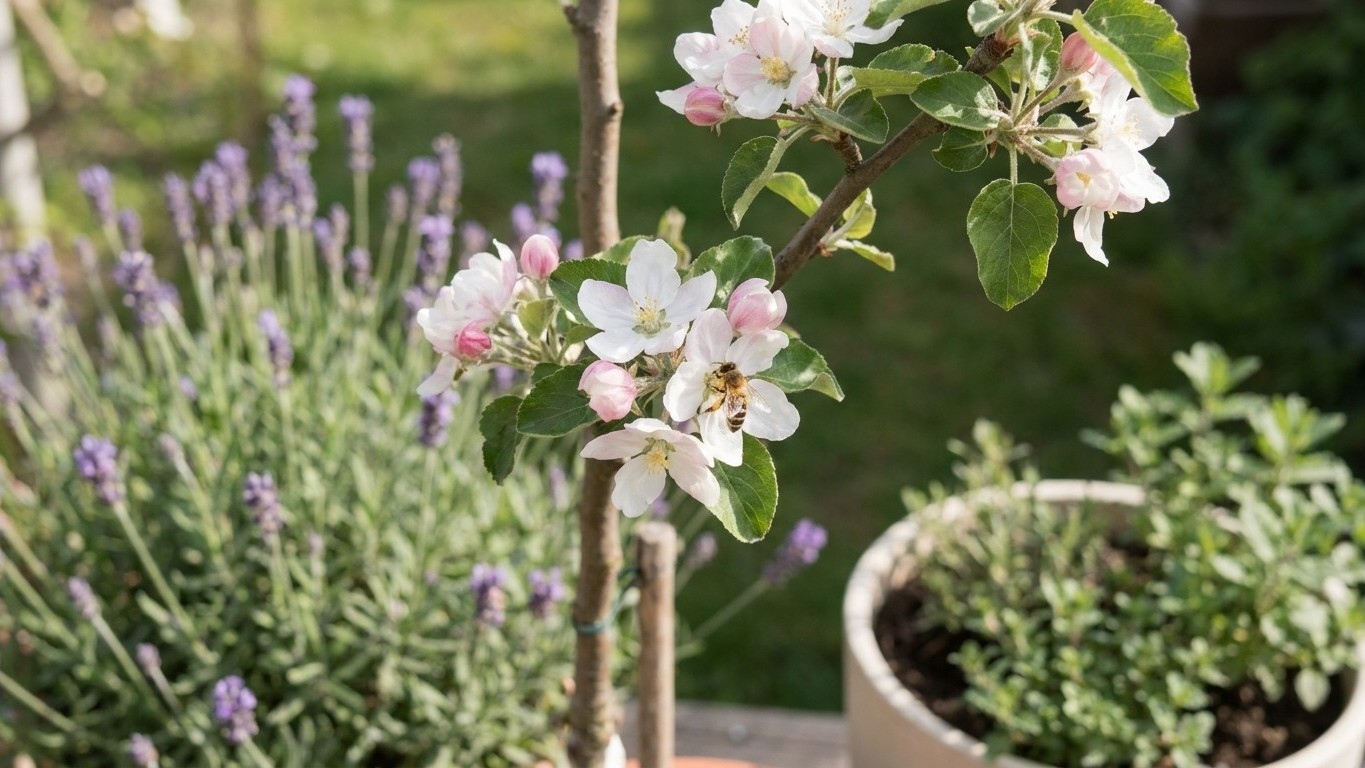

Candy Crisp needs another apple tree blooming in that same mid-season window standing nearby to set fruit — that much is published, and it’s the piece you can actually plan around. Beyond that, no named partner variety or pollen-fertility detail exists for this cultivar in the source used here, so any specific pairing you’ve heard about is unverified until a nursery confirms it. Start by locking down bloom timing, not a variety name, before you plant anything next to it.
The short answer
USU Extension’s Apple Production for the Utah Home Garden does not publish a named list of compatible pollinizers for Candy Crisp. That gap matters more than it might seem. Guessing at a partner variety by name, with no source behind the pairing, is how growers end up with two trees that bloom weeks apart and set almost no fruit. What USU does publish is the bloom timing itself: Candy Crisp flowers in the Mid season window, and that single fact is the one a grower can actually plan around.
The safe move is to choose a second apple tree that a catalog or a local nursery confirms blooms in that same mid-season window, and to treat any specific pairing you hear about informally as unconfirmed until checked against a source you trust. If you already understand the basics of apple pollination, the next question is how many trees to plant, not just which one.
That answer depends on something else USU’s guide does not state for Candy Crisp: whether its pollen is fertile or sterile. Most apple varieties produce fertile pollen and need only one partner tree nearby to crop well. A minority carry sterile pollen, usually triploid varieties, and need two other trees close by, because they can receive pollen but never return the favor. The extension tables name only four pollen-sterile varieties—Jonagold, Mutsu, Stayman, and Winesap—and since Candy Crisp is not among them, a third tree becomes necessary only if the chosen partner variety turns out to be one of those sterile types.
Why these varieties and not others

Apple varieties are sorted into bloom groups, and two trees only cross-pollinate if their bloom groups overlap enough for bees to carry pollen between them while both are still flowering. Clemson Cooperative Extension describes this as a relative order rather than a calendar. An “early,” “mid” or “late” bloom group means a variety flowers before, alongside, or after its neighbors in the same orchard, not on a fixed date. The actual date moves by a couple of weeks or more from one region to the next and even year to year, but the order of who blooms first relative to whom stays largely the same. That is why USU Extension can label Candy Crisp’s bloom timing as Mid without giving a calendar date at all, and why a gardener in Utah and a gardener in a colder or milder climate can both use that same label to find a working partner locally.
What the label does not tell you
A shared bloom group tells you two trees might flower at the same time. It tells you nothing about whether the pollen either tree produces will actually work once bees move it. Fertile pollen is not guaranteed by bloom timing alone. Some mid-season varieties carry sterile pollen despite flowering at exactly the right moment, and a garden built on two such trees blooms beautifully and sets no fruit at all. Bloom group also says nothing about parentage. Two varieties can flower in the same window and still fail to pollinate each other if one was bred directly from the other, because a seedling’s flowers are genetically too close to its own parent’s pollen to set fruit reliably. None of this is unique to Candy Crisp. It is the reason “plant any two apple trees” is bad advice for any variety, and the same two caveats apply to a grower comparing options on the neighboring guide, what pollinates Cortland, and what cannot.
What cannot pollinate it
No source used here names a variety that fails to pollinate Candy Crisp specifically, whether from sterile pollen in the same bloom group or a parent-and-seedling relationship. That is worth saying plainly rather than guessing. Compatibility beyond the bloom-timing label is not published for this cultivar, and a grower who wants a guaranteed pairing should ask a nursery that has actually trialed the cross, not rely on a general chart.
How these exclusions work in apples generally
The two failure modes are well documented across the apple world even where they are not documented for Candy Crisp specifically. The first is sterile pollen, usually found in triploid varieties, cultivars carrying three sets of chromosomes instead of two. Jonagold, Baldwin and Bramley’s Seedling are well-known triploids. Each can be pollinated by a suitable partner, but its own pollen does nothing for the tree standing next to it. A garden planted with only two triploid varieties, or with one triploid and nothing else nearby, blooms fully and sets little or no fruit, because neither tree ever receives working pollen.
The second failure mode is parentage. A variety bred directly from another cannot be reliably fertilized by that same parent, even if both flower in the same week. The genetics are too close, in the same way a seedling apple tree grown from a Red Delicious seed does not reliably cross with a Red Delicious parent nearby. This has nothing to do with bloom timing. Two trees can overlap perfectly and still fail this way. Since USU’s guide does not publish Candy Crisp’s parentage or confirm a triploid status either way, neither exclusion can be stated here as fact. A grower planning an orchard around Candy Crisp should treat any single named partner heard informally the same way, as a claim to verify with a nursery rather than a rule to build a two-tree orchard on without a backup, the same caution that applies on what pollinates Paula Red, and what cannot.
How close the second tree has to be

Apple pollen moves on bees, not on the wind, so distance is a practical question about where bees actually forage, not a fixed number of feet. The closer the two trees, the more reliable the cross. A partner planted in the same garden, ideally within sight of the Candy Crisp tree, gets visited by the same foraging bees on the same pass. A tree three properties away, past a fence line and a driveway, might still work if local bees range that far, but it is a weaker bet than one ten feet from your own trunk.
The second tree does not have to be a named apple cultivar bought on purpose. A neighbor’s mature apple tree, if it blooms in the same mid-season window, does the job as well as one you planted yourself, at no cost. An ornamental crabapple flowering at the same time works too. Many flowering crabapples are heavy pollen producers and are planted in commercial orchards for exactly that reason. A single pollinator branch grafted onto an existing tree, covered in the next section, also puts flowering wood close enough for bees to move between it and the rest of the canopy in one visit.
What no partner can fix
None of this helps if the weather during bloom keeps bees from flying. Cold, wet or windy conditions during the bloom window shut pollination down regardless of how well the partner variety was chosen, because bees simply do not forage in those conditions. A well-matched partner planted at the right distance still sets little fruit in a season where bloom coincides with a cold snap. There is no substitute tree, no third variety and no grafting trick that fixes a week of bad weather at the wrong moment. That risk is why many growers plant more than the bare minimum of two trees, so a poor bloom year for one partner still leaves other flowers open once the weather clears.
If there is no room for a second tree
A small garden still has options short of planting a full second standard tree. Each one solves the space problem differently, and each still depends on the same bloom-timing match covered above.
| Option | Space needed | Effort | Still needs matching bloom time |
|---|---|---|---|
| Multi-grafted “family” tree | Same as one standard tree | Extra pruning to balance varieties | Yes, built into the graft choice |
| Pollinator branch grafted onto existing tree | None extra | Grafting skill, one to two seasons to establish | Yes |
| Columnar apple variety | Border strip or large container | Low, standard care | Yes |
| Flowering crabapple | Small ornamental footprint | Low, standard care | Yes, check the tag |
A multi-grafted tree carries two or more varieties on one trunk, so the pollen source and the fruiting variety share a single footprint. It costs more up front than a single-variety tree. A pollinator graft is the cheaper version of the same idea, using scion wood from a compatible variety grafted onto a branch already in the ground, but it takes a season or two to establish flowering wood. A columnar apple fits into a border or a large container and can serve as the second tree where there is no room for a full canopy. None of these options changes the fact that bloom-time overlap and pollen fertility still have to match, whichever way the second flower reaches the garden.
Common questions
Can Candy Crisp pollinate itself?
Not reliably. Like nearly all apple varieties, Candy Crisp crops better with a compatible partner nearby than it does alone, even in a garden with only one tree and no room for another. A single tree may still set some fruit in some years, but a second mid-season bloomer close by improves that outcome substantially.
Is Candy Crisp a triploid with sterile pollen?
That is not stated in USU Extension’s guide, and no other source used here confirms it either way. Until a nursery or extension office confirms the pollen status directly, the safer plan for a small garden is a third tree if space allows, so the orchard still works whichever way that trait turns out.
Will an ornamental crabapple work as a pollinator?
Yes, provided it flowers in the same mid-season window Candy Crisp does. Many ornamental crabapples bloom heavily and produce abundant pollen, which is why orchards plant them alongside eating apples for exactly that purpose. Check the bloom timing on the crabapple’s own tag or catalog listing before relying on it.
What if my two trees almost overlap but not exactly?
Partial overlap still helps. Bees will cross-pollinate between two trees for as many days as both have open flowers, even if one started blooming earlier and finishes first. A few days of overlap sets less fruit than a full week of overlap, but it is far better than no overlap at all.
Does a compatible partner guarantee a full crop?
No. Weather during bloom, bee activity, and a hard frost around the flowering period all affect the final fruit set regardless of how well the partner variety was chosen. Pollination compatibility removes one obstacle, not all of them.