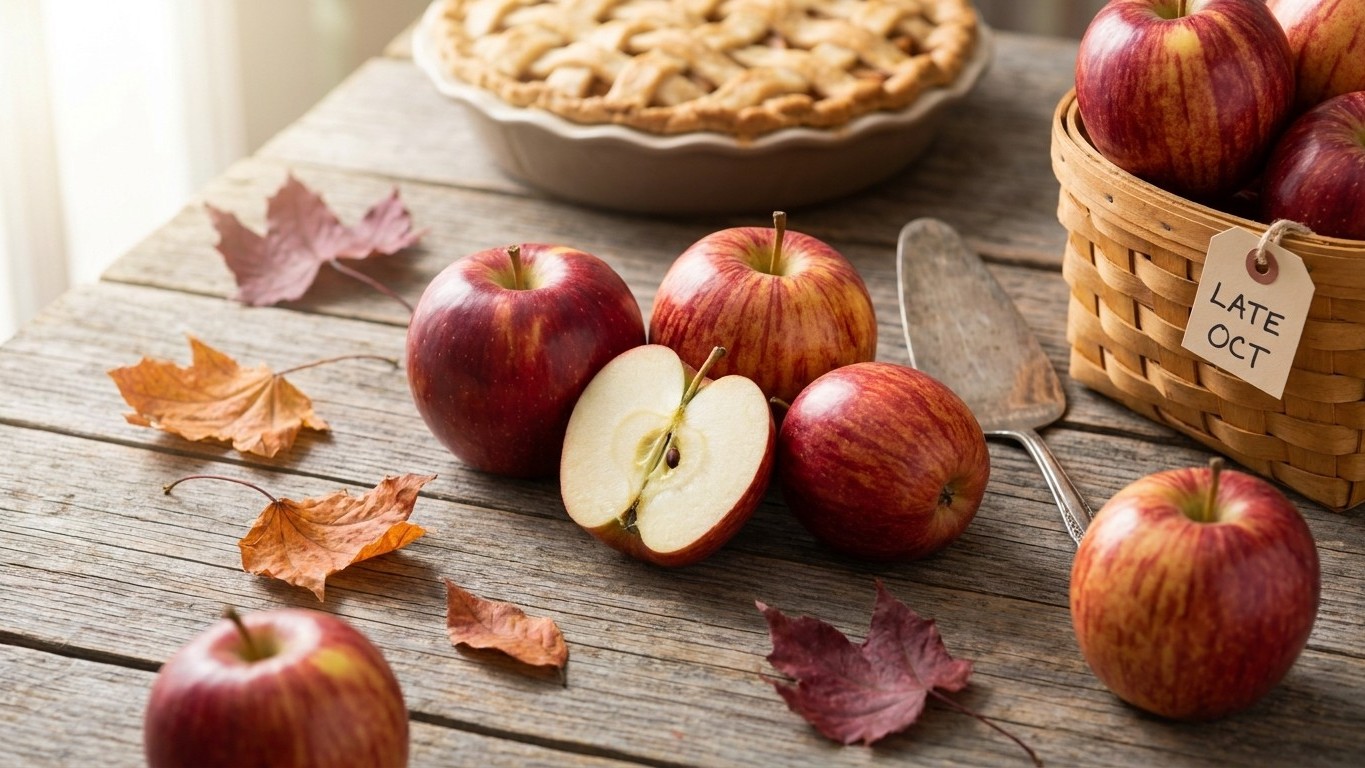

The Cameo apple ripens in late October, carries a sweet-tart flavor with a hint of citrus, and holds its firm, crisp flesh whether you eat it fresh or bake it into a pie. It’s sold in some markets under the name Carousel, so if that label rings a bell, you’ve likely already had one. The variety needs company in the orchard to fruit well, but its exact pollination partners aren’t documented in university extension sources, a gap worth knowing before you plant.
What Cameo actually is

A grower picking up a Cameo tree is buying four specific things: a harvest date, a flavor profile, a set of kitchen uses, and a storage life. Here’s what each one means in practice.
- Ripens: Late October, according to Utah State University Extension’s apple production guide for home gardens.
- Tastes like: Sweet-tart with a slight citrus note, backed by very firm, crisp flesh.
- Good for: Fresh eating and baking, since it holds its shape when cooked and resists browning once sliced.
- Keeps: Longer than most dessert apples, earning it a reputation as a solid keeper.
That combination of firmness and shape retention is the reason a Cameo works in a pie where a softer, mealier apple would collapse into sauce. The acidity that gives it the citrus edge also survives baking, so the filling doesn’t turn flat and sugary the way it can with a purely sweet variety. That’s a physical trait, not a marketing label: flesh structure and acid level, not just a name on a tag, decide whether an apple belongs in a lunchbox or a pie dish.
The resistance to browning matters more than it sounds. Anyone who has packed apple slices for a kid’s lunch or built a cheese board knows how fast cut apple turns brown and unappetizing. A variety that holds its color longer without a lemon-juice bath is genuinely useful in the kitchen, not just a nice-to-have.
Because it’s also marketed as Carousel, a shopper comparing bins at a farm stand or reading nursery catalogs might see both names attached to what is functionally the same apple. That’s worth knowing before you assume you’re choosing between two different varieties when you’re really choosing between two labels for one.
Will it grow where you are
Hardiness zones
Cameo is rated for USDA hardiness zones 5 through 8, per Utah State University Extension. That’s a wide band, stretching from areas with winter lows around minus 20 degrees Fahrenheit up through much milder regions where frost is occasional rather than routine. If your area falls inside that range, cold hardiness alone won’t rule the tree out. If you’re gardening in zone 4 or colder, or in zone 9 and warmer, the tree is working outside its documented comfort range and you should expect more risk of winter injury or, at the warm end, poor performance tied to the second filter below.
Winter chill
Hardiness zone is only half the picture. Apple trees also need a minimum number of hours below about 45 degrees Fahrenheit each winter to break dormancy properly and bloom on schedule. This is called winter chill, and it’s the reason some apple varieties fail in mild-winter regions even when the zone map says they should survive just fine. A tree that doesn’t get enough chill hours can leaf out unevenly, bloom late or sparsely, and set a disappointing crop even in a spot that never freezes hard.
For Cameo, a specific chill-hour figure isn’t published in the sources available for this page, so it’s better to say that plainly than to guess. What can be said with confidence is that a variety rated for zones 5 through 8 is built for regions with real winter cold, meaning it likely needs a moderate-to-high chill requirement typical of Northern and mid-elevation growing areas rather than the low-chill needs of Deep South or coastal Southern California orchards. Gardeners in genuinely mild winter climates should check with a local extension office before planting, since chill requirement, not just cold tolerance, is often the reason a Northern apple sulks in a Southern yard.
What to plant beside it
This is usually the question that brings a reader here in the first place, and it deserves a straight answer: the specific pollination partners for Cameo aren’t documented in the sources used for this page. That’s a real gap, not an oversight worth papering over with a guess, and naming a variety at random would do more harm than saying nothing.
What is known is that Cameo blooms mid to late season, according to Utah State University Extension. That detail matters even without a named partner list, because any pollinizer you choose has to overlap with that bloom window. A very early-blooming variety planted nearby may finish flowering before Cameo even opens, which defeats the purpose of planting it as a partner.
Nearly all apple varieties crop better with a compatible partner nearby, even when they’re capable of setting some fruit alone. A neighbor’s tree, a nearby orchard, or even a well-placed crabapple can sometimes supply enough pollen to get by, but yields and fruit set are typically stronger with a known, deliberately chosen partner in the same yard. Since no specific partner is documented for Cameo here, the safest approach is:
- Choose one or two mid-to-late blooming apple varieties confirmed compatible with Cameo through a local nursery or extension office.
- Avoid pairing it only with early-blooming varieties, since the bloom windows may not overlap enough for effective pollination.
- Consider a crabapple with a long bloom period as a backup pollen source if space allows.
One general rule worth remembering across apple varieties: a parent variety can’t pollinate its own seedling, even if the two bloom at the same time and stand right next to each other. That’s a genetic dead end regardless of timing, and it’s a common trap for gardeners who assume that any two apple trees flowering together will do the job. For a fuller breakdown of how apple pollination works and how to choose compatible pairs, see our apple pollination guide.
Growing it well
Fire blight
Cameo is rated moderately susceptible to fire blight by Utah State University Extension, a bacterial disease that can move fast through blossoms and young shoots in warm, wet spring weather. In the garden, that rating translates into a real task list rather than an abstract warning: watch new growth for a sudden, blackened, “shepherd’s crook” wilt at the shoot tips, especially after a warm rain during bloom, and prune out infected wood promptly, cutting well below the visible damage and disinfecting tools between cuts. Skipping that step lets the bacteria travel back into older wood and, in bad cases, into the trunk.
Avoiding conditions that invite disease
Because the susceptibility is moderate rather than low, a grower doesn’t need to panic over every wet spring, but shouldn’t get complacent either. Heavy nitrogen fertilization pushes soft, fast growth that fire blight exploits more easily, so moderate feeding is generally the safer path for a variety already carrying some vulnerability. Good air circulation from thoughtful pruning also helps foliage and blossoms dry faster after rain, cutting down the window when bacteria can infect open flowers.
Fruit thinning
Like most apple varieties grown for fresh eating, Cameo trees generally benefit from thinning young fruit clusters down to one or two apples per cluster a few weeks after bloom. Thinning isn’t unique to this variety, but it’s worth doing consistently: it pushes the tree’s energy into fewer, larger apples and reduces the strain that can lead to a heavy crop one year followed by a light one the next, a pattern known as biennial bearing that affects many apple varieties to varying degrees.
Picking it and keeping it
Utah State University Extension lists late October as the harvest window for Cameo, but a calendar date is only a starting point. Weather, location, and the individual tree all shift the exact week, so the more reliable approach is to read the fruit itself.
- Lift and twist: Cup a fruit in your hand and give it a gentle upward twist. A ripe apple separates from the spur easily, without needing to be yanked or cut.
- Check seed color: Cut open a sample apple. Seeds that have turned fully brown, rather than pale or greenish, are a strong sign the fruit is ready.
- Check ground color: Look at the background skin color, not the red blush. As the apple ripens, the underlying green tone fades toward yellow or cream, a shift that’s easier to see on a few sample fruits pulled from different parts of the tree.
Storage
Cameo’s very firm, crisp flesh is part of why it holds up in storage better than many dessert apples. Cold, humid conditions, the kind found in a refrigerator’s crisper drawer or a root cellar kept just above freezing, slow down softening and help preserve both the crunch and the flavor for weeks longer than fruit left at room temperature. For a home grower without dedicated cold storage, simply keeping the apples in the coldest part of the refrigerator, away from ethylene-producing produce like bananas, will noticeably extend how long they stay firm and useable for baking.
Common questions
Is Cameo the same apple as Carousel?
Yes. Cameo is also sold under the name Carousel, according to Utah State University Extension, so the two names refer to the same variety rather than two different apples.
Can I grow Cameo without a second apple tree nearby?
You may get some fruit, since a few apples set with only their own pollen, but nearly all varieties, Cameo included, crop more reliably with a compatible pollinizer blooming at the same time nearby.
What zone is best for Cameo apples?
USDA hardiness zones 5 through 8 are documented for Cameo, meaning the entire range from cold Northern winters through milder Southern zones can support the tree, provided winter chill needs are also met.
Does Cameo work for baking as well as fresh eating?
Yes. Its firm flesh holds its shape through baking and its acidity keeps flavor bright in cooked dishes, which is why it works for both eating out of hand and holding together in a pie.
How long does a Cameo apple last in storage?
Sources describe it as a good keeper thanks to its firm flesh, though no specific number of storage weeks is published; cold, humid conditions like a refrigerator crisper will extend its usable life well beyond apples left at room temperature.