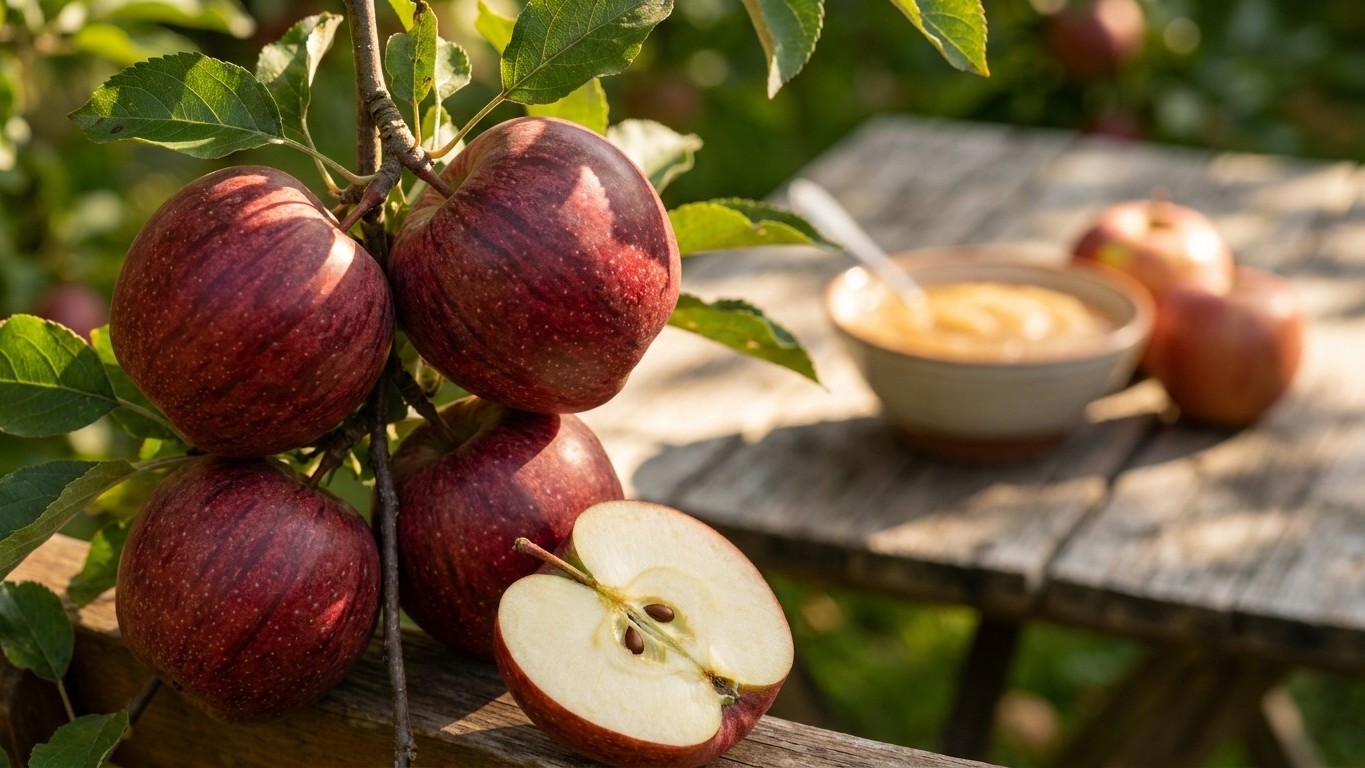

Paula Red delivers one of the earliest home-orchard harvests of the season, a soft, tart apple best eaten fresh or turned into sauce within weeks of picking. It also carries one of the highest fire blight ratings you’ll find on a home variety chart, so the real question for most growers isn’t taste. It’s whether that disease pressure is something you can manage in your yard.
What Paula Red actually is

Paula Red is a McIntosh-type apple that home gardeners plant for speed, not for storage. According to USU Extension’s Apple Production guide for the Utah home garden, here’s what a grower actually gets:
- Ripens: September, among the earlier apples on the calendar
- Tastes like: tart and aromatic, with tender flesh that softens quickly
- Good for: an early apple for sauce and eating fresh
- Keeps: not long, it will not keep
That combination tells you almost everything you need to plan around. The tenderness that makes Paula Red pleasant to bite into fresh is the same trait that rules it out for pie. A tart apple needs flesh that holds its shape under heat and acidity strong enough to survive baking; Paula Red’s flesh breaks down fast, which is exactly why it shines in sauce, where you want the fruit to collapse into something smooth, but falls apart in a lattice-top pie, where you want distinct slices.
None of the sourced material lists Paula Red as sold under a second trade name, unlike some apples where the grocery store label and the nursery tag don’t match (Mutsu sold as Crispin, Pink Lady sold as Cripps Pink are the classic examples). If you’ve bought Paula Red at a farm stand, you’ve bought it under its own name.
The short shelf life is the trade-off for being first. Growers who want a September apple that can also sit in the fridge into winter are choosing a different variety; Paula Red is for the grower who wants fruit on the counter in early fall and doesn’t mind using it up quickly.
Will it grow where you are
Hardiness range
USU Extension lists Paula Red as hardy in zones 4 through 8, a wide band that covers most of the northern two-thirds of the country and stretches down into warmer transitional zones as well. That range rules out very little in terms of winter cold tolerance for the average home gardener; the tree itself isn’t the limiting factor for most of the U.S.
Winter chill
Hardiness zone is only half the picture, and it’s the half people check. The other half is winter chill, the number of cold hours below about 45°F an apple tree needs during dormancy before it will break bud and flower properly the following spring. Our sourced material doesn’t publish a chill-hour figure for Paula Red, so it would be a guess to state one here.
What the source does tell us is that Paula Red blooms mid-season and ripens as early as September, both traits typical of northern-bred apples that expect a real winter. Combined with a hardiness range that bottoms out at zone 4, this is a variety built for regions with cold, defined winters rather than the mild-winter parts of zones 8 and 9 where chill accumulation runs short some years. A grower in a warm-winter climate should check local chill accumulation against what similar early McIntosh-type apples need before planting, since a tree that never gets cold enough will leaf out unevenly and flower poorly regardless of what the hardiness zone map says.
What to plant beside it
This is usually the section that decides whether a tree gets planted at all, and here it has to be said plainly: the sourced material for this page does not publish a named list of pollination partners for Paula Red. No variety names are given, so none should be guessed at.
That gap doesn’t mean the tree is self-fertile. Nearly all apple varieties crop better with a compatible partner nearby, and the general rule holds for Paula Red too. What we do know from the source is that it blooms mid-season, which narrows the search: any partner variety needs to flower at roughly the same time, since two trees that bloom weeks apart won’t overlap enough for bees to cross-pollinate them.
In practice, that means a grower shopping for a companion tree should look for another apple variety labeled as a mid-season bloomer, confirm it isn’t a known sterile-pollen variety, and check that it isn’t a parent or offspring of Paula Red itself, since a parent variety generally cannot pollinate its own seedling. A local extension office or nursery with regional bloom-time charts can confirm which mid-season varieties are actually grown near you, which matters more than any national list. A crabapple with overlapping bloom can also work as a pollen source in a small yard where a second full-size tree isn’t practical.
For the full mechanics of matching bloom times, self-fertility, and known pollen exclusions across apple varieties, see our apple pollination guide.
Growing it well
Fire blight
USU Extension rates Paula Red as Very Susceptible to fire blight, the top end of the susceptibility scale. In the garden, that translates to blackened, wilted shoot tips that curl into a shepherd’s-crook shape during warm, wet spring weather, spreading fast through new growth if left unchecked. Growers in this variety’s zones should prune out infected wood well below the visible damage, sanitize pruning tools between cuts, and avoid heavy nitrogen fertilizer in spring, since lush new growth is the tissue fire blight infects most easily. This is the single biggest reason to think twice about Paula Red in a region with a history of fire blight outbreaks, regardless of how well the hardiness zone and chill requirements line up.
Habit and bearing
The sourced material for this page doesn’t include specifics on tree habit or on whether Paula Red tends toward biennial bearing (heavy crops one year, light the next). Rather than guess, it’s worth noting that thinning young fruit to one apple per cluster is standard practice across most apple varieties to reduce the risk of biennial bearing and to improve the size of the fruit that remains. Given how tender and short-lived Paula Red’s fruit already is, growers may find thinning doubly useful, since it also reduces limb stress in a tree already carrying an early, soft-fleshed crop.
Picking it and keeping it
USU Extension puts the Paula Red harvest window in September. Rather than counting days on a calendar, most growers confirm ripeness with a short physical check right at the tree.
- Lift and twist the apple gently upward. If it separates from the spur easily, it’s ready; if you have to pull or tug, give it more time.
- Cut one apple open and check the seed color. Fully ripe apples generally show brown to dark brown seeds rather than pale or greenish ones.
- Check the ground color, the background color of the skin beneath any red blush. As an apple ripens, that ground color typically shifts from green toward a yellowish tone.
Storage
Storage is where Paula Red asks for a plan. The source is direct on this point: it will not keep. This isn’t a variety to box up for the root cellar or expect to pull out at Thanksgiving. Use it within days to a couple of weeks of picking, refrigerated, and lean on the kitchen use it’s suited for, fresh eating and sauce, rather than trying to stretch its season. If you want September fruit that also stores into winter, that calls for a second, longer-keeping variety planted alongside it, which brings the pollination question back into play.
Common questions
Is Paula Red good for pies?
Not really. Its flesh is tender and softens quickly, so it breaks down under oven heat instead of holding distinct slices the way a firmer baking apple does. It’s better suited to sauce, where that same softness works in its favor.
How long does Paula Red apple last in storage?
Not long. The sourced material describes it plainly as an apple that will not keep, so plan to eat or process it within a short window after picking rather than storing it for winter use.
What zones can grow Paula Red apple trees?
USU Extension lists it as hardy in zones 4 through 8, a wide range covering most of the northern and mid-latitude United States.
Does Paula Red need another apple tree nearby to produce fruit?
Our sourced material doesn’t name specific pollination partners for this variety, but nearly all apple trees, Paula Red included, crop more reliably with a compatible, similarly timed pollinator nearby rather than standing alone.
Why is Paula Red rated so susceptible to fire blight?
USU Extension rates it Very Susceptible, the highest category on their scale. That means growers in regions prone to fire blight should expect to actively manage the disease through pruning and sanitation rather than treat it as a minor risk.