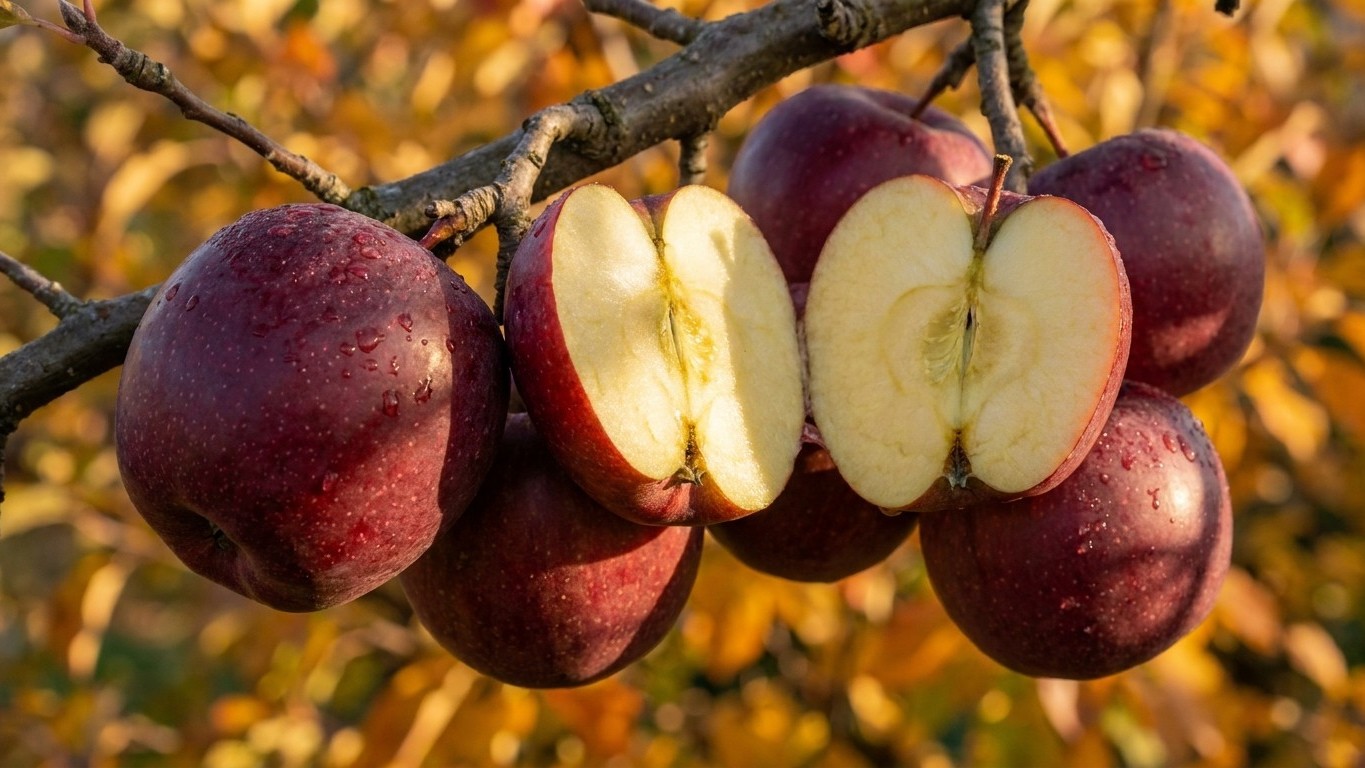

Snapp Staymen is a heavy-cropping strain of the old Staymen apple, prized for its dense, tangy flesh and its late harvest. According to USU Extension’s Apple Production guide for home gardens, it ripens in late October, carries a rich winey flavor, and holds up in storage well into winter. It’s a strain, not a wholly different variety, so anyone growing “Staymen” under a slightly different label is likely working with close kin.
What Snapp Staymen actually is

Before anything else, here’s what a grower actually gets with this tree:
- Ripening time: Late October
- Flavor: Rich, winey and sweet-tart, with very firm coarse flesh
- Best use: Pies, cider, and long-term storage
- Keeping ability: Well into winter
The flavor profile is the first thing people notice. USU Extension describes the eating quality as rich, winey and sweet-tart, backed by flesh that’s very firm and distinctly coarse in texture. That’s not a small detail. Coarse, firm flesh doesn’t collapse into mush when it hits a hot oven, which is exactly why this apple earns its keep in a pie plate rather than a lunchbox. The acidity that makes it a little sharp fresh off the tree is the same acidity that survives baking, balancing the sugar in a filling instead of turning it flat and syrupy.
That firmness and tartness also make it a solid choice for cider pressing, where a single-note sweet apple tends to produce something thin and forgettable. Blended with sweeter varieties, a firm, acidic apple like this one adds backbone.
Storage life is the other half of the equation. Late-ripening apples with dense flesh tend to hold longer in a root cellar or a cold garage than early, soft-fleshed varieties, and this one is built for exactly that kind of patience. A grower who picks in late October and tucks fruit into a cool, dark space can reasonably expect to be eating (or baking with) this apple for months, not weeks. That’s a genuine advantage for anyone trying to stretch a home harvest through the winter without a walk-in cooler.
Will it grow where you are
Two separate questions decide whether this tree belongs in your yard, and they’re not the same question. One is about surviving winter. The other is about actually flowering and fruiting the following spring. Skip either one and the tree either dies in January or sits there green and barren every May.
Hardiness zone
USU Extension lists this variety as suited to hardiness zones 5 through 8. That’s a wide band, running from the colder edges of New England and the upper Midwest down through much of the mid-Atlantic and into the warmer parts of the South and coastal Pacific Northwest. If your winter lows regularly drop well below what zone 5 implies, or if you’re gardening in a subtropical zone 9 or higher, this isn’t the variety to bank on.
Winter chill requirement
Hardiness zone tells you whether the wood survives winter. Chill hours tell you whether the tree actually blooms on schedule the following spring, since most apples need a set number of hours below roughly 45°F to break dormancy properly. A published chill-hour figure for Snapp Staymen isn’t available in the sources used for this page, so it shouldn’t be guessed at here. What can be said with confidence: a zone 5-8 range points toward a variety built for regions with real winter cold, not the mild, low-chill winters of the Deep South coast or Southern California. Gardeners in genuinely low-chill regions should treat this as a variety to research further locally, through a county extension office, rather than plant on faith.
What to plant beside it
This is usually the question that brought a reader here in the first place, and it deserves a straight answer: no pollination partner is named for Snapp Staymen in the USU Extension source used for this guide. That’s worth stating plainly rather than guessing at a name that sounds reasonable, because an apple tree planted next to the wrong partner can sit there blooming for years without ever setting a real crop.
What can be said with confidence is the general rule that governs almost every apple variety, including this one. Nearly all varieties crop better with a compatible partner nearby, since apple pollen doesn’t reliably fertilize the same variety’s own flowers in most cases. A neighbor’s apple tree, a second variety planted in the same yard, or even a well-placed crabapple can supply the pollen needed for a fuller set of fruit. Bloom timing matters here too: USU Extension lists this variety’s bloom season as mid-season, so a workable partner needs to flower at roughly the same time, not weeks earlier or later, or the bees simply won’t be carrying compatible pollen when this tree is in flower.
Two other rules matter enough to repeat even without a named partner list:
- A variety with sterile pollen can receive pollen from others but can’t pollinate anything itself, which sometimes means a garden needs a third variety just to keep the chain working.
- A parent variety generally can’t pollinate its own seedling or sport, since the genetics are too close for reliable fertilization.
Since Snapp Staymen is a strain of the older Staymen apple, a grower who happens to already have a straight Staymen tree shouldn’t assume it will do the pollinating job. Without a confirmed compatibility record for that particular pairing, the safer move is planting a separate, well-documented mid-season variety nearby and treating any existing Staymen tree as a bonus rather than a guaranteed answer. A dedicated pollination guide walks through how to match bloom windows and confirm compatibility before committing a whole growing season to guesswork.
Growing it well
Every apple variety asks for something a little different from the person tending it, and this one has three habits worth knowing before the tree goes in the ground.
Fire blight resistance
USU Extension rates this variety as moderately resistant to fire blight. In practical terms, that means the tree isn’t bulletproof, but it’s also not a magnet for the disease the way some highly susceptible varieties are. A grower will still want to watch for the telltale signs, blackened shoot tips that curl over into a shepherd’s-crook shape, especially after warm, wet weather during bloom. Moderate resistance buys some margin for error, not immunity, so pruning out infected wood promptly the moment it’s spotted still matters.
Growth habit and cropping pattern
Mature size on any apple tree comes down to the rootstock it’s grafted onto, not the variety itself, so anyone comparing a dwarf tree to a standard-sized tree of the same variety is really comparing rootstocks. A nursery tag or grafting record is the only reliable way to know what final size to expect.
Snapp Staymen, like many older, heavy-cropping strains, can lean toward alternating a big harvest one year with a light one the next if the tree is left to its own devices, a pattern known as biennial bearing. Thinning the young fruit down to one apple per cluster in a heavy-set year is the standard fix, since it takes pressure off the tree and encourages it to set flower buds evenly again for the following season rather than exhausting itself on one enormous crop.
Picking it and keeping it
USU Extension lists the harvest window for this variety as late October, but a calendar date is only a starting point. Weather shifts the actual ripening moment from year to year, so the tree itself needs to confirm the timing. Three checks, done in order, tell the story better than a date on a page:
- Lift and twist a sample apple gently upward. If it separates cleanly from the spur with barely any resistance, it’s ready; if it clings and has to be yanked, it needs more time.
- Cut one open and check the seeds. Fully ripe apples usually show dark brown seeds; pale or greenish seeds mean the fruit is still a week or more away.
- Look at the ground color, the background shade beneath any red blush. A shift from green toward yellow or cream signals the fruit is finishing up.
Storage conditions
This variety’s dense, firm flesh is built for the long haul, and USU Extension notes it keeps well into winter. Cold, humid conditions extend that window furthest, ideally somewhere in the mid-30s to low-40s Fahrenheit with decent humidity, whether that’s a root cellar, an unheated garage that stays reliably cool, or a refrigerator’s crisper drawer for smaller batches. Checking stored apples every few weeks and pulling any that start to soften keeps one bad apple from taking down the rest of the bin.
Common questions
Is Snapp Staymen the same as regular Staymen apples?
Snapp Staymen is a strain of the older Staymen variety, selected for heavier cropping. The fruit shares the same rich, winey flavor family as classic Staymen.
Can Snapp Staymen pollinate itself?
No confirmed partner list is published for this variety in the sources used here, but the general rule for apples applies: nearly all varieties crop more reliably with a compatible partner nearby rather than relying on their own pollen.
What zone is best for growing Snapp Staymen?
USU Extension lists hardiness zones 5 through 8 as suitable, covering much of the country from the colder Northeast down through warmer mid-Atlantic and Southern regions.
Is Snapp Staymen a good pie apple?
Yes. Its very firm, coarse flesh holds its shape under heat, and its sweet-tart acidity balances added sugar, which is why it works for both pies and cider.
How long does Snapp Staymen keep in storage?
USU Extension notes it keeps well into winter, especially when stored cold and humid, making it one of the better long-storage choices among home garden apples.