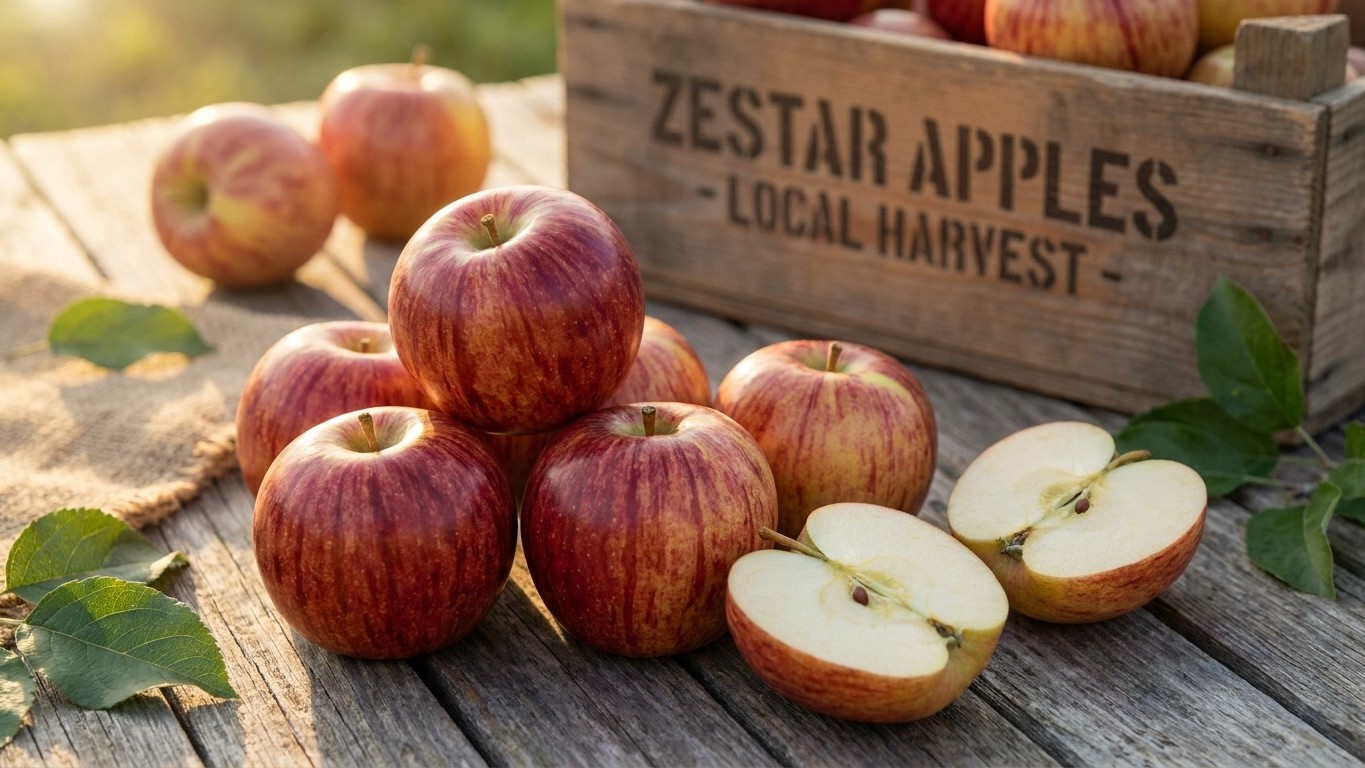

Zestar is a mid-to-late August apple bred for cold climates, with a sweet, zesty, crisp bite that works fresh or in the kitchen. It grows in USDA zones 3 through 6. Its fire blight reputation is genuinely split between extension sources, which matters more than any single rating once you know why. Here’s what a grower actually needs to know before planting one.
What Zestar actually is

- Ripens: Mid to Late August
- Tastes like: Sweet, zesty, juicy, crisp
- Good for: Fresh eating and cooking
- Keeps: not specified in the sources reviewed for this profile
Zestar shows up in the earliest wave of the fall apple harvest, well ahead of the classic October varieties most people picture when they think “apple season.” According to USU Extension’s guide to apple production for the Utah home garden, it lands in the mid to late August window, which makes it one of the first full-flavor apples off the tree rather than a small, tart snack variety used just to bridge summer.
The flavor is the reason people plant it. NDSU Extension’s FN1847 publication describes the eating quality as sweet, zesty, juicy, and crisp, a combination that reads almost contradictory on paper but plays out as a bright, snappy bite with real sugar behind it. That same source lists it for both fresh eating and cooking, which is worth taking seriously rather than skimming past. A dessert apple and a pie apple aren’t interchangeable: the flesh needs enough structure to hold its shape under heat, and the acidity needs to survive baking without going flat and one-note sweet. Zestar’s zesty edge is exactly the acid that keeps a cooked dish from tasting flabby, and its crispness gives it a fighting chance to keep some texture in a tart or a batch of baked slices instead of collapsing into mush.
Storage duration isn’t published in the extension sources used for this profile, so it’s better left unstated than guessed at. What is clear from the harvest timing alone: an August apple is built around eating it relatively soon, not around a winter’s worth of cold-room storage the way a late-October variety might be.
Will it grow where you are
Cold hardiness
USU Extension places Zestar in USDA hardiness zones 3 through 6. That’s a genuinely wide band, running from the coldest apple-growing regions of the northern Great Plains and interior Alaska-adjacent zones down through much of the Midwest and mid-Atlantic. If your winter lows regularly sit anywhere between roughly minus 40°F and minus 10°F, you’re inside the range this variety is documented to tolerate. Outside zone 6, on the warmer end, the source doesn’t make a claim either way, so treat it as untested territory rather than assume it will or won’t perform.
Winter chill
Hardiness zone and winter chill are two separate filters, and a lot of buyers only check the first one. Chill hours, the accumulated cold time a tree needs during dormancy to break properly in spring, isn’t published in the sources used for this profile. That gap matters more in warm-winter regions than cold ones: a tree can be perfectly hardy against a hard freeze and still bloom erratically or unevenly if it never banks enough chill hours over a mild winter. Given that Zestar’s documented hardiness sits at the cold end of the national range (zones 3-6), it reads as a variety built for northern and upper-Midwest climates rather than the Southeast or coastal California, even without a specific chill-hour number to point to. Growers in genuinely mild-winter regions should treat the absence of a published chill requirement as a reason to ask a local extension office before planting, not as a green light.
What to plant beside it
Nearly all apple varieties crop better with a compatible partner nearby, whether that’s a second named variety, a neighbor’s tree within bee range, or even a crabapple planted specifically for pollen. Apples are largely self-unfruitful, meaning a lone tree, isolated from any other apple blossom, typically sets a thin crop at best.
For Zestar specifically, no pollination partner list is published in the sources used for this profile. That’s a real gap, not a minor detail, and it’s better acknowledged than guessed at with a name pulled from general apple-growing habit. Planting it near any other apple or crabapple that blooms in the same mid-season window it occupies (per USU Extension’s bloom timing) gives it a reasonable shot at cross-pollination, but nothing here confirms a specific compatible variety by name.
Two things are worth flagging before buying a second tree. First, bloom timing has to overlap; a variety that flowers weeks earlier or later won’t help no matter how compatible it might otherwise be. Second, a seedling can’t be pollinated by its own parent variety, so if you know Zestar’s parentage, that parent is automatically off the list even if it blooms at the right time. For a fuller rundown of how apple pollination works and how to match bloom windows correctly, see our apple tree pollination guide.
Growing it well
Fire blight
Two extension services rate this variety differently for fire blight, and the disagreement is worth explaining rather than resolving artificially. One rates Zestar “Very Resistant.” The other calls it “Susceptible.” Averaging those or picking whichever sounds more convenient would misrepresent what’s actually known. Fire blight is a bacterial disease that spreads fastest under warm, wet conditions during bloom; a drier spring simply gives the bacterium fewer chances to move, regardless of a variety’s underlying genetics. A resistance rating is an observation made in a specific place and season, not a fixed trait stamped on the variety everywhere it’s grown.
The practical takeaway: in a region with wet, humid springs, plant Zestar as if it carries the worse of the two ratings, susceptible, and manage it accordingly. That means avoiding heavy nitrogen fertilization that pushes soft new growth, pruning out any blighted shoots well below the visible damage during dry weather, and watching bloom-time weather closely. In a drier, low-humidity climate, the risk drops substantially no matter which rating you lean on. A split rating is a reason for caution, not a reason to ignore the disease altogether.
Growth habit and biennial bearing
The extension sources reviewed for this profile don’t publish separate figures on Zestar’s growth habit or its tendency toward biennial bearing, the pattern where a tree alternates a heavy crop year with a light one. Where that documentation gap exists, it’s better acknowledged than filled in with a guess. What does apply broadly across most apple varieties, including this one, is standard thinning practice: removing excess young fruit down to roughly one apple every 6 inches along a branch reduces the strain of overcropping and tends to even out yields from year to year, whatever a tree’s natural bearing pattern happens to be.
Picking it and keeping it
USU Extension places Zestar’s harvest window at mid to late August, but a calendar date is only a starting point. The tree itself gives better signals, and checking them in order beats guessing:
- Lift and twist a sample apple gently with the palm of your hand. If it separates from the spur easily, with no tugging or tearing, it’s likely ready.
- Cut one open and check the seeds. Apples typically aren’t ready while seeds are still pale or white; look for seeds that have turned brown.
- Check the ground color, the base skin tone beneath any red blush. A shift from green toward yellow-green usually signals ripeness approaching.
Running all three checks on a couple of sample apples, rather than relying on just one, gives a much more reliable read than the calendar alone, especially since a warm or cool spring can shift an August harvest window by a week or more in either direction.
Storage
A specific storage duration for Zestar isn’t published in the sources used here, so none is claimed. What follows from the harvest timing itself is straightforward: as a mid-to-late August apple, it belongs to the early-season group that’s generally best used within a reasonably short window after picking rather than treated as a long-haul, root-cellar-through-winter variety the way a late-October apple might be. Refrigeration slows softening in the short term; beyond that, check with a local extension office for guidance specific to your storage setup.
Common questions
Is Zestar the same apple sold under a different name?
The sources used for this profile don’t note an alternate market name for this variety, unlike some apples that are sold under two labels (Mutsu as Crispin, or Pink Lady as Cripps Pink, for example). If you bought a labeled Zestar, that’s the variety documented here.
Can one Zestar tree produce fruit on its own?
Not reliably. Nearly all apple varieties, Zestar included, crop far better with a compatible pollinator nearby, whether that’s a second variety, a neighboring apple tree, or a crabapple planted for pollen.
Does Zestar get fire blight?
It depends on where it’s grown and how wet the spring is at bloom time. One extension source rates it very resistant, another rates it susceptible, and the disease itself spreads fastest in warm, wet weather. In humid regions, it’s safer to manage it as the more vulnerable of the two ratings.
What zones can grow Zestar?
USDA hardiness zones 3 through 6, according to USU Extension, which covers much of the northern Great Plains, the Midwest, and the mid-Atlantic.
Is Zestar better for eating fresh or for baking?
Both, according to NDSU Extension. Its sweet, zesty flavor and crisp texture make it a solid fresh-eating apple, while its acidity holds up under heat and its firmness helps it keep some structure when cooked.