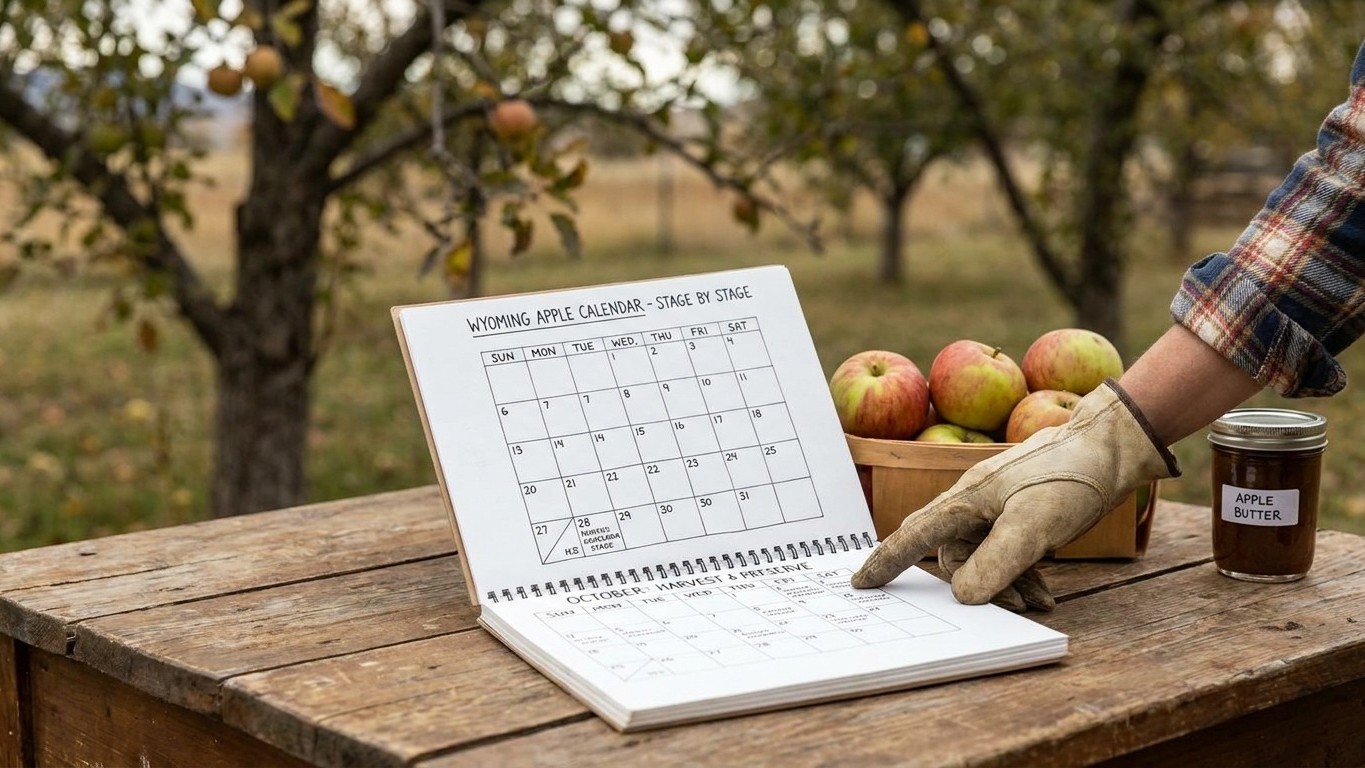

Wyoming apple growers don’t need a date, they need a stage: once your buds have pushed past pink and into bloom, you’re clear to worry about frost instead of guessing about it. In Cheyenne, that pink-to-bloom window falls roughly between May 7 and May 18, though your own trees may run a week either side of that depending on your site. So skip the calendar this week and go look at what the buds themselves are actually doing.
The short answer for Wyoming
The frost calendar
At the reference station in Cheyenne, NOAA’s NCEI 1991-2020 climate normals put the last spring freeze at May 7 to May 18 and the first fall freeze at September 24 to October 5. Between those two windows sits roughly 130 frost-free days at that elevation, and every stage of the tree, from green tip to harvest, has to fit inside it or be worked around with row cover or careful timing.
What shifts it
That answer depends on which cultivar is in the ground, how high up the tree sits, and whether the site drains cold air away or traps it. A tree in a low spot that pools cold air can run several degrees colder on a clear night than one on a slope fifty feet away, and at pink or bloom stage that difference decides whether the crop survives. NOAA’s freeze windows describe Cheyenne specifically, and higher, colder parts of the state push both windows later in spring and earlier in fall.
The figure worth remembering alongside the frost dates is the mean daily minimum for Cheyenne’s coldest month: 17.3°F, also from NOAA’s NCEI 1991-2020 normals. That is an average low across the whole coldest month, not the record low, and it is severe enough to rule out anything not bred for a genuine northern winter. It is why the realistic list of Wyoming apples leans hard on cultivars bred for the northern Great Plains, a subject covered in full in The Best Apple Varieties for Wyoming.
Working through it

Apple timing in Wyoming has to be read off the tree’s stage, not off a fixed date. The stage the buds are in tells you whether frost is a real threat that night. Cheyenne’s own frost windows from NOAA’s NCEI 1991-2020 normals give the framework, but the tree’s stage each spring can run a week or more either side of that framework depending on the winter and the site.
Dormancy to bloom
Dormancy is winter dry-down: no active growth, and the safest time for pruning cuts since the tree cannot bleed sap or push soft new growth into cold. Green tip follows once accumulated warmth breaks bud dormancy, and it often arrives while there is still real frost risk, close to the Cheyenne window of May 7 to May 18. At green tip the bud is still tightly wrapped and tolerates a light frost with little damage.
Pink stage, where the flower shows color just before opening, is the point where a hard frost starts doing real damage, and it often lands close to that same late-spring window. Bloom, when the flower is fully open and pollinators are working it, is the single most frost-sensitive stage of the whole year. An open bloom hit by a freeze inside the May 7 to May 18 window, or later at higher elevation, can lose the entire crop even if the tree itself is undamaged.
Petal fall to harvest
Petal fall marks the end of pollination risk. Fruit set follows over the next few weeks, and a natural June drop thins some of the set fruit on its own. From here the clock that matters is the cultivar’s own days-to-maturity count from bloom, printed on the nursery tag, checked against how many frost-free weeks remain before the first fall freeze.
Harvest has to land before that first fall freeze, which NOAA’s NCEI 1991-2020 normals put at September 24 to October 5 for the Cheyenne station. A late-maturing cultivar that needs more weeks on the tree than that window allows will not finish ripening in a typical year at that elevation, which is exactly why cultivar choice, covered in The Best Apple Varieties for Wyoming, has to be matched against the local frost calendar rather than picked for flavor alone.
What changes across Wyoming
Elevation and cold-air drainage
NOAA’s frost windows above are measured at the Cheyenne station, and Cheyenne sits high on the plains at an elevation that already runs colder than much of the country at the same latitude. The rest of Wyoming runs both warmer and colder than that reference point, and elevation, along with how a site sheds or traps cold air overnight, is the biggest reason why.
The Big Horn Basin, around Powell and Cody in the north-central part of the state, sits at meaningfully lower elevation than Cheyenne and has a long-standing reputation as apple country within Wyoming, with orchards that have produced fruit there for decades. Higher mountain valleys, including the country around Jackson, sit at far greater elevation, and cold air drains into them off the surrounding peaks overnight, so both frost windows there run later in spring and earlier in fall than anything NOAA records at Cheyenne, and the frost-free season is shorter than the roughly 130 days the Cheyenne normals describe.
Laramie, at higher elevation than Cheyenne despite sitting not far to the west, shows how much a short drive can change the picture. A site just a few hundred feet higher, or a low spot collecting cold air draining off nearby slopes, can be enough to change whether bloom survives a night that Cheyenne’s own frost dates call safe. None of the NOAA figures above describe Laramie or the Big Horn Basin directly. A grower there should treat the Cheyenne windows as a starting frame, not a schedule that transfers unchanged, and adjust using local frost history and the site’s own cold-air drainage.
The mistakes this climate punishes
Bloom timing versus frost
The costliest mistake is planting an early-blooming cultivar in a place where the last frost still has weeks to run. NOAA’s NCEI 1991-2020 normals put Cheyenne’s last spring freeze at May 7 to May 18, a real threat to any tree that has already reached bloom by the earlier end of that window. Early bloomers gain nothing here and can lose the whole crop the year a frost lands during an open flower.
| Cultivar | Typical bloom timing | Approx. days bloom to harvest | Risk in this climate |
|---|---|---|---|
| ‘Norland’ | Early | ~70-80 days | Ripens fast but blooms early, exposed to the tail of the frost window |
| ‘State Fair’ | Early to midseason | ~90-100 days | Moderate exposure, ready well ahead of the first fall freeze |
| ‘Haralson’ | Midseason | ~140-150 days | Blooms later, needs the full frost-free window to finish |
| ‘Honeycrisp’ | Midseason to late | ~125-135 days | Later bloom lowers frost risk but cuts it close on fall ripening at high elevation |
Catalog days-to-maturity figures are counted from bloom, not from a fixed calendar date, and they shift by a week or two either way depending on the season, so treat the table as a starting comparison rather than a fixed schedule.
Late growth and false-spring risk
The second mistake is feeding a tree late in the season. Nitrogen applied in mid to late summer pushes soft new growth that has not hardened off by the time the first fall freeze arrives, and NOAA’s normals put that freeze at Cheyenne between September 24 and October 5. Soft wood going into that freeze is far more likely to die back than wood that had time to harden.
The third is assuming a mild winter is simply good luck. Cheyenne’s coldest-month mean minimum runs at 17.3°F per NOAA’s NCEI 1991-2020 normals, but a winter that runs unusually mild can still be followed by a late hard freeze that catches a tree already at pink or bloom stage, since the tree is responding to accumulated warmth, not to the calendar. The safest posture is to keep row cover or frost cloth on hand through the entire NOAA frost window every year, mild winter or not.
Checking this against your county
Every figure above comes from the Cheyenne station in NOAA’s NCEI 1991-2020 climate normals, and a grower anywhere else in Wyoming should treat those dates as a reference point, not a local forecast. The University of Wyoming Extension is the place to check county-level frost history, soil test recommendations, and any pest or disease pressure specific to your part of the state before committing a season’s work to a planting date, a step that pairs well with the site basics laid out in Growing Apples in Wyoming.
A county extension office can also confirm whether a particular cultivar has a track record locally, which matters more in a state where elevation swings the calendar by weeks from one valley to the next, something no single statewide date can capture.
Common questions
Can you actually grow apples at high elevation in Wyoming?
Yes, but the cultivar list narrows fast as elevation climbs and the frost-free season shortens. Cold-hardy cultivars bred for the northern Great Plains, along with sites chosen for good cold-air drainage, are what make it work in the higher, colder parts of the state.
How do I tell pink stage from bloom on my tree?
Pink stage is the bud showing color but still closed, a tight little balloon of pink petal tissue that hasn’t opened yet. Bloom is the flower fully open, with the petals spread flat and the stamens visible and dusted with pollen, and that open stage is far more vulnerable to a freeze than pink.
What happens if frost hits after petal fall instead of during bloom?
The young fruit set is more frost-tolerant than an open flower, so a light frost after petal fall often causes only cosmetic scarring or a bit of extra June drop. A hard freeze at that stage can still kill the developing fruit, it just takes a colder night to do it than it would at full bloom.
Do I need two different apple trees to get fruit?
Most apple cultivars need pollen from a different cultivar blooming at roughly the same time, so a single isolated tree often sets little or no fruit. Check that any two trees you plant have overlapping bloom windows, since one variety blooming early and the other blooming late can miss each other even in the same yard.