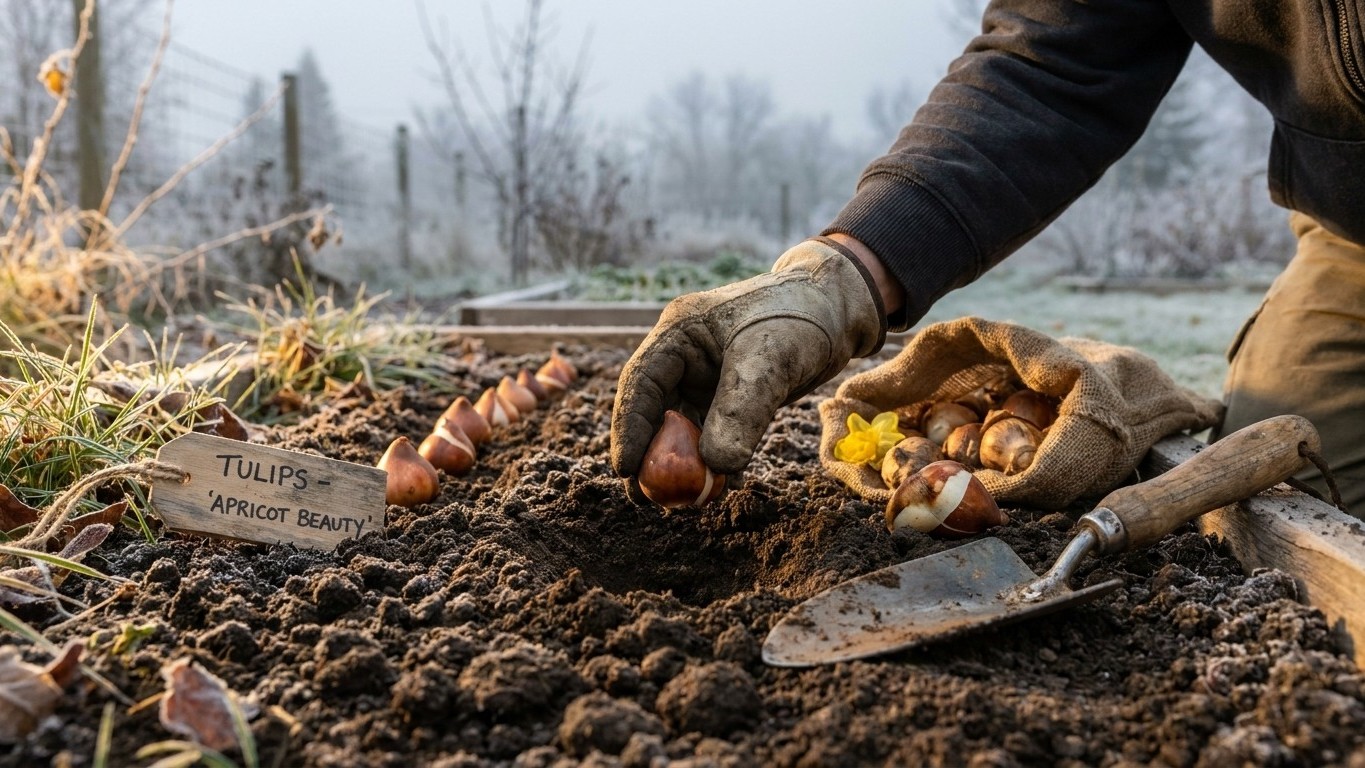

Spring bulbs need cold to flower, and Alberta has more of it than almost any bulb could ask for. The real question isn’t whether your winter is cold enough here, it’s which bulbs can handle just how cold, and which ones will rot, sulk, or vanish before June.
When to plant bulbs in Alberta

The planting window for Spring Bulbs in Alberta runs roughly from early September through late September, closing hard once the ground starts to freeze for good. The anchor point is the average first fall frost, which at Calgary Int’l A sits at September 16, based on the 1981-2010 Canadian Climate Normals from Environment and Climate Change Canada. Bulbs should go in about six weeks before the ground freezes solid, not six weeks before that first frost, the two aren’t the same thing, but the frost date is the marker most gardeners have on hand, so it works as the starting line. Gardeners without much yard space, or those wanting more control over soil and drainage, may prefer Growing Spring Bulbs in Containers in Alberta, which follows the same timing rules but sidesteps some of the risks of in-ground planting. For those who’d rather skip the outdoor timing game altogether, Forcing Spring Bulbs Indoors in Alberta offers a way to enjoy blooms on your own schedule, regardless of frost dates or ground freeze.
Plant too early and the soil is still warm enough to coax up top growth. A tulip or daffodil that pushes green shoots in October has spent its stored energy on foliage that winter kills outright, leaving a weaker bulb underground with nothing to show for it come spring. Plant too late, on the other hand, and the bulb goes into cold ground without enough time to grow roots before freeze-up. Root development, not shoot growth, is the point of fall planting, a bulb with no roots come November is a bulb that either fails to emerge or comes up thin and short the following year.
The frost date is an average, not a promise
September 16 is a mean date pulled from three decades of records at one station. It is not a guarantee, and treating it as one is a mistake half of Alberta’s gardeners make every single year, because in one year out of two, the first real frost lands later than that date, sometimes by two or three weeks. In the other half of years, it arrives earlier. There’s no way to know in advance which kind of year you’re in.
The practical response is to build in slack rather than cut it close. Aim to have bulbs in the ground by mid-to-late September regardless of what the forecast says that particular week, and don’t wait for a frost warning as your cue, by the time frost actually shows up, the six-week rooting window is already behind schedule.
Whether your winter is cold enough
Spring bulbs don’t just tolerate cold. They require it. Most need twelve to fourteen weeks with soil temperatures below about 45°F to complete the internal process that turns a bud into a flower. Skip that chilling period and the bulb doesn’t die, it just fails on schedule, sending up leaves with no flower attached, or a bloom stalk too stunted to clear the soil line. This is the one number worth memorizing before buying a single bulb, anywhere, because it’s the yardstick every other claim on a seed catalog or nursery tag gets measured against.
Alberta doesn’t sit near that threshold. It clears it by a wide margin. The coldest month at the Calgary reference station averages a daily minimum of 8.2°F, more than 36 degrees under the 45°F ceiling bulbs need to start their chill clock. And that cold isn’t a brief dip : Alberta’s winter runs from roughly October through March, a stretch measured in months rather than weeks. Whatever chilling requirement a spring bulb carries, this province delivers it several times over, with no help from a refrigerator required.
What the margin actually buys a gardener
That surplus of cold means Albertans can skip a step that gardeners in mild climates can’t avoid: pre-chilling. In regions where winter soil never drops below 45°F for long enough, bulbs have to spend twelve weeks in a refrigerator before planting, kept away from apples, pears, and other ripening fruit because they release ethylene gas, and ethylene kills the flower bud inside a chilling bulb before it ever reaches the ground. None of that applies here. Alberta’s ground does the refrigerator’s job for free, and does it longer than almost any bulb requires.
| Bulb | Weeks of cold required | What Alberta delivers | Verdict |
|---|---|---|---|
| Tulips | 12-16 weeks | Months below 45°F, minimum near 8.2°F | Exceeds requirement, no pre-chill needed |
| Daffodils | 12-15 weeks | Same | Exceeds requirement |
| Crocus | 8-15 weeks | Same | Exceeds requirement, blooms reliably |
| Hyacinths | 12-14 weeks | Same | Cold is sufficient; hardiness is the limiting factor, not chill |
| Alliums | 8-10 weeks | Same | Exceeds requirement easily |
The one honest caveat: a bulb that gets enough cold can still fail if it isn’t hardy enough to survive that cold underground. Chilling and hardiness are two different tests, and Alberta’s abundant cold is only good news for bulbs built to withstand it.
Which bulbs suit Alberta
Alberta sits at Canadian hardiness zone 4a at the reference city, a rating built from seven climate variables under the Canadian system and not convertible to a single USDA number : Natural Resources Canada says as much directly, noting that zone 4a alone overlaps nine different USDA zones. That means bulb hardiness here has to be judged on the plant’s own published range, checked against how far north and how exposed a particular yard actually is.
These hold up reliably across most of the province:
- Tulips — hardy USDA zones 3 to 7, well matched to Alberta’s cold
- Daffodils — hardy USDA zones 3 to 8, among the most dependable spring bloomers here
- Crocus — hardy USDA zones 3 to 8, reliably early and low-risk
- Ornamental alliums — hardy USDA zones 3 to 8, tough and squirrel-resistant besides
Hyacinths sit closer to the edge, rated hardy USDA zones 4 to 8. They’ll often flower the first spring after planting, then come back smaller and sparser each year after, particularly in an exposed bed without snow cover to insulate the soil. That’s not a total failure, but it’s a fading one, and gardeners who’ve watched a hyacinth planting shrink over three seasons know the pattern.
Tender bulbs like ranunculus and anemone coronaria disappoint outright rather than fading gradually. They aren’t rated for anything close to Alberta’s winter minimums, and left in the ground they rot in the province’s wetter winters or simply freeze solid and never resprout. These need to be treated as annuals here, lifted and stored, or skipped entirely in favor of something built for the cold. A hardiness range near the edge is never a hard line, a sheltered south-facing bed against a foundation wall can carry a marginal bulb through where an open, wind-scoured yard won’t — but that margin buys inches, not zones.
What digs them up here
Squirrels and voles don’t raid bulb beds at random. They’re following chemistry, and the split falls cleanly along the same lines that decide whether a bulb suits Alberta’s cold in the first place. Daffodils and alliums both contain compounds that make them bitter or mildly toxic, and both squirrels and voles learn to leave them alone after one taste, if they bother at all. Tulips, crocus, and hyacinths carry no such defense, and a freshly planted bed of any of them reads to a squirrel as a buried snack.
- Bulbs animals take: tulips, crocus, hyacinths
- Bulbs animals leave alone: daffodils, alliums
For anything in the vulnerable column, one measure actually works: lay galvanized wire mesh flat over the planting bed and pin it down until the ground freezes solid, then remove it in spring before shoots push through. Squirrels dig where soil is loose and recently disturbed, and a mesh barrier removes that cue entirely. Repellent sprays, by contrast, wash off with the first rain or snowmelt and need reapplying constantly to do anything at all, money spent for a result that doesn’t outlast the next storm.
Where to check for your own county
Every figure in this guide, from the September 16 frost date to the 8.2°F coldest-month minimum, comes from the Calgary Int’l A reference station. Alberta spans multiple degrees of latitude and more than one hardiness zone, and a planting calendar built around Calgary can run two to three weeks off at either edge of the province, later in the north, earlier at higher elevation, and unpredictable anywhere the local microclimate departs from the reference city’s.
The provincial resource to check against local conditions is Alberta’s Ministry of Agriculture and Irrigation, which maintains guidance tuned to the province’s growing regions rather than a single station’s averages. Pairing that with a county or municipal district office adds a layer this page can’t: someone familiar with how frost settles into your specific stretch of ground, year after year, rather than a three-decade average pulled from one airport weather station two hundred miles away.