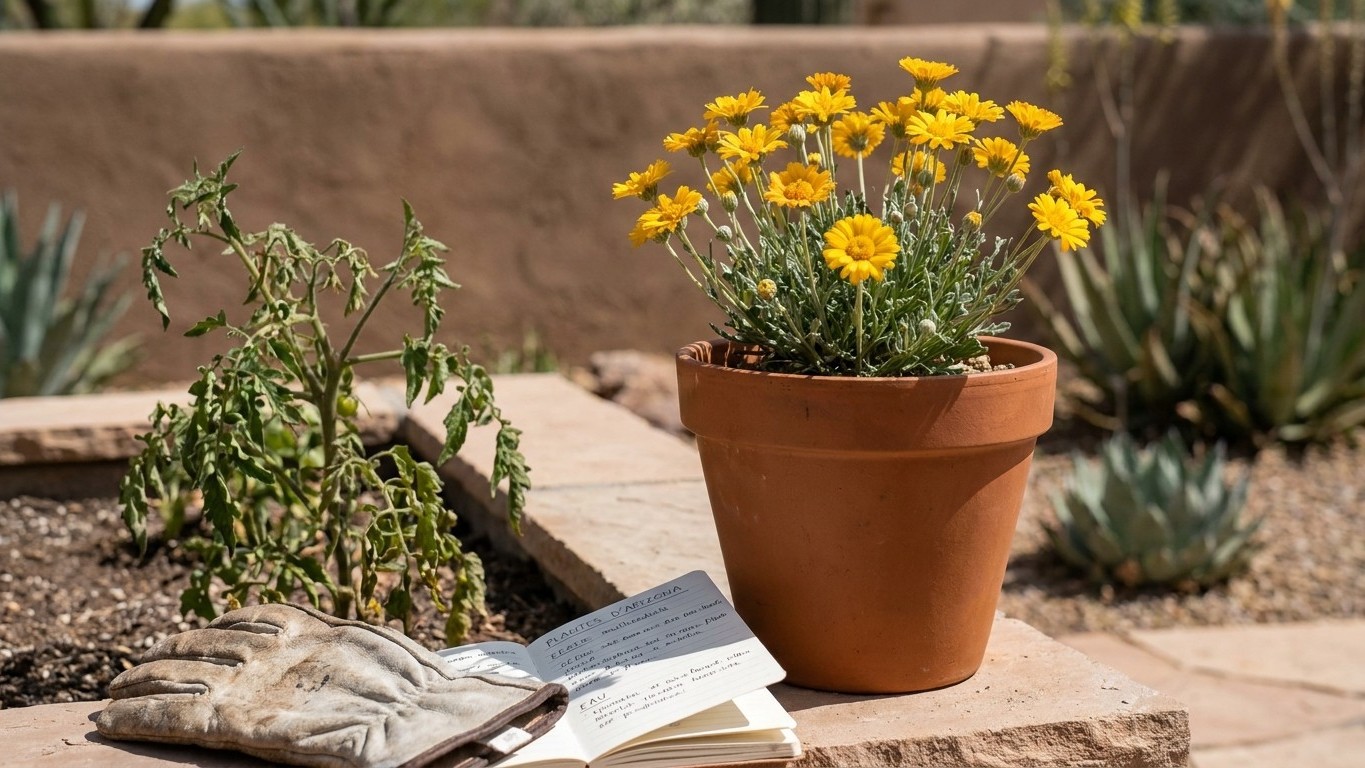

Flowers that actually thrive in Arizona are the ones bred for heat and drought, not cold. At the reference station in Phoenix, NOAA’s 1991-2020 climate normals count 168.9 days a year that reach 90F or hotter, and that heat load, not a spring frost, is what kills most garden-center annuals here long before winter ever arrives. The state’s hardiness range runs from USDA zone 4b in the high country to zone 10b in the low desert, so the single most useful thing you can do before buying anything is confirm your own zone against the plant tag, not the statewide range.
What thrives in Arizona

The flowers that hold up here share three traits: they tolerate long stretches without rain, they keep blooming through triple-digit heat, and they can take whatever cold shows up at your specific elevation. Arizona spans an enormous range on the USDA Plant Hardiness Zone Map (2023, based on 1991-2020 normals), from zone 4b around Flagstaff down to zone 10b around Phoenix and Yuma. A tag that reads “hardy to zone 7” is a real warning at 7,000 feet and background noise at 1,100 feet.
Heat is the bigger filter for most of the state’s population and gardeners. At the NOAA NCEI reference station in Phoenix, the 1991-2020 climate normals count 168.9 days a year at 90F or above, close to half the calendar. That is what knocks out pansies, lobelia, and most cool-season bedding plants by late spring, not a frost. Cold is rarely the limiting factor in the low desert: NOAA’s normals put the coldest month’s average low at 45.3F in Phoenix, and NOAA’s daily records show that reference station only reached 32F in 6 of the last 30 winters. A garden at that elevation effectively skips a true dormant season, which changes how you plan a border more than most new residents expect.
Genera bred for this combination
Look for genera that evolved in Mediterranean or arid climates already. Salvia, Lantana, Verbena, Gaillardia, Penstemon, Zinnia, Portulaca, and Angelonia all carry built-in drought tolerance and keep flowering in heat that stops most bedding plants cold. Desert marigold (Baileya multiradiata) and desert zinnia (Zinnia acerosa) go further still, slowing growth through the hottest stretch of summer and resuming once temperatures ease in fall. None of these need coddling once established, and most resent frequent shallow watering more than they resent missing a week of it entirely.
Because conditions vary this much from one county to the next, a single statewide plant list is a poor substitute for a regional one. The Arizona guides section breaks recommendations down further by elevation and region, which matters more here than in almost any other state.
Native plants worth the space
Native plants earn their keep after the first year or two, once roots reach deep enough to ride out the dry months without help. A newly planted brittlebush or globemallow still needs regular water through its first summer, the same as anything else, but by the second year it should need supplemental water only during the longest dry stretches. That is the trade natives offer: more patience up front, far less maintenance for years afterward.
Species worth planting
Several genera native to the wider Sonoran Desert region hold up especially well in home gardens: brittlebush (Encelia farinosa), desert marigold (Baileya multiradiata), desert globemallow (Sphaeralcea ambigua), fairy duster (Calliandra eriophylla), chuparosa (Justicia californica), and blackfoot daisy (Melampodium leucanthum). Parry’s penstemon (Penstemon parryi) is worth including for its spring bloom alone, a spike of pink-red flowers that hummingbirds find before most gardeners even notice it has opened.
These plants bring more than a low water bill. Chuparosa and Parry’s penstemon are both tubular-flowered and shaped for hummingbird pollination, while brittlebush and desert marigold feed native bees through a bloom season that often runs longer here than in cooler climates, because the plants are matched to the local heat rather than fighting it. Gardeners over the state line in New Mexico work with many of these same native genera at higher, drier elevations, and the New Mexico flowers guide covers how those species perform under that state’s shorter growing season and colder winters.
One caution on buying native: a nursery tag that says simply “native” can mean native to North America broadly, not to the Southwest specifically. Check the botanical name against a source like the extension service before assuming a “native” label means it is adapted to Arizona’s particular rainfall pattern.
Natives adapted to the Sonoran Desert’s two-season rainfall, a dry spring followed by summer monsoon storms, tend to do best in the low desert. Higher-elevation regions with steadier winter moisture and colder nights favor a different native palette, one built around Rocky Mountain and Great Basin species rather than Sonoran ones. Whatever palette fits your elevation, group natives by bloom time rather than scattering them singly through the bed, so pollinator activity concentrates instead of thinning out across the season.
Perennials that come back

A plant tag’s hardiness rating describes cold tolerance, and that is only half the story in Arizona.
Reading a plant tag correctly
Lantana (Lantana camara) is rated hardy to about zone 8, so it comes back reliably from the root in Phoenix and Tucson, both well within that range on the USDA map’s 9b-10b end of the state. The same plant is grown strictly as a one-season annual across most of the country. Flip that logic around for zone 4b-6b country near Flagstaff: many salvias and penstemons that behave as long-lived perennials in the low desert freeze out there most winters and need treating as annuals or replaced from new nursery stock each spring.
The tag tells you the cold limit. It says nothing about whether a plant can survive summer here, and that gap catches a lot of transplanted gardeners. Delphinium and lupine are hardy perennials by any zone map, but they need a real cool season to set buds and rebloom, something the low desert’s 168.9 annual days above 90F, per NOAA NCEI’s Phoenix normals, simply does not provide. They are worth growing here only as a one-season cool-weather planting, not as a permanent border piece.
What actually persists
| Plant | Typical hardiness rating | Low desert (Phoenix, roughly zone 9b-10b) | High country (Flagstaff, roughly zone 4b-6b) |
|---|---|---|---|
| Lantana (Lantana camara) | Zone 8-11 | Reliable perennial, roots hardy | Grown as annual, killed by winter |
| Yarrow (Achillea millefolium) | Zone 3-9 | Persists but stressed by extreme heat | Reliable perennial |
| Delphinium | Zone 3-7 | One-season cool-weather planting only | Perennial where summers stay cool |
| Red bird of paradise (Caesalpinia pulcherrima) | Zone 9-11 | Reliable perennial, dies back and returns | Grown as annual or not attempted |
In the low desert, expect lantana, angelonia, gaura, red bird of paradise, and most salvias rated to at least zone 8 to return year after year without replanting. At higher elevations closer to zone 5 or 6, lean instead on yarrow, catmint (Nepeta), and coreopsis, all rated hardy well into the 4b-5 range and unbothered by a real winter freeze. Gardeners coming from a colder, wetter climate should be cautious about assumptions built there: Pennsylvania’s perennial borders lean on peonies and hostas that simply do not perform in Arizona regardless of zone, and it is worth checking a guide like our Pennsylvania flowers guide before assuming a plant that thrived back home will do the same here.
Putting a border together
Start with height, then work backward. Tall anchors like red bird of paradise, a large desert willow (Chilopsis linearis), or a trellised bougainvillea go at the back of a bed or the center of an island. Mid-height bloomers like penstemon, salvia, and gaura fill the middle, and low, spreading plants like verbena, portulaca, and blackfoot daisy edge the front. Skipping this order is the most common mistake in a first Arizona border: a tall zinnia planted in front of a low groundcover blocks everything behind it by midsummer.
Spacing for the plant it becomes, not the plant you bought
A gallon-size lantana looks like a small, tidy plant on the nursery bench and can spread four to six feet across within two seasons of low desert heat. Leave the mature spacing listed on the tag, not the spacing that looks right on planting day, or you will be pulling out crowded plants within a year. The gaps look bare for the first few months. They close fast once real heat arrives and growth accelerates.
Succession and repeated color
Aim for at least one plant blooming in every season the garden is active. Penstemon and desert marigold carry spring, salvia, angelonia, and lantana carry the long hot stretch through summer and into fall, and cool-season annuals like marigold and dianthus can fill the gap over winter in the low desert, where the mild coldest-month lows, averaging 45.3F in Phoenix per NOAA, rarely stop them outright. Repeat two or three key colors through the length of the border rather than planting one each of many different flowers. A border that repeats the same orange-red through gaillardia, penstemon, and red bird of paradise reads as a designed planting from a distance. One of each color scattered singly reads as a collection, not a border.
Local help
The University of Arizona Cooperative Extension runs Master Gardener volunteer programs across the state’s counties, and its horticulture agents publish plant lists tuned to specific elevations rather than one statewide recommendation. Since conditions shift so much between the low desert and the high country, a county-specific list from the Arizona Cooperative Extension is worth more than any general list, including this one. Call or email your county office before investing in a large planting, especially near a zone boundary where the wrong guess gets expensive fast.
Common questions
Can flowers even survive an Arizona summer or should I just wait?
Many can, but not the ones sold as spring bedding plants in most of the country. Lantana, angelonia, gaura, salvia, and portulaca keep blooming through the heat, while pansies, lobelia, and most cool-season annuals need to be treated as a fall-through-spring planting in the low desert and replaced before the heat sets in.
Why did the flowers I bought at a big-box store die within a couple of months?
Most nurseries stock what sells regionally rather than what is suited to the local climate, so a rack of petunias in April in Phoenix is a display, not a recommendation. Check the plant’s actual heat tolerance and hardiness rating against your elevation before buying, not just what is on the shelf that week.
Do I need to worry about frost for flowers planted in Phoenix?
Rarely. NOAA’s 1991-2020 climate normals and daily records for the Phoenix reference station show a freeze reaching 32F in only 6 of the last 30 winters, and it lists a 365-day frost-free season there. Higher elevations like Flagstaff are a different climate entirely and do freeze hard most winters, so that same assumption does not travel with you if you move up in elevation.
My plant tag says it’s hardy to my zone, so why did it die in summer?
A hardiness rating measures cold tolerance only, not heat tolerance, and Arizona’s low desert can push past that limit in the other direction. A plant can be perfectly hardy for a Flagstaff winter and still fail in a Phoenix summer because nothing on the tag addresses 168.9 days a year above 90F, the actual stress most of the state’s flowers face.
Related guides
- Flowers That Actually Thrive in California, and the Ones That Struggle
- Flowers That Actually Thrive in Nevada, and the Ones That Struggle
- Flowers That Actually Thrive in New Mexico, and the Ones That Struggle