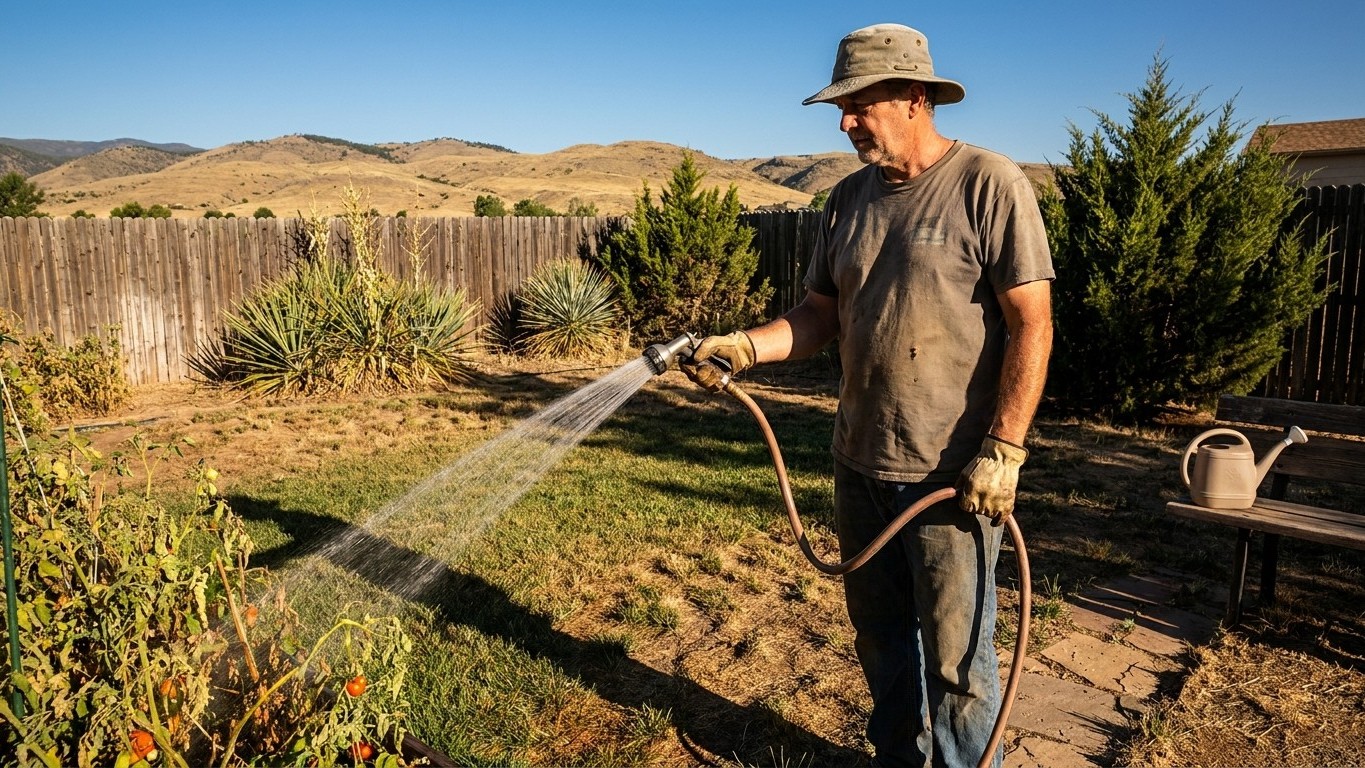

Colorado doesn’t get watering restrictions because of habit or paranoia. It gets them because the state runs hot, dry, and increasingly crowded, and because most of its water starts as snow hundreds of miles from where a garden hose is running. Here’s what the numbers actually say about how much your yard needs, how often to give it, and who sets the rules on turning the spigot on.
What the climate asks of you

Two figures set the terms for a Colorado garden. The first is heat: at the Denver reference station, an average year sees 39.6 days at 90F or hotter, based on NOAA’s 1991-2020 Climate Normals. That’s roughly five and a half weeks of stress-level heat stacked into a single growing season, and it’s the number that rules out anything resembling a cool, forgiving lawn or a garden that can coast on neglect.
The second figure is the season itself, and it comes from the frost dates rather than a rainfall total. The last spring freeze at that same station lands somewhere between May 1 and May 11, and the first fall freeze arrives between September 30 and October 12. Run the arithmetic on the tightest and widest combinations of those dates and the frost-free window comes out to somewhere between 142 and 164 days, depending on the year and exactly where you sit within that band. That’s the whole runway a garden gets, and close to a quarter of it can include a 90-degree afternoon.
What that window does not come with is a dependable rain schedule. Colorado’s summer precipitation arrives as isolated afternoon thunderstorms rather than steady, soaking rain, and totals swing hard from one yard to the next depending on elevation, whether you’re on the plains, the Front Range, or the Western Slope. There’s no single average-week rainfall figure that holds true statewide, which is exactly the point: a garden here can’t be planned around what the sky is expected to deliver, because the sky in Colorado doesn’t keep a predictable schedule. A bed wants roughly an inch of water a week to stay healthy through summer heat, and in most of Colorado, most weeks, the gardener is the one supplying nearly all of it, which is exactly why Watering Through a Dry Spell in Colorado becomes an essential skill rather than an occasional chore.
Soil texture changes how far that inch goes once it lands. Much of the Front Range sits on heavy, clay-based ground that holds moisture for days, while parts of the Eastern Plains run sandier and drain fast. Knowing which one you’re standing on matters more here than in wetter states, because in a climate this dry, there’s little margin for water that runs off before it soaks in. For gardeners working with pots rather than in-ground beds, soil type matters less than container size and material, which is covered in more detail in Watering Pots and Containers in Colorado.
How much, how often
The rule that matters most: water deep and infrequent, not shallow and daily. A quick sprinkle every evening trains roots to stay near the surface, where Colorado’s heat and thin summer air dry them out fastest. A deep soak once or twice a week pushes roots downward, into cooler, more stable ground that survives a 90-degree afternoon without wilting by 3 p.m.
The way to know if it’s time is to check, not guess. Push a finger or a trowel two inches into the soil near the base of the plant. If it’s dry at that depth, water. If it’s still cool and damp, wait another day and check again.
Soil texture decides the schedule from there. Sandy ground on the Eastern Plains holds little moisture, so it needs shorter, more frequent soakings to keep from drying out between waterings. Heavy clay along much of the Front Range holds a week’s worth of water, but it punishes overwatering: soaking clay that hasn’t dried, or working it while it’s still wet, compacts it and can drown roots outright. And with no reliable weekly rain to fall back on through a stretch that can run nearly six weeks above 90F, most Colorado gardens are effectively running on irrigation for the length of the summer, not on whatever the sky happens to contribute.
A watering routine that works with this climate
- Water early morning, before 9 a.m., so moisture soaks in before the day’s heat and wind pull it back out through evaporation.
- Aim at the base of the plant, not the leaves, since wet foliage in the sun invites fungal problems without helping the roots at all.
- Check soil at two inches deep before every watering, rather than watering on a fixed calendar day.
- Give one deep soak, roughly an inch of water total, once or twice weekly on clay-heavy ground; split that into shorter, more frequent sessions on sandy soil.
- Skip a cycle after a real thunderstorm, then go back to checking the soil rather than the calendar once it’s passed.
Restrictions and rules
Watering restrictions are common across Colorado, and for good reason: the state’s climate is naturally dry, its population keeps growing, and most of its water supply depends on mountain snowpack that varies year to year. That combination means many municipalities and water districts have adopted rules on outdoor watering, from designated days of the week to time-of-day limits during the hottest, driest stretches of summer.
What those rules actually say, though, varies by city and even by water provider within the same metro area, and they change from one summer to the next depending on drought conditions. There is no single statewide watering schedule to memorize. The only reliable move is to check directly with your local water utility or municipality before setting an automatic timer, since a schedule that’s fine in one neighborhood can trigger a fine in the next town over.
Colorado State University Extension is a solid starting point for understanding how local water rules interact with garden planning, even though it won’t list every district’s specific days: extension.colostate.edu. Given how much of the summer runs hot and how little rain shows up reliably to fill the gap, treating restrictions as a real planning factor, not an afterthought, makes sense almost anywhere in the state.
Using less
Cutting water use in a Colorado garden isn’t about one dramatic change. It’s a handful of small habits that each shave demand off a season that’s already running hot for nearly six weeks a year.
- Mulch, two to three inches deep: slows evaporation from soil that’s already fighting sun and dry air, and matters even more on sandy Eastern Plains ground that drains fast on its own.
- Drip irrigation instead of overhead sprinklers: delivers water straight to the root zone instead of losing a share of it to evaporation and wind drift before it hits the ground.
- Group plants by water need: keeps thirsty vegetables and flower beds separate from drought-tolerant natives, so you’re not overwatering the tough plants just to satisfy the thirsty ones nearby.
- Work organic matter into the soil: improves how much water clay holds without waterlogging, and helps sandy soil retain moisture it would otherwise lose within a day.
- Rain barrels, where allowed: an inch of rain falling on a 1,000-square-foot roof works out to roughly 600 gallons of runoff. In a state where summer rain shows up as isolated thunderstorms rather than steady totals, that math cuts both ways: one good storm can fill a barrel fast, but with no dependable weekly rain to refill it, that barrel can just as easily sit empty for weeks at a stretch. It’s a real supplement, not something to plan a whole irrigation schedule around.
Colorado is also one of the few states with specific state law addressing residential rainwater collection, a legacy of its historically strict water-rights system. The rules include a volume cap on how much you can store, so it’s worth confirming current limits with your local water provider or CSU Extension before installing a barrel, rather than assuming any size container is fair game.
Common questions
How often should I water my garden in Colorado during summer?
Most beds do best with one or two deep soakings a week rather than daily sprinkling, adjusted by checking soil moisture two inches down before each watering. Sandy soil needs more frequent, shorter sessions; heavy clay holds water longer and needs less frequent watering.
Are there statewide watering restrictions in Colorado?
No single statewide schedule applies everywhere. Restrictions are set locally by cities and water districts and change with drought conditions, so checking with your local water provider before setting a schedule is the only reliable approach.
What time of day should I water my lawn or garden?
Early morning, generally before 9 a.m., so water soaks into the soil before heat and wind pull it back out through evaporation. Watering in the evening leaves foliage wet overnight, which can invite fungal issues.
Can I collect rainwater in Colorado?
Yes, state law permits residential rain barrel use, a notable exception given Colorado’s historically strict water-rights rules, but it comes with a volume cap. Check current limits with CSU Extension or your local water provider before installing one.