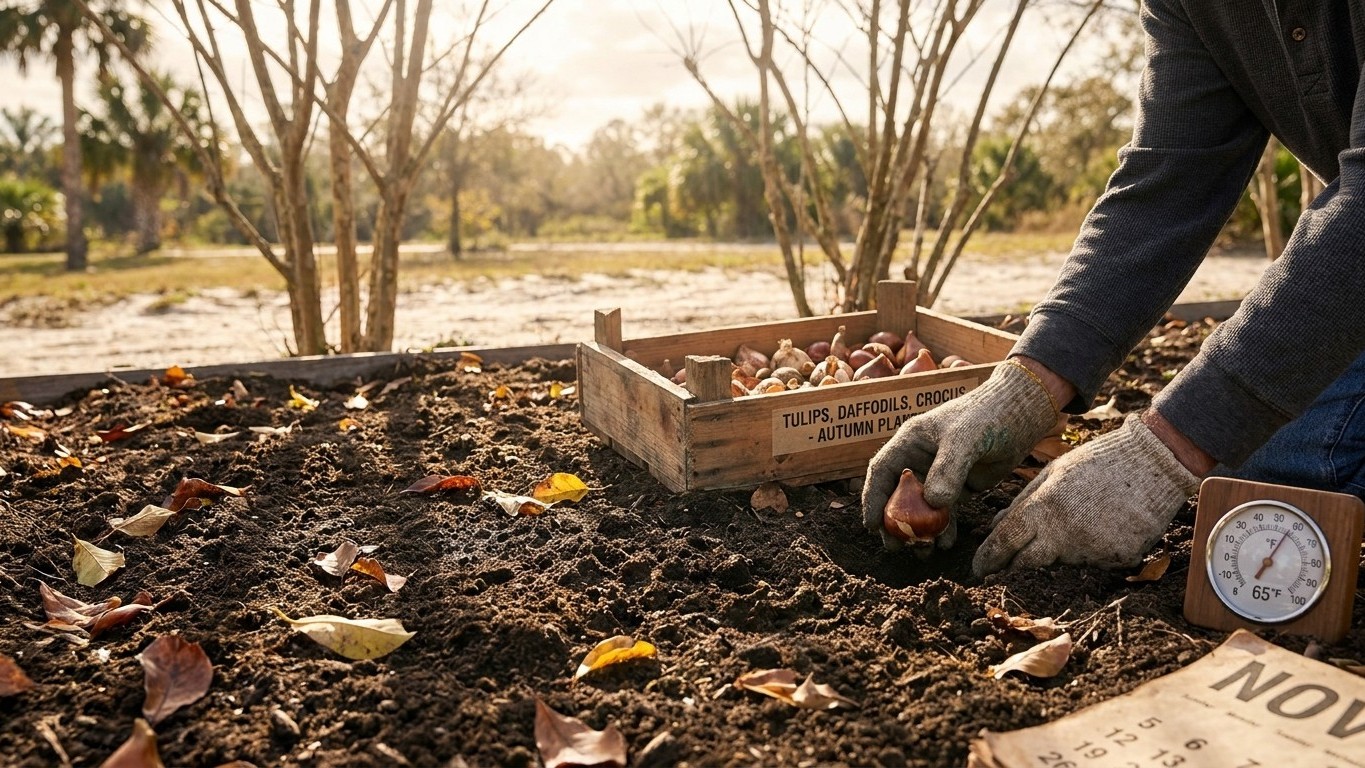

Florida sits mostly outside the cold that spring bulbs need to flower, and that single fact decides more than any planting date. Jacksonville’s coldest month averages a 42.9°F low, which sounds close to the mark until you learn most bulbs need that temperature sustained for three months, not one. Here’s what actually survives.
When to plant bulbs in Florida

For north Florida, where Jacksonville sits, the working rule is to get bulbs in the ground about six weeks before the ground freezes hard. NOAA’s 1991-2020 climate normals put the first fall frost for the Jacksonville area (station USW00013889) somewhere between November 26 and December 13. Counting back six weeks lands the planting window in mid-to-late October, running through the first days of November.
That window has real edges, and missing either one costs you the bloom. Plant too early, while the soil still holds summer heat, and a bulb pushes soft top growth well before winter arrives. That growth gets nipped the first time a real cold front rolls through, and the bulb spends its stored energy recovering instead of flowering. Plant too late, after the soil has already gone cold, and the bulb goes in without enough time to root before dormancy. It may sit through winter and come up weak in spring, or not come up at all.
Treat that November window as an average, because it is one. NOAA builds it from freeze probabilities across thirty years of records, and roughly half of those years fell on the early side of the range, half on the late side. Three of those thirty falls at the Jacksonville airport station saw no freeze whatsoever. Planning around the midpoint of the window, rather than either end, gives you the best odds without staking everything on a single date.
Central and south Florida run a different calendar
None of this applies once you move south of roughly Orlando. Central and south Florida are effectively frost-free, and the whole growing calendar flips: the main planting season for cool-season plants runs through the fall and winter months, and summer heat becomes the obstacle instead of winter cold. A planting date built around Jacksonville’s frost window would be meaningless in Miami or Tampa, because there is no frost to count backward from. Anyone gardening south of the panhandle should treat the rest of this guide as a north Florida reference point and adjust accordingly, which section five covers directly, and may find more success by Growing Spring Bulbs in Containers in Florida instead of relying on in-ground planting, or by Forcing Spring Bulbs Indoors in Florida to guarantee the cold period bulbs never get outdoors.
Whether your winter is cold enough
Spring bulbs flower because of a cold trigger inside the bulb, not because of anything happening above ground. Tulips, daffodils, hyacinths and crocus all need a sustained cold spell, typically twelve to fourteen weeks with the soil sitting below about 45°F, before the flower embryo inside the bulb will finish developing. Skip that chill and the bulb still grows leaves the following spring, because leaf growth doesn’t need it, but the flower stalk stays short or never forms at all. That number, twelve to fourteen weeks below 45°F, is the one figure to hold onto no matter what bulb you’re offered at a garden center. It’s the yardstick everything else gets measured against.
Jacksonville’s coldest month averages a 42.9°F daily minimum. That’s a mean minimum, not a record low and not a sustained soil temperature, and it covers roughly one month. A single month brushing 45°F is nowhere close to the twelve to fourteen consecutive weeks a tulip or hyacinth requires. Florida’s north edge, the coldest part of the state, still comes up well short.
That shortfall is why nurseries sell pre-chilled bulbs to southern gardeners, and why the pre-chilling has to be done right to mean anything. Twelve weeks in a refrigerator, kept apart from apples, bananas or any ripening fruit, does the job a Florida winter can’t. Ripening fruit gives off ethylene gas, and ethylene damages the flower bud sitting inside the bulb well before you ever see it. A bag of bulbs left in the produce drawer next to a fruit bowl can come out looking fine and bloom for nothing.
None of that makes tulips, hyacinths, crocus or trumpet daffodils a good bet here without extra work, and skipping the chill wastes the bulb outright.
| Species | Weeks below 45°F required | What north Florida delivers | Verdict |
|---|---|---|---|
| Tulip | 12-16 weeks | About 1 month near 42.9°F | Fails without pre-chilling |
| Hyacinth | 12-14 weeks | About 1 month near 42.9°F | Fails without pre-chilling |
| Daffodil, trumpet/large-cup types | 12-16 weeks | About 1 month near 42.9°F | Fails; often blooms once then stops |
| Crocus | 12-15 weeks | About 1 month near 42.9°F | Fails without pre-chilling |
| Paperwhite Narcissus (N. tazetta) | 0 weeks | Not needed | Works, blooms without chilling |
Which bulbs suit Florida
The bulbs that actually work here share one trait: they never needed the cold in the first place. Their hardiness range overlaps Florida’s 8b-11b zoning, and their flower buds form without any winter trigger. A short list, but a reliable one.
- Paperwhite Narcissus (Zones 8-11): blooms on schedule with no chilling at all.
- Crinum lily (Zones 7-11): a heat-tolerant bulb built for the Deep South.
- Amaryllis / Hippeastrum (Zones 8-11): flowers reliably without a cold dormancy.
- Society garlic (Tulbaghia violacea, Zones 7-10): a low-chill bulb-like perennial that flowers through most of the year.
- Rain lily (Zephyranthes, Zones 7-10): flowers in flushes after rain, no winter needed.
- Walking iris (Neomarica, Zones 8-11): a rhizomatous relative that behaves like a bulb in the landscape.
Now the disappointing side. Tulips, planted without pre-chilling, will produce a rosette of leaves the first spring and nothing above it, and even chilled bulbs are usually treated as one-season annuals here rather than perennials, since they rarely rebuild enough cold credit to repeat. Trumpet daffodils follow the same pattern: a decent show the first year on stored energy from the nursery, then leaves only after that. Hyacinths and crocus rot as often as they disappoint outright, because Florida’s wet winters keep the soil damp exactly when these bulbs expect a dry, cold dormancy.
None of these hardiness ranges are hard lines. A tulip near the northern edge of Zone 8 sometimes limps through a season in a sheltered, shaded bed where soil stays a few degrees cooler, and the same bulb dies in an open, sun-baked border a mile away. Treat the zone numbers as a strong lean, not a guarantee either way.
What digs them up here
Squirrels and voles aren’t opportunists so much as chemists. They leave certain bulbs alone because those bulbs are toxic or simply unpalatable, and they dig up others because there’s nothing stopping them. Daffodils and every plant in the onion family carry compounds that make rodents sick, so they’re skipped outright. Tulips and crocus carry no such defense and rank among the most raided bulbs in any yard where squirrels are active.
Almost everything recommended above already carries a built-in defense. Paperwhite narcissus, crinum, rain lily and amaryllis all belong to the same toxic family as daffodils, and society garlic earns its safety the same way true onions do.
- Bulbs squirrels and voles dig up: tulip, crocus.
- Bulbs they leave alone: paperwhite narcissus, daffodil, crinum, amaryllis, society garlic.
For anything still worth protecting, wire mesh laid flat over the planting works better than any spray. In climates further north the advice is to leave it down until the ground freezes solid, but Florida’s ground rarely freezes at all, so the useful window is shorter: keep the mesh down for the first four to six weeks after planting, while the disturbed soil still smells fresh to a digging animal. Repellent sprays wash off with the first heavy rain and need reapplying constantly to do anything.
Where to check for your own county
Every figure above traces back to Jacksonville, the reference station for north Florida in this guide, and Florida stretches across several degrees of latitude and multiple USDA hardiness zones between the panhandle and the Keys. A frost date and a coldest-month minimum measured at one airport won’t hold true for a county three hours south, or one sitting closer to the coast where ocean air moderates winter lows.
The University of Florida’s Institute of Food and Agricultural Sciences runs the state’s land-grant extension service, and its county offices track local frost patterns and soil conditions block by block in a way no statewide guide can match. Their directory is available at sfyl.ifas.ufl.edu. A planting window built for Jacksonville can run three weeks early or late once you cross into a neighboring county, and that gap is often the difference between a bulb that roots properly and one that doesn’t.