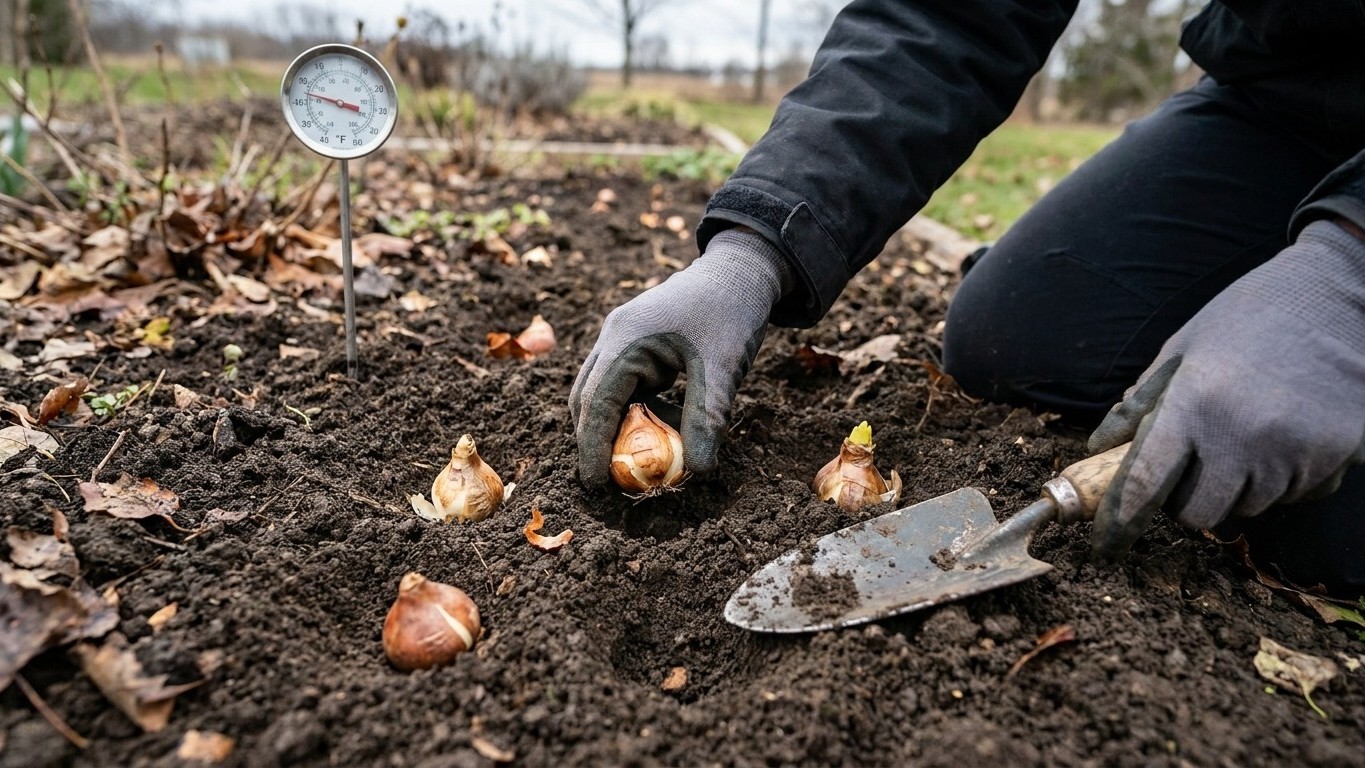

Most spring bulbs sold at Louisiana garden centers will leaf out fine and never flower, or flower once and quit. The reason isn’t soil, sun, or planting depth. It’s cold. New Orleans averages 46.1°F on the coldest nights of the year, and that single number determines which bulbs are worth your money here and which ones are a one-season experiment.
When to plant bulbs in Louisiana

The planting window in most of the country is built around a hard freeze date. In Louisiana, that math gets complicated fast. NOAA’s 1991-2020 climate normals put the first fall freeze (32°F) somewhere between December 17 and January 8, based on the 30-70 percent probability band at the New Orleans station. That’s a three-week spread on when winter even starts to bite, and it lands late enough that some gardeners are still in shorts weather while catalog deadlines for fall bulb orders have already passed.
The bigger surprise is buried in the same dataset: a 32°F freeze occurs in only 86.8 percent of years at that station. Flip that around and roughly one year in seven, south Louisiana gets no freeze at all. That’s not a rounding error, it’s a real chance that “winter” here is a string of chilly mornings that never actually crosses the freezing line.
Plant too early, while soil is still warm from summer, and bulbs often push soft top growth that gets burned back by the first real cold snap, weakening or killing the bulb before it ever roots properly. Plant too late, after soil has already cooled hard, and roots don’t have time to establish before spring warmth arrives, which shows up as short stems, small flowers, or bulbs that skip blooming entirely their first year.
Why the calendar date is only a guide
Because the freeze window spans three weeks and misses entirely in one year out of seven, treat the December date as a target, not a deadline. Aim for mid-to-late November through mid-December for most of south Louisiana, watching soil temperature rather than the calendar. North Louisiana, which sits at a higher latitude and sees more reliable freezes, can generally plant a couple of weeks earlier and count on more consistent cold to follow. For gardeners who want more direct control over soil temperature timing, Growing Spring Bulbs in Containers in Louisiana can make it easier to hit that cold-exposure window precisely. The real limiting factor for most of this state isn’t frost at all. It’s the length and intensity of summer heat that follows, since spring bulbs need to finish their growth cycle and go dormant before that heat arrives.
Whether your winter is cold enough
This is the question that decides everything else, and most bulb packaging never answers it. A spring bulb like a tulip or hyacinth doesn’t just tolerate cold, it requires it. The bulb needs a sustained period, typically twelve to fourteen weeks, with so cold that many Louisiana gardeners skip the guesswork entirely by Forcing Spring Bulbs Indoors in Louisianail temperatures below about 45°F, to complete an internal hormonal process that forms the flower inside the bulb. Skip that requirement and the bulb still grows leaves, sometimes vigorously, but produces no flower, or a flower bud so short it never clears the foliage.
New Orleans’ coldest-month mean minimum is 46.1°F. That’s barely above the 45°F threshold, and it’s a monthly average, not a description of sustained weeks. In practice, the region rarely delivers the kind of extended, consistently cold soil that tulips and hyacinths evolved to expect. This isn’t a marginal case that clears the bar with room to spare. It’s a case where the natural chill supply falls short for the bulbs most commonly sold in fall bulb displays.
For bulbs that need that kind of sustained chill, the only workaround is pre-chilling: storing bulbs in a refrigerator, at a consistent temperature, for the full twelve weeks before planting. Keep them away from apples, pears, or any ripening fruit stored nearby, since fruit releases ethylene gas that can damage or kill the flower bud forming inside the bulb, even at refrigerator temperatures. This isn’t a shortcut, it’s a substitute for a season Louisiana doesn’t reliably provide, and it means treating those bulbs as an annual, dug up and discarded or re-chilled each year rather than left in the ground.
| Bulb | Cold required | What Louisiana delivers | Verdict |
|---|---|---|---|
| Tulips | ~14-16 weeks below 45°F | Coldest month averages 46.1°F; sustained sub-45°F weeks are rare | Pre-chill 12 weeks or skip; grow as an annual |
| Hyacinths | ~12-14 weeks below 45°F | Same shortfall as tulips | Pre-chill required; not a perennial here |
| Standard trumpet daffodils | ~12-14 weeks below 45°F | Shortfall in most years | Leaves without flowers after year one; not worth planting |
| Crocus | ~8-10 weeks below 45°F | Marginal, inconsistent | Unreliable; treat as a gamble, not a given |
| Low-chill narcissus (paperwhites, jonquils) | Low or no chill requirement | Fully met without any pre-chilling | Reliable perennial performer |
A gardener who plants standard tulips or hyacinths in Louisiana soil without pre-chilling them has, in effect, wasted the bulb cost on a single season of leaves.
Which bulbs suit Louisiana
The bulbs that actually work here are the ones bred or native to warm climates, where a hardiness range of 7-10 overlaps comfortably with this state’s zones 8a-10a, and where the flower doesn’t depend on a hard winter to form.
- Narcissus tazetta, paperwhites — hardiness zones 8-10
- Narcissus jonquilla hybrids, jonquils — hardiness zones 7-10
- Crinum lily — hardiness zones 7-10
- Zephyranthes, rain lily — hardiness zones 7-10
- Louisiana iris — hardiness zones 6-9
- Tulbaghia violacea, society garlic — hardiness zones 7-10
- Lycoris, spider lily — hardiness zones 7-10
Hardiness ranges are never a hard line. A tulip pushed to the edge of its range might scrape by in a sheltered courtyard bed with reflected heat and good drainage, while the same bulb dies outright in an open, exposed lawn a mile away. Treat the zone number as a strong lean, not a guarantee in either direction.
The bulbs to skip are the ones sold in big-box fall displays alongside pumpkins: tulips, hyacinths, and standard trumpet daffodils bred for northern winters. They disappoint in one of three specific ways. Some come up as leaves only, with no flower ever forming. Others put on a decent first-year show, using stored energy from the original bulb, then fade to nothing the second spring once that reserve is spent. And in wet Louisiana winters, some simply rot in the ground before they get the chance to do either, because these bulbs also expect a drier dormancy than Gulf Coast clay typically offers.
What digs them up here
Squirrels and voles aren’t random about which bulbs they raid. It comes down to chemistry. Daffodils, jonquils, and anything in the onion family contain compounds that make them bitter or mildly toxic to rodents, so they’re left alone almost every time. Tulips and crocus contain none of that natural defense, which is exactly why they’re a favorite target.
- Bulbs squirrels and voles dig up: tulips, crocus, true lilies
- Bulbs they leave alone: daffodils, jonquils, paperwhites, society garlic, other allium-family bulbs
This lines up conveniently with the cold-hardiness math above: the bulbs Louisiana’s winter can actually support, mostly narcissus and allium types, are also the ones rodents skip. For anything else, or for freshly planted beds where scent still lingers, laying a sheet of galvanized wire mesh flat over the planting bed for the first few months after planting is the one method that reliably works, since it physically blocks digging until roots establish. Repellent sprays are a waste of money in this climate specifically, since Louisiana’s frequent rain washes them off within days.
Where to check for your own county
Everything above is anchored to New Orleans, the reference station for the coldest-month figure and the frost dates cited here. Louisiana spans multiple USDA hardiness zones, from 8a to 10a, and a planting window built around the state’s largest city can run three weeks off in either direction once you move toward the Arkansas border or down into the coastal parishes. North Louisiana’s cooler winters and earlier frosts change the pre-chill math; the immediate coastal zone barely sees a freeze most years.
The LSU AgCenter, the state’s land-grant extension service, publishes county-level planting guidance that accounts for this spread. Calling or checking with a local parish office is worth the ten minutes, since their recommendations are built on data specific to your soil and microclimate rather than a single reference city three hours away.