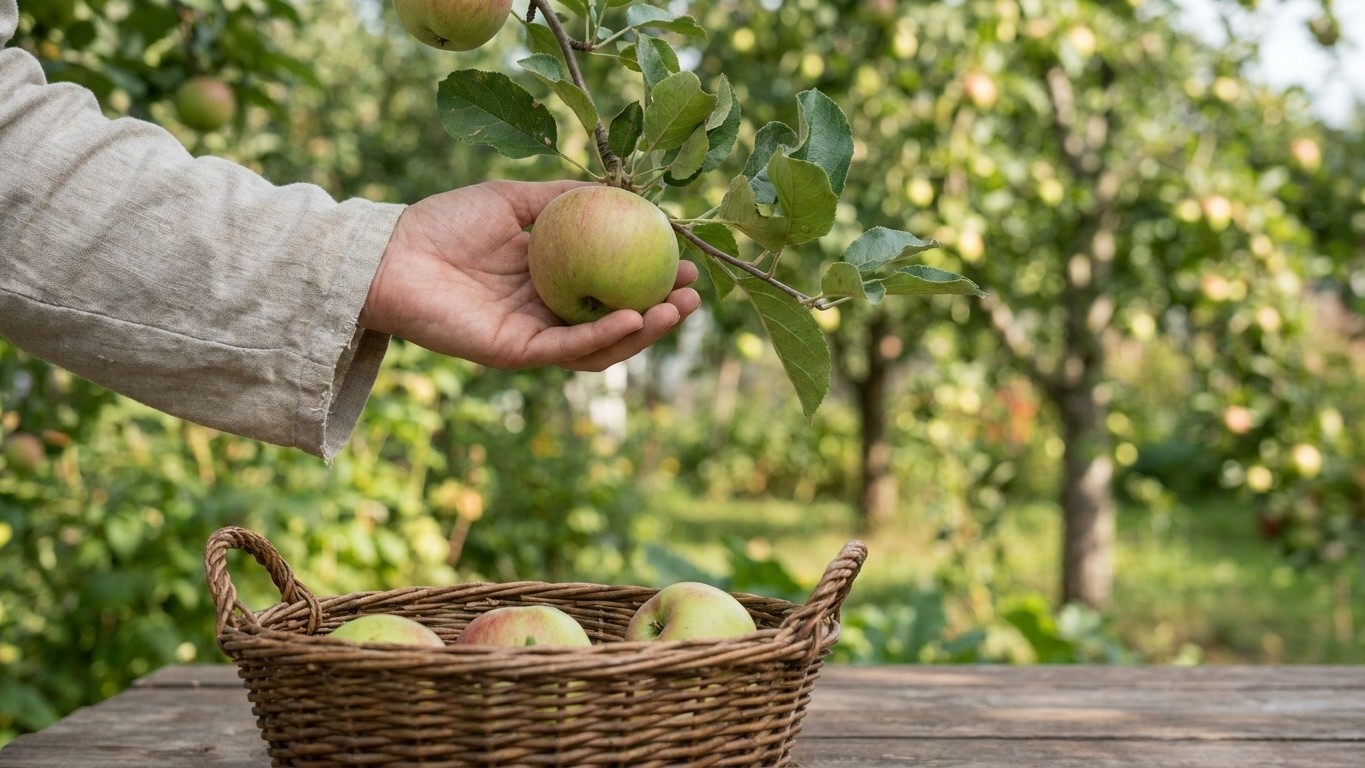

An apple is ready when its background color shifts from green to yellow or cream under the blush, when the stem releases from the branch with a gentle upward twist, and when a cut fruit shows brown seeds instead of white ones. No fixed date tells you this, because the same variety ripens on a different day from one orchard to the next, even from one branch to the next on the same tree. Pick one fruit near the outside of the canopy, cut it open, and check the seed color a week before you think the crop is ready, then repeat every few days until it matches.
Why it matters
Harvest is the one step in an apple tree’s year that a calendar cannot schedule for you. Dormancy, green tip, pink, bloom and petal fall all follow a rough sequence a grower can watch for on the tree, but the stretch between petal fall and a ripe apple lengthens or shortens depending on the variety, the crop load, and the weather that season. A date that worked last year on the same tree can run a week or more off this year.
What a missed call costs
Getting the timing right decides what the fruit tastes like off the tree and how long it keeps afterward. An apple picked before its starch finishes converting to sugar tastes sharp and hard rather than sweet, and it will not develop much further once it is off the tree. An apple picked too late softens fast, drops on its own, and bruises on the way down, and it will not last in storage the way a correctly timed picking does, a difference covered in more detail in Storing Apples: What Keeps Until Spring and What Does Not.
This matters most for anyone growing more than one variety, since each one reaches its window at a different point in the season and a grower who has only learned to read one apple has to relearn the signs for the next. The four checks below carry over to every cultivar, which is the point of learning them instead of a date. Anyone still working through the earlier stages of the tree’s year can catch up on the basics in Growing Apples before circling back to harvest.
When to do it
Read the stage, not the month
Ripening sits at the far end of the same sequence that starts at dormancy and runs through green tip, pink, bloom and petal fall. Once petal fall has passed and the small green fruitlets have set, the tree needs a run of weeks to finish the job, and how many weeks depends on the variety more than on anything else. Some cultivars are built to ripen early in the season and others hold on the tree for months longer, which is exactly why an orchard planted with several varieties never has one harvest day. It has a harvest season.
Crop load moves the date too. A tree carrying a heavy set of fruit ripens its crop later and smaller than the same tree thinned to a lighter load, since each fruit competes for the same supply of sugar coming from the leaves. A hot, dry stretch late in the season speeds up the sugar buildup that turns a starchy apple sweet, while a cool, wet one slows it down, which is why the same tree can run ahead of its own history in a warm year and behind it in a cool one.
Uneven pollination adds another layer. A poor fruit set, whether from a late frost at bloom or from a pollination partner that flowered out of step, leaves some fruit smaller and slower to ripen than the rest of the crop on the same branch. Matching bloom times across varieties is its own project, covered in Apple Pollination: Which Varieties Work Together, and it pays off at harvest as much as it does at bloom.
How to do it

Check the fruit, not the tree
Start with fruit on the outside of the canopy, in direct sun, since that fruit always ripens ahead of anything shaded deeper inside the tree. Pick one apple, not the whole crop, and run it through four checks before deciding the rest of the tree is ready.
The four signs, read together
| Signal | How to check it | Still unripe | Ready |
|---|---|---|---|
| Background color | Look at the skin color showing through or around the red or pink blush, not the blush itself | Green | Yellow, cream, or gold, depending on the variety |
| Stem release | Cup the fruit and twist gently upward, without pulling down or sideways | Stem resists and tears | Stem separates cleanly with the fruit |
| Seed color | Cut the fruit through the middle and look at the seeds inside the core | White or pale green | Brown to dark brown |
| Taste and texture | Bite into the flesh near the skin, not just the center | Starchy, sour, hard | Crisp, sweet, juicy |
No single signal decides the case on its own. Background color can turn before the seeds do on some varieties, and a fruit that twists free easily on a windy day is not proof the whole tree is ready, only that one apple was loose. Weigh all four signals together, and treat the seed cut as the tie-breaker when the others disagree.
Once the first fruit passes the test, work the tree in stages rather than stripping it in one visit. Go back every few days and pick only the fruit that passes the same four checks, leaving the rest to finish on the tree. This staggered approach also spreads the load on storage, since a smaller batch handled right away keeps better than a full crop rushed indoors all at once.
What goes wrong
Testing the wrong fruit
The most common mistake is checking one apple on one side of the tree and calling the whole crop by it. Fruit on the south or west side of the canopy, in full sun, ripens ahead of fruit tucked into shade on the interior or north side, sometimes by a week or more. The gap widens on a tree with a large canopy: a tree on seedling rootstock, which USU Extension lists at 35 to 40 feet at maturity, or on MM.111, at 30 to 35 feet, shades its own interior far more than a tree on a dwarfing rootstock like M.9, at 8 to 12 feet, or M.26 and G.11, both 12 to 15 feet. A small, open canopy ripens far more evenly than a tall, shaded one.
Picking on the calendar instead of the fruit is the second mistake, and it runs both directions. Picking early because it has “been about the right number of weeks” locks in a starchy, sour apple that never improves once it is off the tree. Picking late because the color looks good from the ground misses the point that background color is only one of the four checks, and a fruit can look ripe from a distance while the seeds inside are still pale.
Ignoring how the fruit lets go
Pulling or yanking fruit downward instead of twisting it upward tears the stem out of the spur, and a torn spur often fails to set fruit again the following year. A bruised or punctured apple also breaks down in storage days ahead of an unbruised one, spreading rot to whatever it touches in the same crate, which is one more reason the picking method matters as much as the picking date, covered further in Storing Apples: What Keeps Until Spring and What Does Not.
What changes where you are
The sequence holds, the dates do not
The stage-by-stage sequence, from dormancy through green tip, pink, bloom, petal fall, and finally harvest, holds true in every climate an apple tree grows in. What shifts is how many calendar weeks separate one stage from the next. A grower in a short, cool season sees the whole sequence compress into a narrower window than a grower in a long, warm one, and the same variety can finish ripening a month or more apart between the two.
Bloom groups shift with climate too. Clemson Cooperative Extension’s HGIC 1350 fact sheet places Anna and Dorsett Golden in bloom group A, Fuji, Gala, Ginger Gold, Granny Smith, Jerseymac, Mollie’s Delicious, Mutsu, Red Delicious and Yates in group B, and Arkansas Black, Golden Delicious, Jonagold, Ozark Gold, Priscilla, Rome Beauty and Stayman in group C. The order of these groups holds everywhere, since it reflects how the varieties flower relative to each other, but the calendar dates each group blooms on move earlier or later depending on the climate a grower is in.
That relative order carries some weight at harvest too, since fruit that flowered later in the season, on the same tree and in the same weather, tends to finish later as well. Anyone setting up a new planting for pollination overlap should work from the group list and the sterility notes together, since a few varieties, Jonagold, Mutsu, Stayman and Winesap among them, carry sterile pollen and cannot pollinate a neighboring tree even though they can be pollinated by one, a distinction laid out fully in Apple Pollination: Which Varieties Work Together. For frost dates, chill hour totals and other locally specific numbers that affect the exact calendar window, a state or county extension office is the right place to check, since those figures move from one county to the next even within the same state.
Common questions
My Granny Smith apples never turn yellow, how do I know they’re ripe?
Some varieties stay green at the background even when fully ripe, so the color check is not useful on its own for those. Lean on the seed cut, the stem release, and the taste test instead, and treat a green background as normal for that fruit rather than a sign it still needs time.
Will an apple keep ripening after I pick it?
It will soften and lose some starch further, but the sugar level it left the tree with is close to what it will have in the fruit bowl. An apple picked while the seeds were still pale stays underripe in flavor no matter how long it sits on the counter.
Some apples are falling off the tree before I’ve picked any, is that normal?
Yes, a natural preharvest drop is common as a crop nears ripeness, especially on a tree carrying a heavy load or after a windy day. Check a fallen fruit’s seeds. If they are already brown, the rest of the crop on that tree is likely close behind.
How many apples should I test before I pick the whole tree?
Test several, taken from different heights and different sides of the canopy, not just one from arm’s reach. Sun-exposed fruit ripens first and shaded interior fruit lags behind it, and that gap runs wider on a tree with a large, dense canopy than on a small, open one.