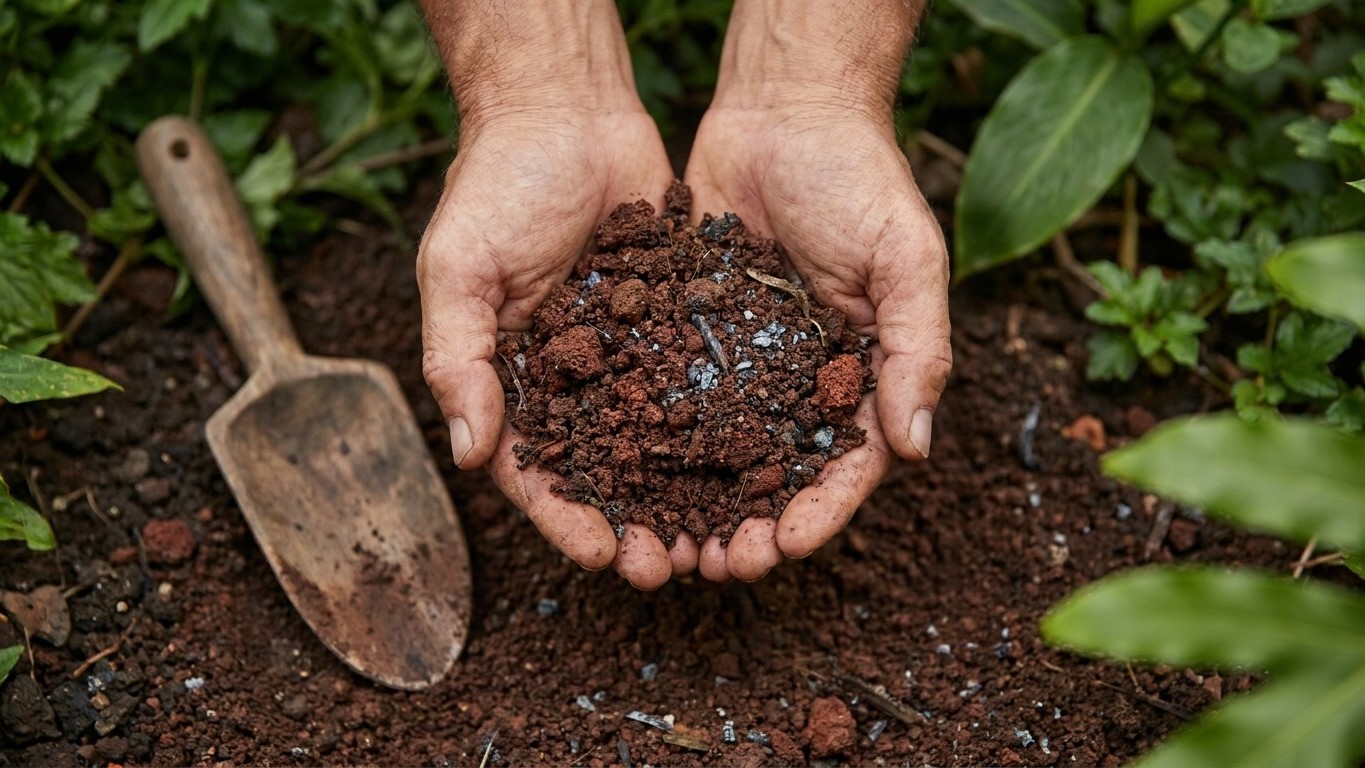

The soil USDA lists as representative of Hawaii is the Hilo series, an Andisol built from volcanic ash. It’s porous, holds water and phosphorus unusually well, and sits at a surface pH of about 5.8. That’s the baseline. What’s actually under your own trowel depends on where you garden, what’s been trucked in, and what a bulldozer may have done to it before you moved in.
What is under your garden

The Hilo series is the soil USDA NRCS names to represent Hawaii in its State Soils program. It’s an Andisol, a soil order built from weathered volcanic ash rather than the sedimentary or granite-derived material you’d find in most of the mainland. That ash weathers into short-range-order clays (mostly allophane) that behave nothing like ordinary clay. The result is a soil that’s light to work, holds moisture and nutrients with surprising efficiency, and grips phosphorus so tightly that plants sometimes go hungry for it even when there’s plenty in the ground.
Here are the measured values for the surface horizon, exactly as USDA NRCS Soil Data Access reports them for the Hilo series:
| Reading | Value |
|---|---|
| Surface pH | about 5.8 (slightly acid) |
| Sand | 10 percent |
| Clay | 35 percent |
| Silt | 55 percent |
| Organic matter | about 9.0 percent |
| Drainage class | well drained |
Those numbers describe the major components mapped as Hilo series soil, not every backyard in the state. Hawaii runs from black-sand coastal flats to rain-forest slopes to bulldozed subdivision lots, and none of those are the same ground twice. If a builder scraped, graded, or filled your lot before the house went up, you’re likely gardening in subsoil or fill dirt that has almost nothing in common with a native Hilo profile, no matter what the county soil map says about your address.
So don’t take the table above as your personal soil report. Take it as a description of what volcanic-ash ground in this state tends to do: hold onto water and phosphorus, run mildly acid, and stay loose and workable rather than turning into a brick when it dries.
Read your own dirt in five minutes
Two quick checks tell you more than staring at the ground ever will. First, the ribbon test: wet a small handful of soil until it’s the consistency of putty, then squeeze it between thumb and forefinger, pushing it upward into a ribbon. Soil high in clay forms a long, glossy ribbon over 2 inches before it breaks. Sandy soil won’t ribbon at all, it just crumbles. Silty soil forms a short, dull ribbon that snaps quickly.
Second, the jar test. Fill a clear quart jar about a third full with soil, top it off with water, add a drop of dish soap, shake hard for a minute, then set it down and walk away overnight. Sand settles within minutes and forms the bottom layer, silt settles over a few hours and sits above it, clay stays suspended longest and forms the top layer once it finally drops. The relative thickness of those three bands, measured the next morning, gives you a rough texture reading you can compare against the table above.
Testing before you amend
Eyeballing soil tells you texture and maybe drainage, but it can’t tell you pH, phosphorus availability, or whether your organic matter is anywhere near that 9.0 percent mark the Hilo series carries. Guessing at amendments wastes money twice: once on the wrong product, and again when you have to undo the damage. A lab soil test costs a few dollars and settles the question in about a week.
Because the region’s volcanic-ash ground tends to run mildly acid, it’s reasonable to expect a similar reading in your own bed if you’re gardening on undisturbed native soil nearby. Expecting is not knowing, though. Fill, imported topsoil, years of fertilizer, or a previous owner’s lime application can all push your actual number well away from that regional tendency.
Taking a sample properly matters as much as sending it in. Follow these steps standing in the garden with a trowel:
- Pick 6 to 10 spots scattered across the bed, avoiding odd corners like old fence lines or compost dump sites.
- At each spot, dig a small core 4 to 6 inches deep, the zone where most vegetable and lawn roots actually feed.
- Drop all the cores into one clean bucket and mix them together thoroughly.
- Spread the mixed soil out and let it air-dry for a day, away from direct heat.
- Bag about a pint of the dried, mixed sample and label it with the bed’s location and what you plan to grow there.
- Send it to your local extension-affiliated soil lab, or drop it at the county office if they collect samples locally.
The report that comes back will list pH, phosphorus, potassium, and often organic matter, each with a target range for the crop you named. Compare that against what you expected from the regional soil, and let the actual numbers, not the state average, decide what you buy.
Amending it
The Hilo series sits at pH 5.8, which is mildly acid but not deep into the range where most crops struggle. That number matters because it sits close to, but above, the 5.5 threshold where lime becomes the obvious fix. Above 5.5, most vegetables, lawns, and ornamentals do fine without any pH correction at all.
Liming, only if your test calls for it
If your own soil test comes back below roughly 5.5, lime is the tool, not sulfur. Acid ground below that line locks up phosphorus and makes life hard for brassicas like broccoli and cabbage, which prefer a closer-to-neutral pH. Apply lime according to the lab’s recommendation and expect it to work over a season or two, not overnight; lime has to react with soil moisture and dissolve gradually, so retesting after six months to a year is the honest way to check progress. Never add sulfur to soil that’s already acid. That pushes the pH the wrong direction and can tip a marginal bed into genuinely poor territory for most garden crops.
Phosphorus lock-up
Andisols like the Hilo series are notorious among agronomists for fixing phosphorus, the ash-derived clays grab onto phosphate ions and hold them out of reach of plant roots even when a soil test shows adequate total phosphorus. If your test flags low available phosphorus despite decent organic matter, banding phosphorus fertilizer close to the root zone, rather than broadcasting it across the whole bed, gets more of it to the plant before the clay can grab it.
Working with the clay and silt
At 35 percent clay and 55 percent silt, this soil carries real body, but its volcanic-ash structure keeps it looser and better draining than a mainland clay of the same percentages would be. Even so, the fix for heavy, fine-textured ground is the same everywhere: add organic matter, compost, aged manure, leaf mold, every season, and never work it while it’s wet, which collapses the loose aggregate structure that makes Andisols easy to dig. Never add sand to clay soil hoping to lighten it; the two combine into something closer to concrete. Organic matter improvements show results within a season for tilth, but rebuilding real structure and biology takes two to three years of steady additions.
If you’re gardening on sandy fill
Where a lot has been graded or filled with sandy material instead of native ash soil, water and nutrients drain through fast. Organic matter is still the fix, along with shorter, more frequent watering cycles rather than the deep, occasional soaking that works on the native ground described above.
Drainage and compaction
The Hilo series carries a well drained rating, which in practice means water moves through it steadily after rain rather than pooling on the surface or sitting in a soggy layer near the roots. That’s a benefit of the loose, porous ash structure, high clay and silt percentages notwithstanding.
Confirm it on your own ground with a simple percolation test rather than trusting the map. Dig a hole about a foot deep and a foot across, fill it with water, let it drain completely once, then refill it and time how fast the water level drops. A drop of 1 to 3 inches per hour is a healthy range for most garden plants. Faster than that, water and nutrients wash through before roots can use them. Slower, especially under an inch an hour, means roots are sitting in water they can’t use and are prone to rot.
Drainage aside, foot traffic and equipment compact any soil over time, flattening the pore spaces that let air and water move. Double digging used to be the standard fix, but it’s fallen out of favor because it disturbs soil biology and structure more than it helps, and the compaction often returns within a season or two anyway. On ground that’s been driven over during construction or packed down by years of foot traffic, a raised bed filled with a proper blend is frequently the better bet, not three years of patient decompaction work that may never fully pay off.
- Do: test percolation before planting anything with a deep root system.
- Do: keep foot traffic off garden beds by using defined paths.
- Avoid: tilling or digging the soil while it’s wet, especially in the clay-heavy zones.
- Plant elsewhere: anything drought-sensitive on ground that drains faster than 3 inches per hour without amendment first.
Local help
The University of Hawaii CTAHR Cooperative Extension runs soil testing for the state. County extension offices collect samples and can walk a gardener through the results in person, matching the numbers against whatever’s actually planned for the bed rather than a generic chart.
Common questions
Is Hawaii soil naturally acidic everywhere?
The Hilo series, representative of the state’s volcanic-ash ground, runs mildly acid at about 5.8. Rainfall, elevation, and how much the soil has weathered all shift that number locally, so a test is the only way to know your own reading.
Why does my garden struggle even with fertilizer?
Andisols like the Hilo series can lock up phosphorus in their ash-derived clays, keeping it out of reach of roots even when a fertilizer bag says it’s there. Banding phosphorus near the root zone instead of broadcasting it often helps.
Do I need to add sand to loosen heavy clay soil?
No. Mixing sand into clay tends to create a dense, cement-like texture. Organic matter is the safer, more effective way to lighten heavy, silt-and-clay-rich ground.
How often should I retest my soil?
Every two to three years for an established garden, or sooner after a major amendment like a lime application, so you can confirm it actually moved the pH before adding more.