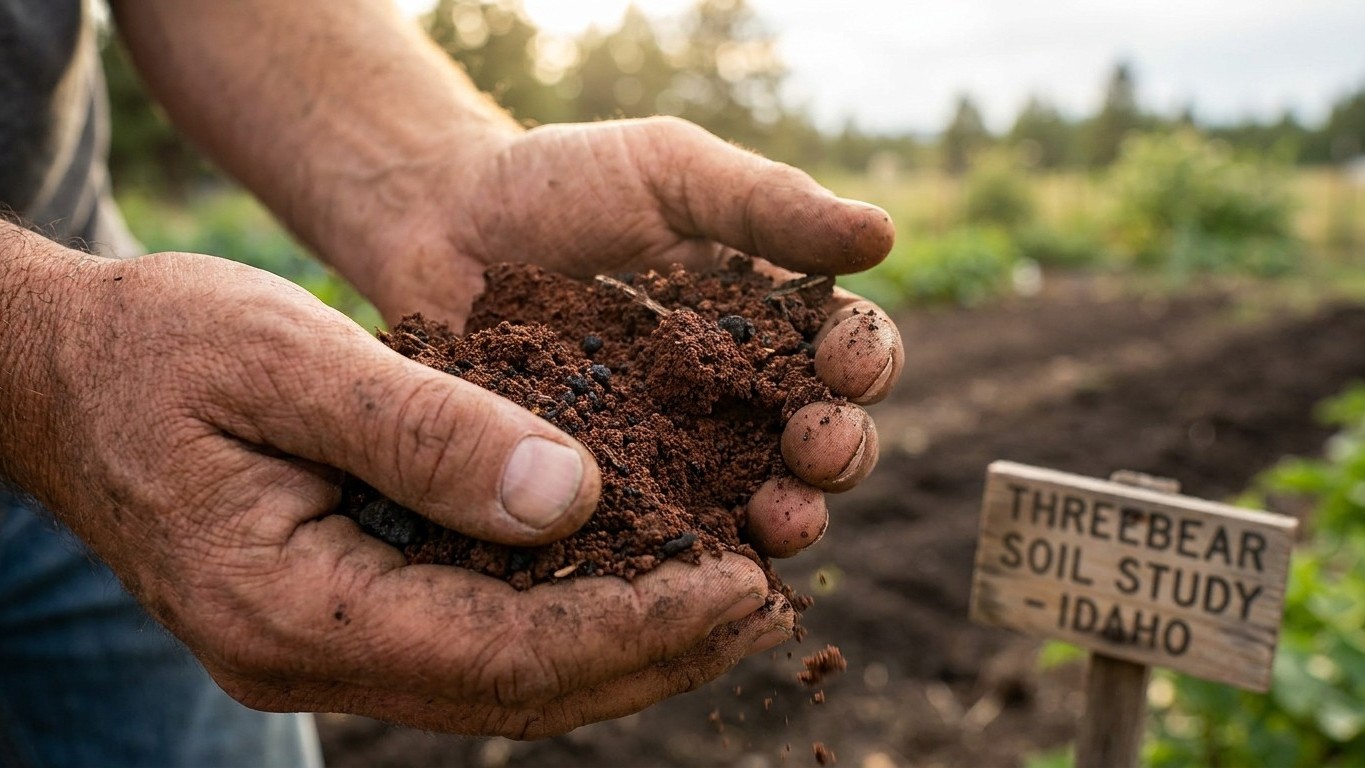

The ground under an Idaho garden is, more often than not, volcanic ash that fell centuries ago and never left. It drains oddly, holds phosphorus tighter than most soils, and runs acidic almost everywhere it hasn’t been limed. Here’s what the state’s representative soil actually is, and how to work with it instead of against it.
What is under your garden

Idaho’s representative soil is the Threebear series, an Andisol, meaning it formed from volcanic ash rather than from weathered rock or river sediment. Andisols are unusual soils: light, porous, and remarkably good at holding onto both water and phosphorus, which is exactly what the Threebear series does. The USDA’s mapped surface horizon for this series comes in at a pH of about 5.0, which is strongly acid, with a texture described as loam to silt: 35 percent sand, 15 percent clay, and 50 percent silt. The organic matter figure is about 75.0 percent, and drainage is classed as moderately well drained.
| Reading | Value |
|---|---|
| Surface pH | About 5.0 (strongly acid) |
| Sand | 35 percent |
| Silt | 50 percent |
| Clay | 15 percent |
| Organic matter | About 75.0 percent |
That organic matter number deserves an honest flag. Anything above roughly 20 percent organic matter usually means the mapped surface isn’t a worked garden bed at all, but a natural organic layer, think peat, muck, or forest litter sitting on top of the mineral soil. A cultivated bed on a Threebear-type soil will not carry anywhere near 75 percent organic matter once it’s been tilled, planted, and rained on for a few seasons. Treat that figure as a description of the untouched surface, not a promise about your raised bed.
And that’s the bigger caution here. The Threebear series is what USDA lists as representative of Idaho as a whole, not a guarantee about the dirt in your specific yard. A garden in a river bottom, a hillside plot, or a lot where a builder scraped topsoil and brought in fill can be a completely different animal from the state soil on paper. What this series tells you is the tendency: acid-leaning, ash-derived, phosphorus-hungry ground that drains reasonably well but isn’t a heavy clay or a pure sand.
Read your own soil in five minutes
Grab a handful of moist soil from your garden and squeeze it between thumb and forefinger, pushing it upward into a ribbon. Sandy soil won’t ribbon at all; it just crumbles. Silty soil forms a short, fragile ribbon under an inch. Clay-rich soil forms a long, flexible ribbon over two inches before it breaks. A second test: fill a clear jar a third full of soil, top it off with water, shake it hard, and let it sit overnight. Sand settles within minutes, silt within a few hours, and clay stays suspended or forms the topmost, thinnest layer by morning. The proportions you see in that jar tell you far more about your actual garden than any statewide average.
Testing before you amend
Guessing at soil chemistry wastes money, plain and simple. Adding lime to soil that’s already neutral, or sulfur to soil that’s already acidic enough, can set a garden back a full growing season. A lab test tells you the actual pH, the actual phosphorus and potassium levels, and sometimes the actual organic matter percentage of your bed, none of which your eyes or a ribbon test can give you.
The regional pH of about 5.0 for the state’s representative soil lets you expect acidic ground going in. Expecting is not knowing. Your particular lot could sit closer to neutral if it’s been limed in the past, or it could run even more acidic if it’s undisturbed forest soil. The only way to know is to sample it and send it to a lab, and that lab is almost always run through your state’s extension service for a modest fee.
- Pick eight to ten spots scattered across the bed or lawn area you’re testing, avoiding spots right next to a foundation, a driveway, or a compost pile.
- At each spot, dig a small core six to eight inches deep, the depth where most vegetable and lawn roots actually live.
- Drop all the cores into a clean plastic bucket, breaking up clumps and removing rocks, roots, and mulch.
- Mix the cores thoroughly so the sample represents the whole bed, not just one corner.
- Spread a cup or two of the mixed soil out to air-dry for a day, then bag it and label it with the bed’s location.
- Drop the sample at your county extension office or mail it in with the lab’s submission form, and note it if you’re testing for anything specific, like a suspected iron deficiency.
Results usually come back with pH, phosphorus, potassium, and sometimes a lime or sulfur recommendation already calculated for your crop. That recommendation is worth more than any statewide figure, because it’s built from your dirt, not the state’s.
Amending it
The Threebear series points in one clear direction: a pH around 5.0 is well below the 5.5 threshold where lime becomes the right tool, not sulfur. If your own test comes back anywhere near that range, sulfur is a mistake, it pushes already-acid soil further into territory where nutrients lock up and roots struggle.
Lime for acid ground
Acid soil ties up phosphorus in forms plants can’t use, even when the raw phosphorus level looks fine on paper, which matters a great deal on an Andisol like this one that already holds phosphorus tightly. Brassicas, cabbage, broccoli, kale, suffer the most in strongly acid ground and are also more prone to clubroot disease in it. Lime is the correction, but it works on a calendar measured in seasons, not weeks. Ground limestone needs months of contact with soil moisture to react and raise pH, so the honest move is to apply it in fall for a spring garden, then retest the following year rather than assuming one application solved it.
Organic matter for the silty loam
With 50 percent silt and only 15 percent clay, this is a loam-to-silt soil, not heavy clay and not straight sand. That’s a genuine advantage: it doesn’t crack into concrete when dry the way a clay-heavy soil does, and it doesn’t drain water away in minutes the way a sandy soil does. But silt-dominant soils have their own quirk. They can cap and crust at the surface after heavy rain, forming a thin seal that blocks seedling emergence and slows water infiltration. Working in compost or well-rotted manure breaks up that surface tendency and adds the structural stability silt alone doesn’t provide.
What never belongs on ground like this
Never add sand to a silty or clay-leaning bed hoping to “loosen” it; without enough sand to genuinely change the texture, it tends to compact into something closer to concrete. And never work this soil, or any soil this fine-textured, while it’s wet. Tilling or even walking a wet silt loam collapses the pore spaces that let air and water move, and that damage can take years of organic matter additions to reverse. The lime correction can show measurable results within a single season if applied generously in fall; the organic matter and structural fixes are a three-year project, added a little every season rather than all at once.
Drainage and compaction
Moderately well drained is the drainage class USDA gives this series, meaning water moves through it at a reasonable but not fast pace, and standing water after a hard rain shouldn’t linger more than a day in undisturbed ground. In a compacted or heavily trafficked garden bed, though, that same soil can hold water far longer, because the pore spaces that let it drain have been crushed shut by foot traffic or equipment.
A simple percolation test settles the question for your specific spot. Dig a hole about a foot deep and a foot wide, fill it completely with water, and let it drain once. Refill it a second time and start timing. An inch-per-hour drop or faster is good drainage for most vegetables and ornamentals; anywhere from half an inch to an inch per hour is workable but worth watching; under half an inch per hour signals a drainage problem serious enough to change what you plant there.
- If drainage tests fast: water more often, since the soil won’t hold moisture as long between rains.
- If drainage tests slow: avoid deep-rooted perennials and anything labeled “well-drained soil required,” and steer those toward a raised bed instead.
- If the spot floods after every storm: stop amending it and build up rather than dig down.
Compaction from lawnmowers, foot traffic, and even repeated tilling is the more common culprit than the soil series itself. Double digging, once the standard fix, has fallen out of favor because it disturbs soil biology and often creates a hardpan just below the dug layer rather than eliminating one. On genuinely slow-draining or heavily compacted ground, a raised bed filled with a purchased or blended soil mix is the honest answer, not three more years of organic matter additions hoping the underlying dirt will change its nature.
Local help
The University of Idaho Extension runs soil testing through its county offices statewide. Bring a properly sampled bag to your local office and staff there will walk through the results with you, translating the lab numbers into an actual plan for your garden rather than a statewide average.
Common questions
Is all Idaho soil volcanic ash?
No. The Threebear series is what USDA lists as representative of the state, but Idaho spans river valleys, mountain forests, and irrigated farmland with dozens of different soil series. Ash-influenced Andisols are common in many areas, but your particular yard could sit on something else entirely.
Can I just add lime every year without testing?
That’s a risky habit. Lime raises pH, and soil that’s already been limed once or twice can climb past neutral into alkaline territory, where a different set of nutrient problems, like locked-up iron, starts showing up. Retest every year or two rather than liming on a fixed schedule.
Why does my soil crust over after rain even though it’s not clay?
Silt-dominant soils, like the loam-to-silt texture typical of the Threebear series, are prone to surface crusting because the fine particles pack tightly when wet and then bake into a thin crust as they dry. Organic matter breaks up that tendency over time.
How long before a lime application actually changes my soil’s pH?
Expect months, not weeks. Ground limestone needs sustained soil moisture to react fully, so a fall application is generally reacting through winter and ready to show its effect by the following spring’s soil test.