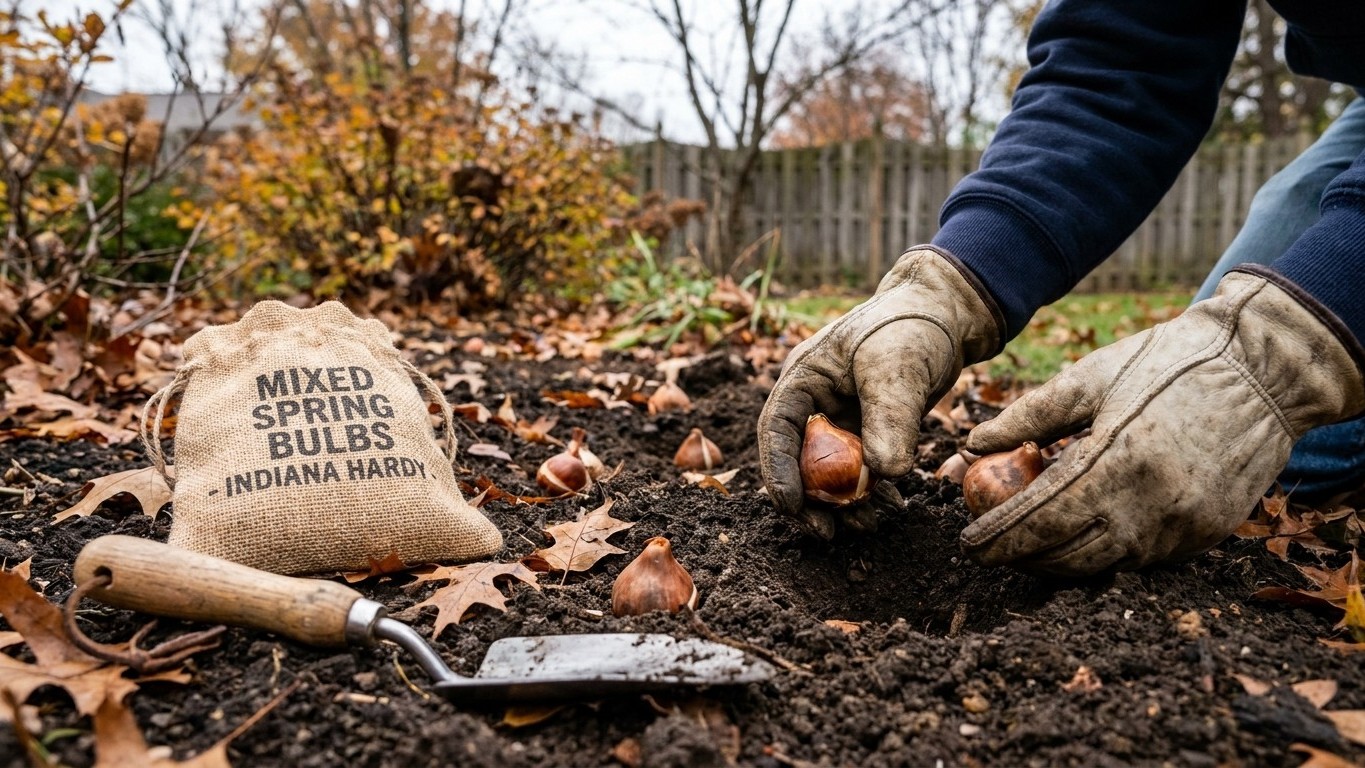

Spring bulbs go into Indiana soil once the ground has cooled but before it locks up for winter, and whether a given bulb even wakes up in April depends on one number most guides never mention: how many weeks of real cold it needs underground first. Indiana clears that bar for almost everything gardeners plant here. Here’s the math, and the exceptions.
When to plant bulbs in Indiana

The planting window in Indiana runs from mid-October through late November, timed to land about six weeks before the ground freezes solid. That anchors on the average first fall frost for the Indianapolis area, which NOAA’s 1991-2020 climate data puts between October 21 and October 30. Bulbs need those six weeks to grow roots before winter shuts things down, even though nothing shows above ground.
Plant too early, while soil is still warm from summer, and a bulb can push soft top growth in a mild November. That growth has no chance against a hard freeze in December or January; it dies back, and the bulb spends stored energy repairing damage instead of building a flower. Plant too late, after the ground has already gone cold and stiff, and the bulb sits without rooting at all. Come spring it either pushes up a stunted, off-center bloom or skips flowering entirely for a year while it tries to catch up underground. For gardeners without in-ground space, Growing Spring Bulbs in Containers in Indiana follows the same timing principles with a few adjustments for pot exposure, while those who’d rather skip the outdoor timing puzzle altogether can look into Forcing Spring Bulbs Indoors in Indiana instead.
The frost date is an average, not a guarantee
That October 21-30 window is exactly what it sounds like: an average drawn from thirty years of data. Roughly half of all autumns in central Indiana will see that first hard freeze earlier than the range, and half will see it later. A gardener working off a calendar reminder rather than the actual weather can easily plant two weeks off target in either direction. Watching soil temperature and the extended forecast matters more than circling a date in October and walking away.
Southern Indiana, worth noting here even though the detailed section on regional differences comes later, tends to freeze later in the fall than the Indianapolis reference point, sometimes by two weeks or more. A gardener near the Ohio River planting on the same day as one in Indianapolis is not necessarily planting at the right time for their own ground.
Whether your winter is cold enough
This is the question that decides whether a bulb blooms at all, and it gets skipped constantly. Spring bulbs are not simply cold-tolerant; they require cold. Most need somewhere in the range of twelve to fourteen weeks with soil temperatures below about 45F to complete the internal process that builds a flower bud inside the bulb. Skip that exposure, or cut it short, and the plant still comes up green and leafy in spring. It just never flowers, or it sends up a bloom on a stem too short and weak to notice. Cold isn’t a formality here. It’s the trigger.
Indianapolis, the reference point for this state’s climate data, records a coldest-month mean minimum temperature of 20.9F. Air and soil temperatures across the state sit below the 45F threshold for a stretch that typically runs from late November into March, well past the twelve-to-fourteen-week minimum most spring bulbs need. That’s not a marginal pass. Indiana clears the requirement with room to spare for nearly every bulb sold as hardy in this region, which means no refrigerator, no pre-chilling, no extra steps. The bulb goes in the ground and the winter does the rest.
Where cold requirements aren’t automatically met
The exceptions aren’t hardiness-zone bulbs at all. Corms like ranunculus and anemone, often shelved next to true spring bulbs at garden centers, need a cold period too, but they’re not reliably winter-hardy in Indiana’s ground to begin with. Gardeners who want them here pre-chill in a refrigerator for about twelve weeks, kept well away from apples, pears, or other ripening fruit, since the ethylene gas fruit gives off can kill the flower bud sitting inside the corm before it ever gets planted. Skip that step, or store the corms near the produce drawer, and the investment is wasted before it goes in the ground.
| Bulb | Weeks of cold typically needed (below ~45F) | What Indiana delivers | Verdict |
|---|---|---|---|
| Tulips | 14-16 weeks | 16-18+ weeks, late Nov-Mar | Meets easily, no pre-chill needed |
| Daffodils | 12-14 weeks | 16-18+ weeks | Meets easily |
| Hyacinths | 12-14 weeks | 16-18+ weeks | Meets easily |
| Crocus | 8-15 weeks | 16-18+ weeks | Meets easily |
| Alliums | 8-10 weeks | 16-18+ weeks | Meets easily |
| Ranunculus / anemone | Requires cold regardless of zone; not reliably ground-hardy in Indiana | Ground too unpredictable for these corms to overwinter | Needs refrigerator pre-chill, or treat as spring-planted annual |
Which bulbs suit Indiana
The USDA Plant Hardiness Zone Map places Indiana across zones 5b to 7a, based on the average annual extreme minimum temperature. Nearly every bulb sold in the spring-flowering category is rated for that range, which is why the state’s cold winters do most of the work without special handling.
- Tulips (hardy zones 3-8)
- Daffodils (hardy zones 3-8)
- Crocus (hardy zones 3-8)
- Hyacinths (hardy zones 4-8)
- Alliums (hardy zones 4-8)
- Grape hyacinth / Muscari (hardy zones 4-8)
- Snowdrops (hardy zones 3-7)
- Fritillaria (hardy zones 3-8)
A hardiness range is not a hard line, though. A bulb rated to zone 7 that sits at the warm edge of Indiana’s climate, in a sheltered spot against a south-facing foundation, often outperforms the same bulb planted in an exposed, windswept bed two counties over. Microclimate can push a marginal planting either way.
Bulbs that disappoint here
A handful of bulbs sold seasonally are simply mismatched to Indiana’s winters, and the disappointment shows up in a specific way each time. Gladiolus, rated for zones 8-10, is not winter-hardy here at all; left in the ground it rots by January, so gardeners who want it treat it as a corm to dig up every fall and replant every spring. Freesia and true amaryllis fall into the same tender category and belong indoors or in pots, never in open ground over an Indiana winter. Anemone coronaria, rated to zone 7 at best, is a coin flip even in the warmest pocket of southern Indiana and frequently rots in a wet winter rather than freezing outright. The failure mode to watch for with any borderline bulb isn’t always a hard freeze-out; often it’s soggy soil that never drains before the ground freezes, which does more damage than the cold itself.
What digs them up here
Squirrels and voles are selective, and the pattern comes down to chemistry rather than chance. Bulbs that contain lycorine or other bitter, mildly toxic compounds get left alone; bulbs that are essentially starchy and sweet get eaten first. Wire mesh laid flat over a new planting bed, left in place until the ground freezes and the digging pressure drops, works better than anything sprayed on. Repellent sprays wash off in the first hard rain and need reapplying constantly, which makes them a poor long-term fix.
- Usually left alone: daffodils, alliums, fritillaria, snowdrops
- Regularly dug up: tulips, crocus, hyacinths, lily bulbs
Anyone picking bulbs specifically to avoid a wildlife problem can lean on the first list without sacrificing much: daffodils and alliums cover a full range of bloom times and colors, and both meet Indiana’s cold requirement with no trouble at all.
Where to check for your own county
Every figure in this guide, the frost dates, the hardiness zone range, the coldest-month minimum, comes from Indianapolis as the reference station. Indiana runs north to south across several degrees of latitude, and the practical effect shows up at both ends of the growing season: a planting window built around the state capital can run two to three weeks off for a gardener near Lake Michigan or one near the Ohio River.
Purdue University’s extension service, the land-grant office for the state, publishes county-level guidance that adjusts for exactly that spread. Their county extension offices track local frost data and soil conditions more closely than any statewide average can. Anyone gardening outside the immediate Indianapolis area, and that’s most of the state, gets a more accurate planting date by checking with the county office directly rather than relying on a single reference point.