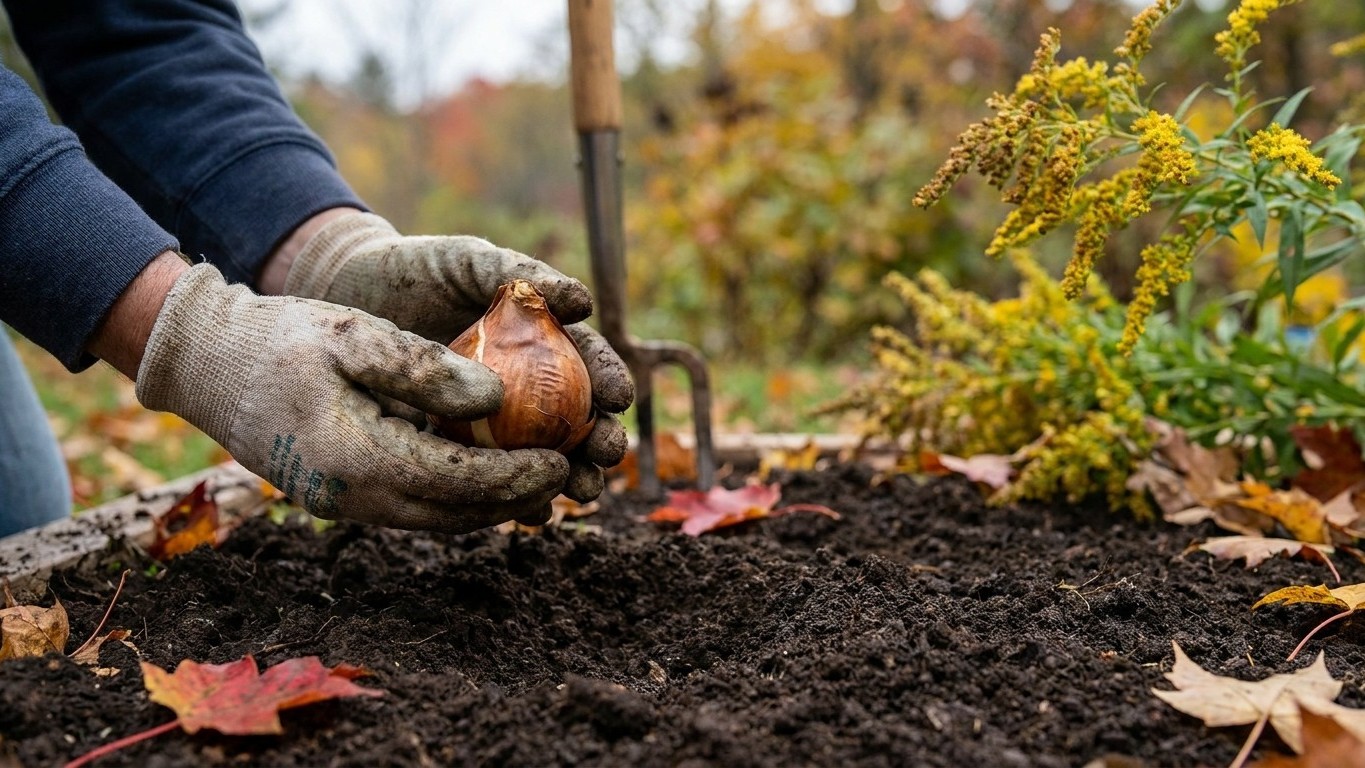

Soil temperature, not the calendar, decides when spring bulbs go in the ground here. Massachusetts clears the cold threshold every bulb needs to flower, sometimes by a wide margin, but only if you plant early enough for roots to establish and pick species that actually match this climate. Some popular bulbs simply fail in this state. Here’s what works, what doesn’t, and why.
When to plant bulbs in Massachusetts

The target is soil that has cooled from summer but hasn’t frozen solid, which in practice means planting about six weeks before the ground freezes hard. That window anchors on the average first fall frost, which for the Boston area falls between November 3 and November 14, according to NOAA’s 1991-2020 climate normals. Working backward from that date puts the ideal planting window in the second half of September through most of October for the milder coastal and eastern parts of the state.
Plant too early, while the soil is still warm from summer, and the bulb reads the warmth as a signal to push top growth. That green shoot then gets caught by the first hard freeze and dies back, weakening the bulb before it’s even had a chance to root properly. Plant too late, after the ground has already started to lock up, and the bulb goes into winter without enough time to grow the root system it needs. The result the following spring is a stunted plant, a bloom that never opens fully, or nothing at all.
Why the frost date is a guide, not a guarantee
That November 3-14 window is an average built from three decades of data, which means roughly half of all years fall on the early side and half on the late side. A gardener in Worcester or the Berkshires, working with colder inland conditions than the waterfront Boston reference station, should treat the earlier end of that range as the safer target. Waiting until Halloween to plant in a year when the first frost lands on November 3 leaves almost no cushion.
The safest approach is to watch soil temperature directly rather than relying on the calendar alone. Once the soil at planting depth consistently reads in the 50s Fahrenheit and stays there, bulbs are ready to go in. That threshold usually lines up with the six-weeks-before-frost rule, but it accounts for the year-to-year swings that an average date can’t capture. For gardeners without in-ground beds, Growing Spring Bulbs in Containers in Massachusetts follows the same soil-temperature logic while offering more control over timing and placement, and Forcing Spring Bulbs Indoors in Massachusetts is another option for gardeners who want blooms without waiting on outdoor soil conditions at all.
Whether your winter is cold enough
This is the question that decides whether spring bulbs are worth planting at all in a given place, and it has nothing to do with whether the bulb survives the winter. Spring bulbs like tulips, daffodils, and hyacinths need a sustained cold period to trigger the internal process that produces a flower. Most require twelve to fourteen weeks with soil temperatures below about 45°F. Skip that chilling period and the bulb doesn’t die, but it also doesn’t bloom properly. It sends up leaves and nothing else, or a flower stem so short it barely clears the soil line.
Massachusetts clears that bar without difficulty. The mean daily minimum temperature in the coldest month, based on the Boston reference station, is 23.1°F, and that cold typically holds from December through February. That’s not a brush with the 45°F threshold, it’s a wide margin below it, sustained for well over the twelve-to-fourteen-week requirement. Practically, that margin means gardeners here don’t need to pre-chill any spring bulb before planting, and it opens up the full range of tulip, hyacinth, and daffodil varieties sold at garden centers, including the ones bred for showier, longer-stemmed blooms that need the full chilling period to perform.
Cold requirement by bulb, measured against Massachusetts winters
| Bulb | Typical cold requirement | What Massachusetts delivers | Verdict |
|---|---|---|---|
| Tulips | 12-16 weeks below 45°F | ~13 weeks below freezing, well under 45°F | No pre-chilling needed |
| Daffodils | 12-14 weeks below 45°F | Same as above | No pre-chilling needed |
| Hyacinths | 8-15 weeks below 45°F | Same as above | No pre-chilling needed |
| Crocus | 8-15 weeks below 45°F | Same as above | No pre-chilling needed |
| Alliums | 8-10 weeks below 45°F | Same as above | No pre-chilling needed |
This is a very different situation from a place like coastal South Carolina or the Gulf Coast, where the coldest month barely dips into the 40s and gardeners have to buy pre-chilled bulbs or refrigerate them themselves. That process means twelve weeks in a refrigerator crisper drawer, kept well away from apples, pears, or any ripening fruit, because those fruits release ethylene gas that kills the flower bud forming inside the bulb. Massachusetts gardeners can skip that entire step. A gardener anywhere in this state who’s told they need to pre-chill tulips has been given bad advice, and a gardener who plants heat-zone bulbs like freesia expecting them to flower without any winter protection has wasted the money.
Which bulbs suit Massachusetts
Massachusetts sits within USDA Hardiness Zone 5a-7b, based on the 2023 USDA Plant Hardiness Zone Map, and that range covers the winter survival needs of nearly every popular spring bulb sold in the region. Combined with the chilling margin described above, the bulbs below are reliable choices for most yards in the state.
- Daffodils (Narcissus) — hardy zones 3-9, among the most dependable bulbs for this climate
- Tulips — hardy zones 3-8, though many hybrid types perform best as a strong first-year show and fade over subsequent seasons
- Crocus — hardy zones 3-8, reliable and often the first bloom of the season
- Hyacinths — hardy zones 4-8
- Alliums — hardy zones 3-9
- Snowdrops (Galanthus) — hardy zones 3-7
- Grape hyacinth (Muscari) — hardy zones 4-8
The bulbs that disappoint in Massachusetts tend to come from warmer hardiness zones that gardeners buy anyway because they see them in catalogs or at big-box stores that ship the same inventory nationwide. Freesia, hardy only to zones 9-10, will grow leaves here if planted in spring but has no chance of surviving a Massachusetts winter left in the ground. Anemone coronaria, hardy to zones 7-10, behaves the same way, often putting on a decent first-year display from a spring planting before rotting out entirely once the ground freezes. Ranunculus, rated for zones 8-10, is especially prone to rot in a wet Massachusetts winter, where saturated, freezing soil is a near-certain death sentence for a corm that evolved for a dry-summer, mild-winter climate.
None of these hardiness lines are absolute. A tulip variety rated to zone 3 will still struggle in a low-lying, poorly drained yard that holds water and freezes into a solid block, while a borderline zone 7 bulb might survive for years tucked against a south-facing foundation wall that radiates heat through the winter. Microclimate matters as much as the zone map.
What digs them up here
Squirrels and voles are a real threat to a fall bulb planting in Massachusetts, but which bulbs get eaten comes down to plant chemistry rather than chance. Daffodils and every member of the onion family produce compounds that are toxic or simply unpalatable to rodents, which is why they’re left alone in yards where other bulbs vanish overnight. Tulips and crocus contain none of that natural defense, and both rank among the most reliably raided bulbs in the region.
- Frequently dug up: tulips, crocus
- Left alone: daffodils, alliums, hyacinths, snowdrops
If tulips or crocus are the priority, the one method that consistently works is laying wire mesh, hardware cloth, directly over the planting bed and pinning it down until the ground freezes solid. Squirrels can’t dig through it, and by the time it’s removed in late fall, the ground is usually too hard for them to bother anyway. Repellent sprays and granules get marketed heavily every fall, but they wash off after the first rain and need constant reapplication to do anything at all, which makes them a poor long-term solution compared to a physical barrier.
Where to check for your own county
Every figure in this article, the frost date, the coldest-month minimum, the hardiness zone, is drawn from data centered on the Boston area, which sits at the mild, waterfront edge of the state. Massachusetts itself spans hardiness zones from 5a to 7b, and a planting calendar built around the state’s biggest city can run three weeks off in either direction once you move inland or into higher elevation.
The Berkshires and the higher elevations of central Massachusetts see their first frost weeks earlier than Boston and hold onto cold weather longer into spring, which shifts the ideal planting window earlier in the fall. Coastal areas south of Boston, moderated by ocean water, often get an extra couple of weeks before the ground freezes. For a planting date and variety list adjusted to actual local conditions, the University of Massachusetts Amherst Extension and its county-level offices track frost dates and soil conditions specific to each region of the state, and that local read is worth checking before committing an order of bulbs to the ground.