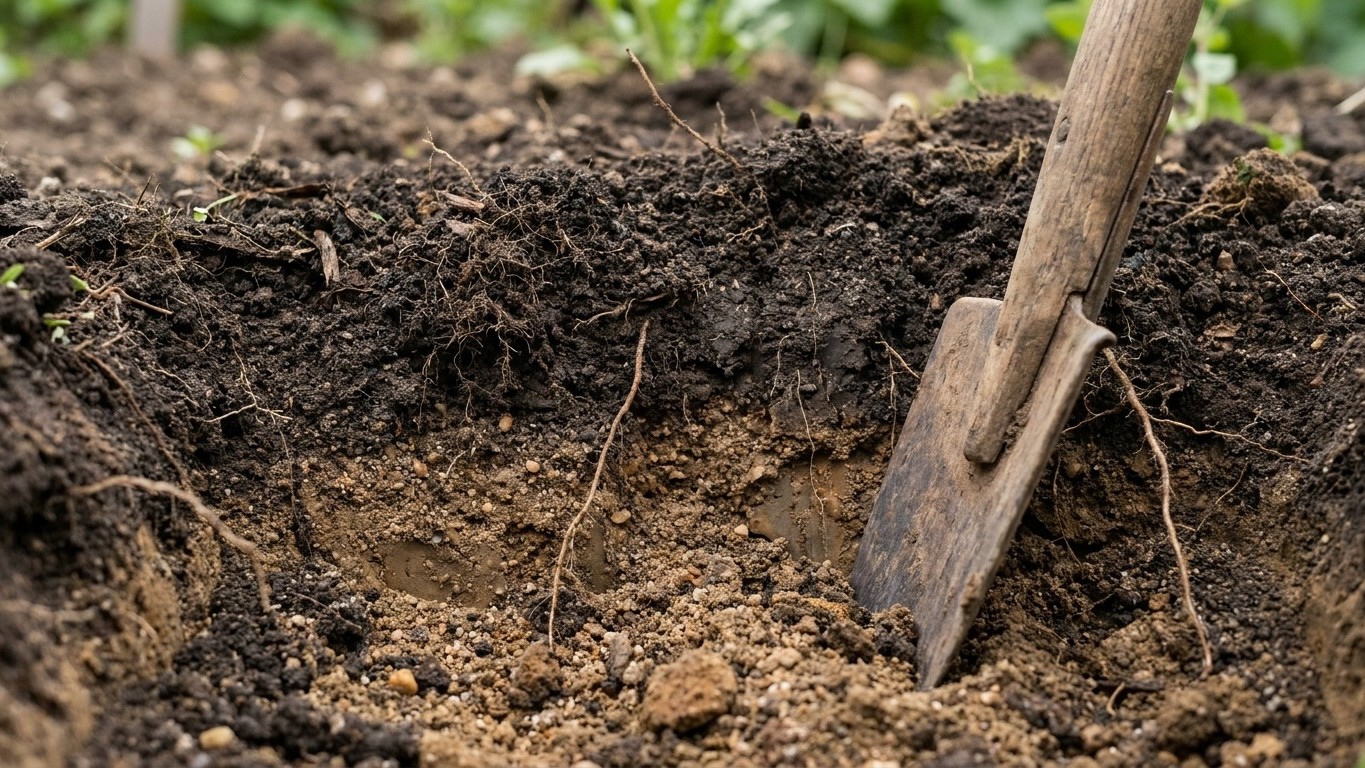

Dig a shovel into Minnesota ground and you’re most likely hitting the Lester series, an Alfisol that state law named the official soil back in 2012. It’s a forest soil built over glacial till, moderately fertile, and it holds onto nutrients better than most. But “most likely” isn’t “definitely”, your yard could be something else entirely, and a five-minute check settles the question.
What is under your garden

The Lester series formed under hardwood forests on the rolling till plains that cover much of central and southeastern Minnesota. As an Alfisol, it’s part of a soil order known for decent natural fertility and a subsoil that clings to calcium, magnesium, and potassium rather than letting them wash away. That’s part of why so much of Minnesota’s farmland and woodland has supported crops and timber for generations without the ground giving out.
Here’s what USDA soil surveys record for the surface horizon of the series, averaged across 251 mapped components:
| Property | Value |
|---|---|
| Surface pH | about 6.6 (near neutral) |
| Sand | 39 percent |
| Clay | 24 percent |
| Silt | 37 percent |
| Organic matter | about 3.0 percent |
| Drainage | well drained |
Those numbers describe a loam, roughly balanced between sand, silt, and clay, sitting almost exactly at neutral pH. That’s a fortunate texture. It’s fine enough to hold water and nutrients, coarse enough to drain and let roots breathe. But this is the soil that represents Minnesota on a map, not the soil in your specific garden. River bottoms run sandier and often more acidic. Low ground and old wetlands can carry heavy clay or even peat. And if a builder scraped topsoil off your lot before pouring a foundation, or brought in fill from somewhere else, you could be gardening in subsoil that shares nothing with the Lester series numbers above.
Reading your own dirt in five minutes
Grab a handful of moist soil from six inches down and try the ribbon test. Squeeze it between thumb and forefinger, pushing it upward into a ribbon. If it barely holds together before crumbling, you’ve got a sandy soil. A ribbon that stretches two inches or more before breaking points to clay. Somewhere in between, holding a short ribbon of an inch or so, you’re looking at something closer to that Lester loam.
The jar test backs that up. Fill a clear quart jar about a third full of soil, top it off with water, shake hard for a minute, then let it sit overnight. Sand drops first and settles on the bottom within minutes. Silt follows over the next few hours. Clay stays suspended longest, sometimes clouding the water for a full day before it settles into the thinnest top layer. Measure the bands the next morning and you’ll have a rough percentage breakdown of your own ground, not the state’s.
Testing before you amend
Eyeballing soil tells you texture and maybe drainage. It tells you nothing about pH, phosphorus, potassium, or organic matter content, and those are the numbers that actually decide what you add and how much. Gardeners who skip the test and dump lime or fertilizer based on a guess routinely waste money correcting a problem that either didn’t exist or ran the opposite direction from what they assumed.
Given that the Lester series sits near pH 6.6, a reasonable expectation for much of the region is soil hovering close to neutral. But expecting is not knowing. Local pockets swing acidic under decades of pine litter, or alkaline near old concrete or limestone-heavy fill. Only a lab test on your own dirt settles it.
Taking a sample correctly matters as much as sending it in. Follow this sequence:
- Pick five or six spots scattered across the bed or lawn area you’re testing, avoiding unusual spots like old ash piles or compost dumps.
- Dig a small core at each spot to a depth of about six inches, the zone where most vegetable and flower roots actually feed.
- Drop all the cores into a clean plastic bucket and break up any clumps by hand.
- Mix thoroughly, then pull out about two cups of the combined soil for your sample.
- Let it air dry on newspaper for a day if it’s wet, then bag it and label it with the bed location and today’s date.
The results come back with a pH reading, phosphorus and potassium levels, and often an organic matter percentage. Compare that organic matter number to the region’s 3.0 percent baseline and you’ll know right away whether you’re building soil or coasting on what nature already gave you.
Amending it
The Lester series’ near-neutral pH of 6.6 doesn’t demand lime or sulfur. It sits comfortably in the range where most vegetables, lawns, and ornamentals thrive without intervention. If your test comes back close to that number, the honest answer is to leave pH alone and put your effort into organic matter instead. But plenty of Minnesota gardens test outside that window, and the correction depends entirely on which direction the needle swings.
If your soil tests acidic, below about 5.5: lime
Acidic ground locks up phosphorus so plants can’t use it even when it’s present in the soil, and it makes life miserable for brassicas like cabbage and broccoli, which prefer sweeter conditions. Ground limestone is the fix, worked into the top few inches in fall so it has all winter to react. Lime moves slowly through soil chemistry, and a single application can take a full season or more to shift pH meaningfully. Sulfur has no business going on acidic ground; it would only push the pH further in the wrong direction.
If your soil tests alkaline, above about 7.3: sulfur and organic matter
Lime must never touch alkaline ground. The fix runs the opposite direction: elemental sulfur, worked in gradually over one or two seasons, plus a steady diet of compost and other organic matter to buffer the pH down slowly. High pH locks iron out of reach of plant roots, and that’s exactly what’s behind the yellow leaves with dark green veins you sometimes see on maples, azaleas, and blueberries planted in alkaline soil. There’s no fast fix here. Sulfur works over seasons, not weeks, and pushing it too hard risks scorching roots.
Heavy clay: organic matter, never sand
If your texture test showed clay well above the region’s 24 percent baseline, organic matter is the only real answer. Compost, aged manure, shredded leaves, worked in every fall, gradually open up clay’s tight structure and let air and water move through. Never add sand to clay soil hoping to lighten it; the two combine into something closer to concrete than loam. And never work clay soil while it’s wet. Compacting wet clay with a shovel or tiller can undo years of improvement in a single afternoon.
Sandy ground: organic matter and shorter, more frequent watering
Sand above the region’s 39 percent baseline drains fast and holds almost nothing, nutrients included. Organic matter helps here too, giving sandy soil something to hold onto. But watering habits matter just as much. Shorter, more frequent watering keeps moisture available near the surface roots without wasting it on deep drainage the plant never reaches. Clay corrections take three seasons or more to show real change. Sandy ground responds faster to organic matter, often showing improved moisture retention within a single growing season.
Drainage and compaction
The Lester series carries a well drained rating, meaning water moves through it at a reasonable pace without pooling for days after a storm. That’s good news if your garden matches the series. Standing water an hour after rain, or a lawn that squishes underfoot for two days straight, tells you your ground drains slower than the regional norm, whatever the map says.
Running your own percolation test
Dig a hole about a foot deep and roughly the same across. Fill it with water and let it drain completely once, just to saturate the surrounding soil. Then fill it again and time how fast the water level drops. An inch per hour or faster is solid drainage. Half an inch or less signals a compacted or clay-heavy subsoil that’s going to fight you on almost anything you plant beyond the toughest natives.
Compaction from foot traffic, parked equipment, or even repeated tilling packs soil particles together and squeezes out the pore space roots and water both need. Double digging, once the standard fix, has fallen out of favor because it disturbs soil biology and often compacts the layer just below where the shovel stops. On genuinely slow-draining ground, a raised bed filled with good loam is usually the smarter move than three years of fighting compacted clay with a garden fork.
- Fast-draining sandy soil: water more often, in smaller amounts, and add organic matter to slow the loss.
- Well drained loam matching the Lester baseline: standard watering schedules work fine.
- Slow-draining or compacted ground: build raised beds rather than fighting the subsoil, and keep heavy equipment off wet lawns.
Local help
The University of Minnesota Extension runs the state’s soil testing lab through its Soil Testing Laboratory program. County extension offices help interpret results and recommend amendments specific to your test numbers, not just regional averages. That conversation with a local agent is often worth more than the test itself.
Common questions
Is Minnesota soil good for gardening?
Much of it, yes. The Lester series that represents the state carries a fertile, near-neutral profile that supports a wide range of vegetables and ornamentals without heavy correction. Your specific lot may differ, which is why a soil test still matters.
Why is my Minnesota soil so clay-heavy when the state soil isn’t?
The Lester series is a mapped average across hundreds of sites. Low-lying areas, old wetlands, and certain glacial till deposits run heavier in clay than that average, and construction fill can introduce clay-rich subsoil that has nothing to do with the natural profile underneath.
Do I need to lime my Minnesota garden every year?
Not automatically. Since the region’s baseline pH sits near neutral, many gardens never need lime at all. Only apply it if a soil test shows pH below roughly 5.5, and even then, expect the correction to take a full season or more to show results.
How much does a soil test cost through University of Minnesota Extension?
The extension office can confirm current pricing and turnaround times when you call, and staff there will walk through your specific results once the lab report comes back.